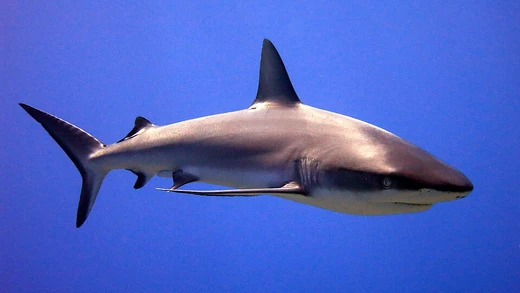
Dusky shark
A slow-growing, long-gestating apex predator of warm continental seas.
Last updated

Happy Little Nomad from Everywhere, Anywhere · via Wikipedia: Dusky shark · CC BY-SA 2.0
You'll find the dusky shark cruising tropical and warm-temperate seas all over the planet.[1]
Scientific classification
- KingdomAnimalia
- PhylumChordata
- ClassChondrichthyes
- SubclassElasmobranchii
- DivisionSelachii
- OrderCarcharhiniformes
- FamilyCarcharhinidae
- GenusCarcharhinus
- SpeciesCarcharhinus obscurus
Named by (Lesueur, 1818)
Close relatives
Other species of Carcharhinus with a Codexery entry.
- Bignose shark Carcharhinus altimus
- Bull shark Carcharhinus leucas
- Caribbean reef shark Carcharhinus perezi
- Copper shark Carcharhinus brachyurus
- Galapagos shark Carcharhinus galapagensis
- Sandbar shark Carcharhinus plumbeus
- Silky shark Carcharhinus falciformis
- Silvertip shark Carcharhinus albimarginatus
Sources: Wikipedia taxobox: Dusky shark (CC BY-SA 4.0) · order, family and genus agree with WoRMS AphiaID 105796 (CC BY 4.0)
Conservation status
Endangered (EN)
- LC
- NT
- VU
- EN▲ this species
- CR
- EW
- EX
Source: IUCN Red List assessment · GBIF copy of the Red List category
How big is it?
Largest length in the source, 4.2 m, next to a 1.8 m person.
Diagram: drawn by Codexery, schematic shapes to scale (not a likeness). Length: Wikipedia: Dusky shark
Where the dusky shark has been recorded
Each dot is a place where the species has been observed and reported (27,744 records, half-degree grid) — not a modelled range. 15 inland records left out (institution coordinates).
Map: drawn by Codexery. Data: GBIF occurrence search (records CC0 / CC BY) · Natural Earth basemap (public domain)
Description
The biggest dusky shark on record measured 4.2 meters long and weighed 372 kilograms, though some reports mention sizes up to 4.5 meters and 500 kilograms.[2] The first dorsal fin is medium-sized and curves back like a sickle.[3] The fins darken towards the tips, which is more obvious in juveniles.[4] The big pectoral fins are sickle-shaped and come to a point.[3]
Biology and ecology
The dusky shark is viviparous, meaning the developing embryos are initially nourished by a yolk sac, which becomes a placental connection to the mother once the yolk supply is exhausted.[5] Newborn dusky sharks measure 0.7 to 1.0 m long.[6] A big dusky can wolf down more than a tenth of its own body weight in one meal.[7] In the northwestern Atlantic, bony fishes make up about 60% of its diet, with bluefish and summer flounder being the top picks.[8]
Cartilaginous fishes—mostly skates and their egg cases—come in second on the menu.[8] Young dusky sharks, though, get hunted by ragged tooth sharks, great white sharks, bull sharks, and tiger sharks.[9] Moms give their pups a head start with energy stored in a liver that makes up one-fifth of the newborn's weight.[10] For the first five years of life, a young dusky shark grows about 8 to 11 centimeters each year.[10]
These sharks are thought to live for 40 to 50 years or even longer.[10]
Distribution and habitat
Dusky sharks live off continental coastlines, from the surf zone out to the outer continental shelf and nearby open ocean.[11] In the eastern Atlantic, people have reported it from the western and central Mediterranean, the Canary Islands, Cape Verde, Senegal, and Sierra Leone.[1] In the Pacific, it lives off Japan, China, Taiwan, Vietnam, Australia, and New Caledonia in the west, and from southern California to the Gulf of California in the east.[1] One tracking study in the northern Gulf of Mexico found that this shark spends most of its time between 10 and 80 meters deep, with occasional dives below 200 meters.[11]
Human interactions
Commercial and recreational retention of dusky sharks was prohibited in the U.S. in 1998.[12] Because of its size, the dusky shark is considered potentially dangerous to people, though we don't know much about how it acts around them underwater.[13] Stocks off the eastern United States are badly overfished; a 2006 survey showed the population had fallen to just 15 to 20% of what it was in the 1970s.[12]
Taxonomy and phylogeny
The original specimen they used to describe the species turned out to be a copper shark, so the name C. lamiella doesn't count as a synonym for the dusky shark.[14] Teeth belonging to the dusky shark are fairly well represented in the fossil record, with specimens dating to the Miocene epoch found in the Caribbean, Egypt, Florida, and possibly Venezuela.[15] In 1982, Jack Garrick published a phylogenetic analysis that placed the dusky shark and the Galapagos shark at the center of the "obscurus group".[16] This group consisted of large, triangular-toothed sharks with a ridge between the dorsal fins.[16]
References
- Wikipedia, "Dusky shark" (CC BY-SA 4.0), which cites: Rigby, C.L., "Carcharhinus obscurus", 2019; Compagno, L.J.V., "Sharks of the World", Princeton University Press, 2005, p. 302–303; "The extent of population genetic subdivision differs among four co-distributed shark species in the Indo-Australian archipelago", BMC Evolutionary Biology, 2009, p. 40 (we also read that source) en.wikipedia.org
- Wikipedia, "Dusky shark" (CC BY-SA 4.0), which cites: ; Knickle, C. Biological Profiles: Dusky Shark. Florida Museum of Natural History Ichthyology Department. Retrieved on May 18, 2009.; Castro, "The Sharks of North America", Oxford University Press, USA, 28 July 2011, p. 445; Cooper, "Fishing Techniques", Australian Fishing Network, May 2007, p. 119; Natanson, L.J., "Age and growth estimates for the dusky shark, Carcharhinus obscurus, in the western North Atlantic Ocean", Fishery Bulletin, 1995, p. 116–126 (original not read by us) en.wikipedia.org
- Wikipedia, "Dusky shark" (CC BY-SA 4.0), which cites: "Fishes of the Gulf of Mexico: Myxiniformes to Gasterosteiformes", University of Texas Press, 1998, p. 82; Knickle, C. Biological Profiles: Dusky Shark. Florida Museum of Natural History Ichthyology Department. Retrieved on May 18, 2009. (original not read by us) en.wikipedia.org
- Wikipedia, "Dusky shark" (CC BY-SA 4.0), which cites: "Sharks and Rays of Australia", Harvard University Press, 2009, p. 269–270 (original not read by us) en.wikipedia.org
- Wikipedia, "Dusky shark" (CC BY-SA 4.0), which cites: Ebert, D.A., "Sharks, Rays, and Chimaeras of California", University of California Press, 2003, p. 160–162; Compagno, L.J.V., "Sharks of the World: An Annotated and Illustrated Catalogue of Shark Species Known to Date", Food and Agricultural Organization, 1984, p. 489–491 (we also read that source) en.wikipedia.org
- Wikipedia, "Dusky shark" (CC BY-SA 4.0), which cites: Rigby, C.L., "Carcharhinus obscurus", 2019 (we also read that source) en.wikipedia.org
- Wikipedia, "Dusky shark" (CC BY-SA 4.0), which cites: "Sharks and Rays of Australia", Harvard University Press, 2009, p. 269–270; "Food habits of the smooth dogfish, Mustelus canis, dusky shark, Carcharhinus obscurus, Atlantic sharpnose shark, Rhizoprionodon terraenovae, and the sand tiger, Carcharias taurus, from the northwest Atlantic Ocean", Env; "The condition conundrum: application of multiple condition indices to the dusky shark Carcharhinus obscurus", Marine Ecology Progress Series, 2009, p. 199–212 (we also read that source) en.wikipedia.org
- Wikipedia, "Dusky shark" (CC BY-SA 4.0), which cites: "Food habits of the smooth dogfish, Mustelus canis, dusky shark, Carcharhinus obscurus, Atlantic sharpnose shark, Rhizoprionodon terraenovae, and the sand tiger, Carcharias taurus, from the northwest Atlantic Ocean", Env (we also read that source) en.wikipedia.org
- Wikipedia, "Dusky shark" (CC BY-SA 4.0), which cites: Knickle, C. Biological Profiles: Dusky Shark. Florida Museum of Natural History Ichthyology Department. Retrieved on May 18, 2009. (original not read by us) en.wikipedia.org
- Wikipedia, "Dusky shark" (CC BY-SA 4.0), which cites: "The condition conundrum: application of multiple condition indices to the dusky shark Carcharhinus obscurus", Marine Ecology Progress Series, 2009, p. 199–212; "Sharks, Rays and Chimaeras: The Status of the Chondrichthyan Fishes", International Union for Conservation of Nature and Natural Resources, 2005, p. 297–300; "A preliminary estimate of age and growth of the dusky shark Carcharhinus obscurus from the South-West Indian Ocean, with comparisons to the western North Atlantic population", South African Journal of Marine Science, 19 en.wikipedia.org
- Wikipedia, "Dusky shark" (CC BY-SA 4.0), which cites: Compagno, L.J.V., "Sharks of the World: An Annotated and Illustrated Catalogue of Shark Species Known to Date", Food and Agricultural Organization, 1984, p. 489–491 (we also read that source) en.wikipedia.org
- Wikipedia, "Dusky shark" (CC BY-SA 4.0), which cites: Species of Concern NOAA (we also read that source) en.wikipedia.org
- Wikipedia, "Dusky shark" (CC BY-SA 4.0), which cites: Compagno, L.J.V., "Sharks of the World: An Annotated and Illustrated Catalogue of Shark Species Known to Date", Food and Agricultural Organization, 1984, p. 489–491; ISAF Statistics on Attacking Species of Shark. International Shark Attack File, Florida Museum of Natural History, University of Florida. Retrieved on May 14, 2; Compagno, L.J.V., "Sharks of the World: An Annotated and Illustrated Catalogue of Shark Species Known to Date", Food and Agricultural Organization, 1984, p. 489–491; "Remains found after rare shark attack o en.wikipedia.org
- Wikipedia, "Dusky shark" (CC BY-SA 4.0), which cites: Ebert, D.A., "Sharks, Rays, and Chimaeras of California", University of California Press, 2003, p. 160–162; "Description of a new shark (Carcharias lamiella) from San Diego, California", Proceedings of the United States National Museum, July 3, 1882, p. 110–111; (we also read that source) en.wikipedia.org
- Wikipedia, "Dusky shark" (CC BY-SA 4.0), which cites: Heim, B. and Bourdon, J. (April 20, 2009). Species from the Fossil Record: Carcharhinus obscurus. The Life and Times of Long Dead Sharks. Retrieved on April 29,; "Miocene sharks in the Kendeace and Grand Bay formations of Carriacou, The Grenadines, Lesser Antilles", Caribbean Journal of Science, 2008, p. 279–286; "A Miocene selachian fauna from Moghra, Egypt", Historical Biology: An International Journal of Paleobiology, February 8, 2010, p. 78–87; Brown, R.C., "Florida's Fossils: Guide to Location, Identification, and Enjoyment", Pineapple en.wikipedia.org
- Wikipedia, "Dusky shark" (CC BY-SA 4.0), which cites: Garrick, J.A.f. (1982). Sharks of the genus Carcharhinus. NOAA Technical Report, NMFS Circ. 445: 1–194.; Compagno, L.J.V., "Sharks of the Order Carcharhiniformes", Princeton University Press, 1988, p. 319–320 (original not read by us) en.wikipedia.org
Each numbered sentence above was checked against the source it cites before publication. Sentences citing Wikipedia adapt text from the English Wikipedia article Dusky shark (contributors), used under CC BY-SA 4.0; this entry is available under the same licence. Other sources were used for facts only; no text or images are copied from them.
More in Reef sharks
Elsewhere in Sharks
Test yourself
Three questions drawn from this entry’s sources. Pick an answer to check it.
Answers checked against the source article
Sources
Compiled from Wikipedia and the sources listed below. Text from Wikipedia is available under CC BY-SA 4.0; this entry is adapted from it.
- Wikipedia: Dusky shark (CC BY-SA 4.0).
- Classification: the source article's taxobox; order, family and genus checked against WoRMS, the World Register of Marine Species (CC BY 4.0).
- Conservation status: IUCN Red List assessment.
- Occurrence records: GBIF (CC0 / CC BY). Basemap: Natural Earth (public domain).
- Word definitions: the Codexery glossary, each quoted from its Wikipedia article.
Spotted an error? Know more?
Reader corrections go straight into our review queue. Suggest an edit · How this site is sourced