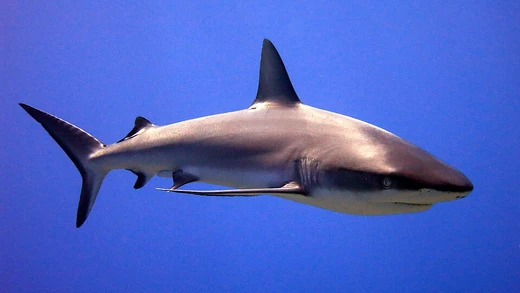
Bull shark
A stocky, aggressive requiem shark found in warm coastal waters and rivers worldwide.
Last updated

Sylke Rohrlach from Sydney · CC BY-SA 2.0
Bull sharks are stocky, powerful requiem sharks that live in warm, shallow waters along coasts and in rivers around the world.[1] They're famous for thriving in both salt and fresh water, traveling far up rivers and even living in lakes.[2] This adaptability, combined with its aggressive nature, makes it one of the sharks most likely to encounter humans.[1][3]
Scientific classification
- KingdomAnimalia
- PhylumChordata
- ClassChondrichthyes
- SubclassElasmobranchii
- DivisionSelachii
- OrderCarcharhiniformes
- FamilyCarcharhinidae
- GenusCarcharhinus
- SpeciesCarcharhinus leucas
Named by (J. P. Müller & Henle, 1839)
Close relatives
Other species of Carcharhinus with a Codexery entry.
- Blacktip reef shark Carcharhinus melanopterus
- Oceanic whitetip Carcharhinus longimanus
- Pigeye shark (Carcharhinus amboinensis) Carcharhinus amboinensis
- Pondicherry shark (Carcharhinus hemiodon) Carcharhinus hemiodon
Sources: Wikipedia taxobox: Bull shark (CC BY-SA 4.0) · order, family and genus agree with WoRMS AphiaID 105792 (CC BY 4.0)
Conservation status
Vulnerable (VU)
- LC
- NT
- VU▲ this species
- EN
- CR
- EW
- EX
Source: IUCN Red List assessment · GBIF copy of the Red List category
Description
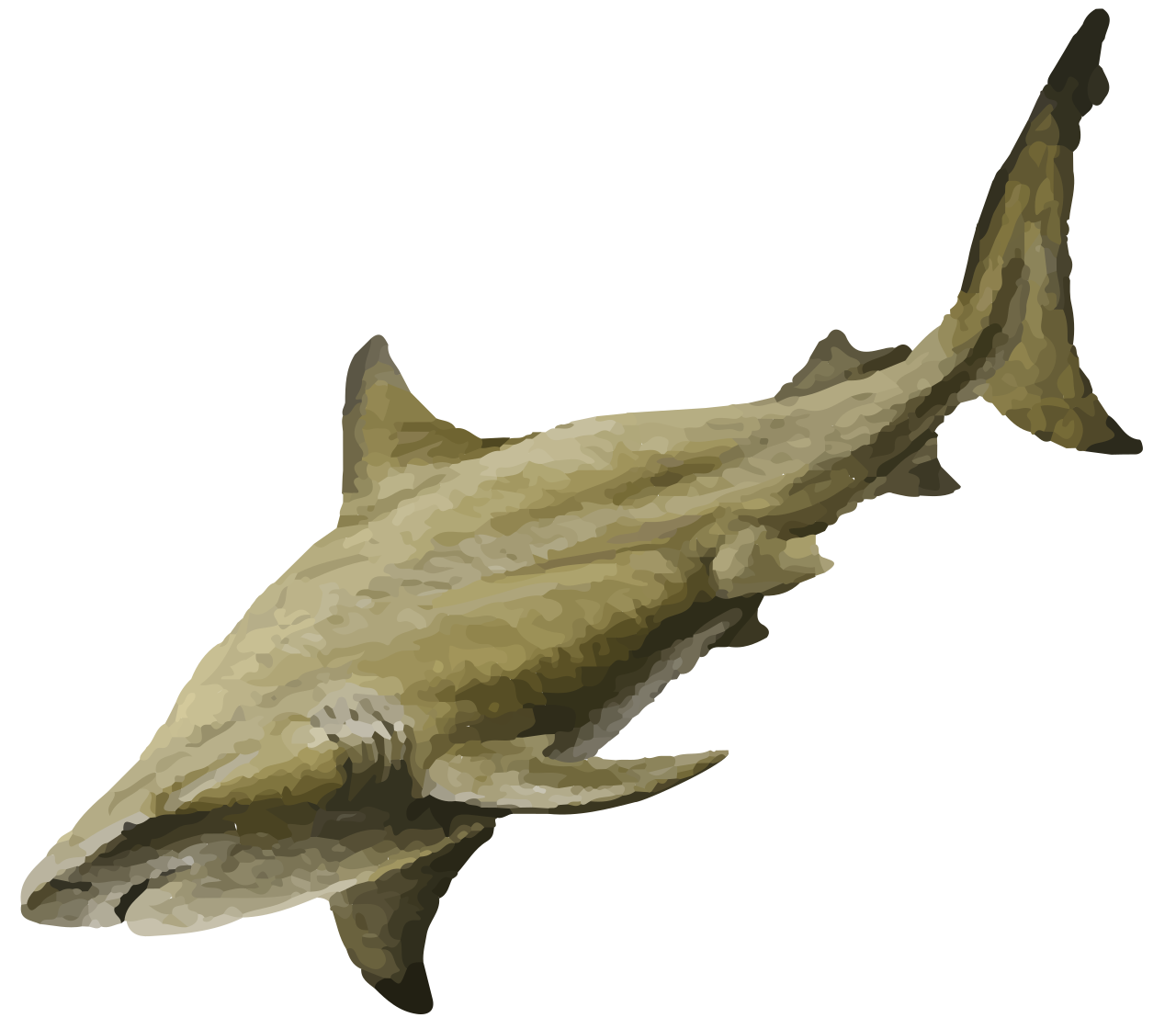
Bull sharks lack an interdorsal ridge.[4] Female bull sharks are bigger and heavier than males, with a stocky, robust build.[4] On average, adult females measure about 2.4 meters long and tip the scales at 130 kilograms, while adult males are a bit smaller at 2.25 meters and 95 kilograms.[4] People often report a maximum size of 3.5 meters, but there's one documented case of a female that was exactly 4.0 meters long.[5]
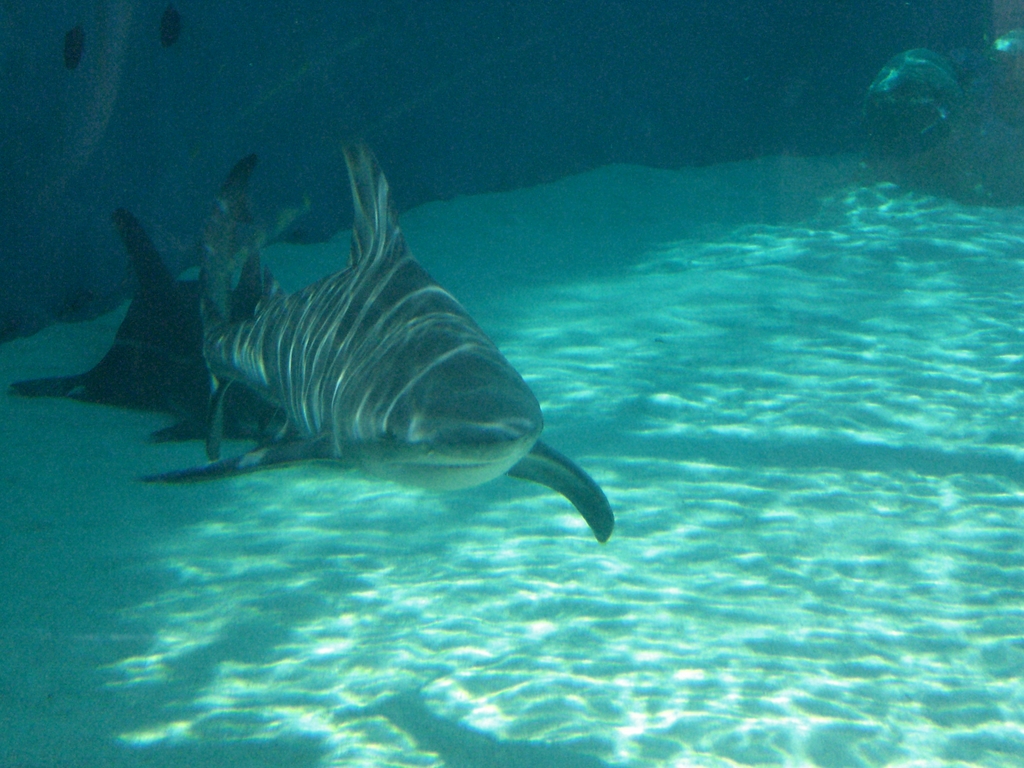
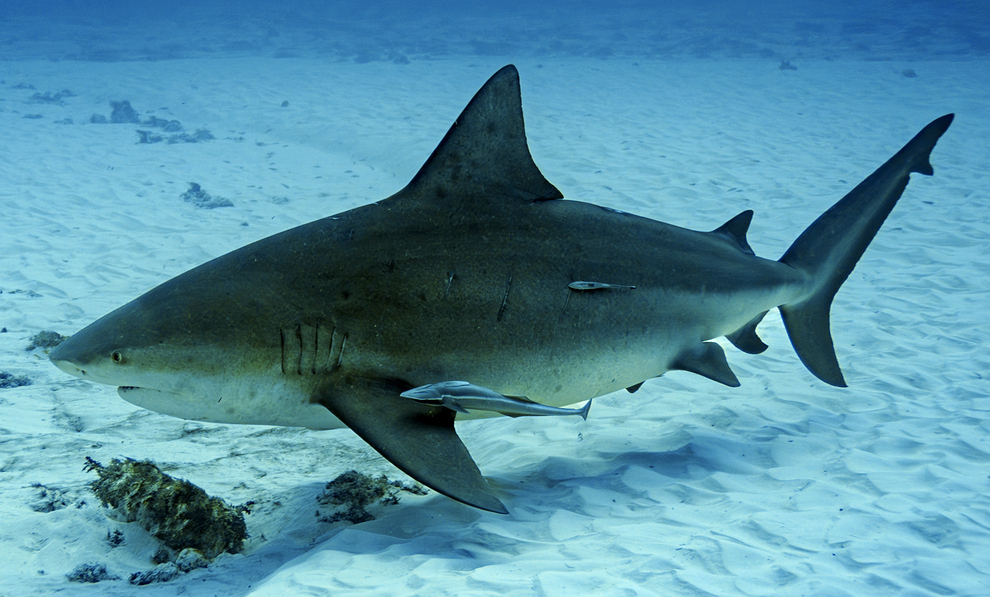
That 4.0-meter pregnant female could have weighed over 600 kilograms.[5] They have a grey back and a white belly, and their snout is blunt and rounded.[6][5][7] The second dorsal fin is not as big as the first one, and the tail fin is longer and lower compared to what you see on larger shark species.[4]
Biology and ecology
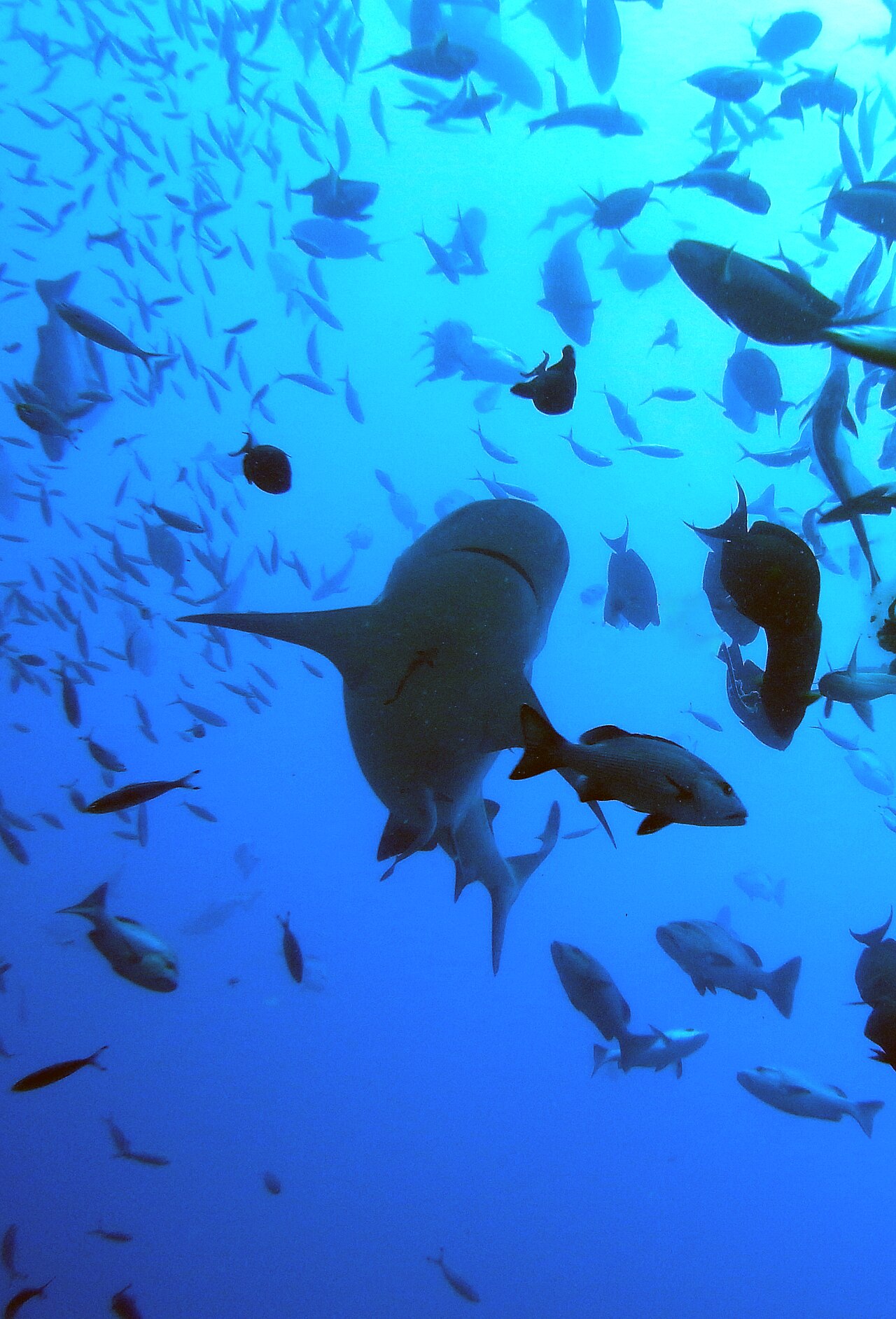
It hunts in murky waters, often using a bump-and-bite technique, and is a solitary hunter that may briefly pair with another shark.[8][9] Bull sharks give birth to live young. The babies develop inside the mother and are born free-swimming.[10] Mating occurs in late summer and early autumn in bays and estuaries, and after a 12-month gestation, a female gives birth to 1 to 13 live young.[11] Young are about 70 cm at birth and are born into protected, low-salinity nursery areas such as coastal lagoons and river mouths.[10]
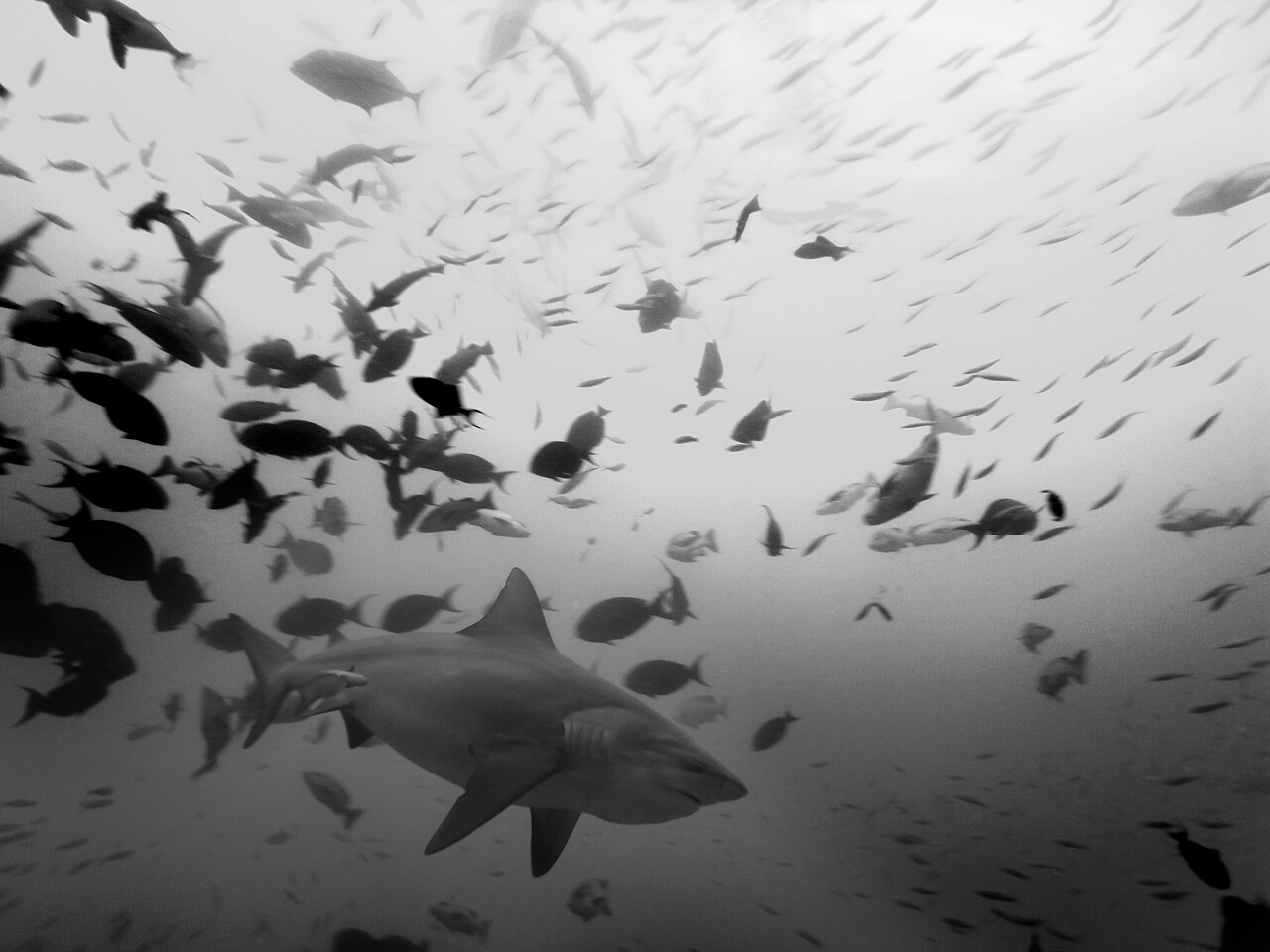
Males begin reproducing around age 15, females around age 18.[12] Bigger sharks like tiger sharks and great whites will sometimes go after young bull sharks, and in rivers, crocodiles are also a danger to them.[13][14] The sandbar shark, a close relative, can't handle salt and water balance the way bull sharks can.[15]
Distribution and habitat
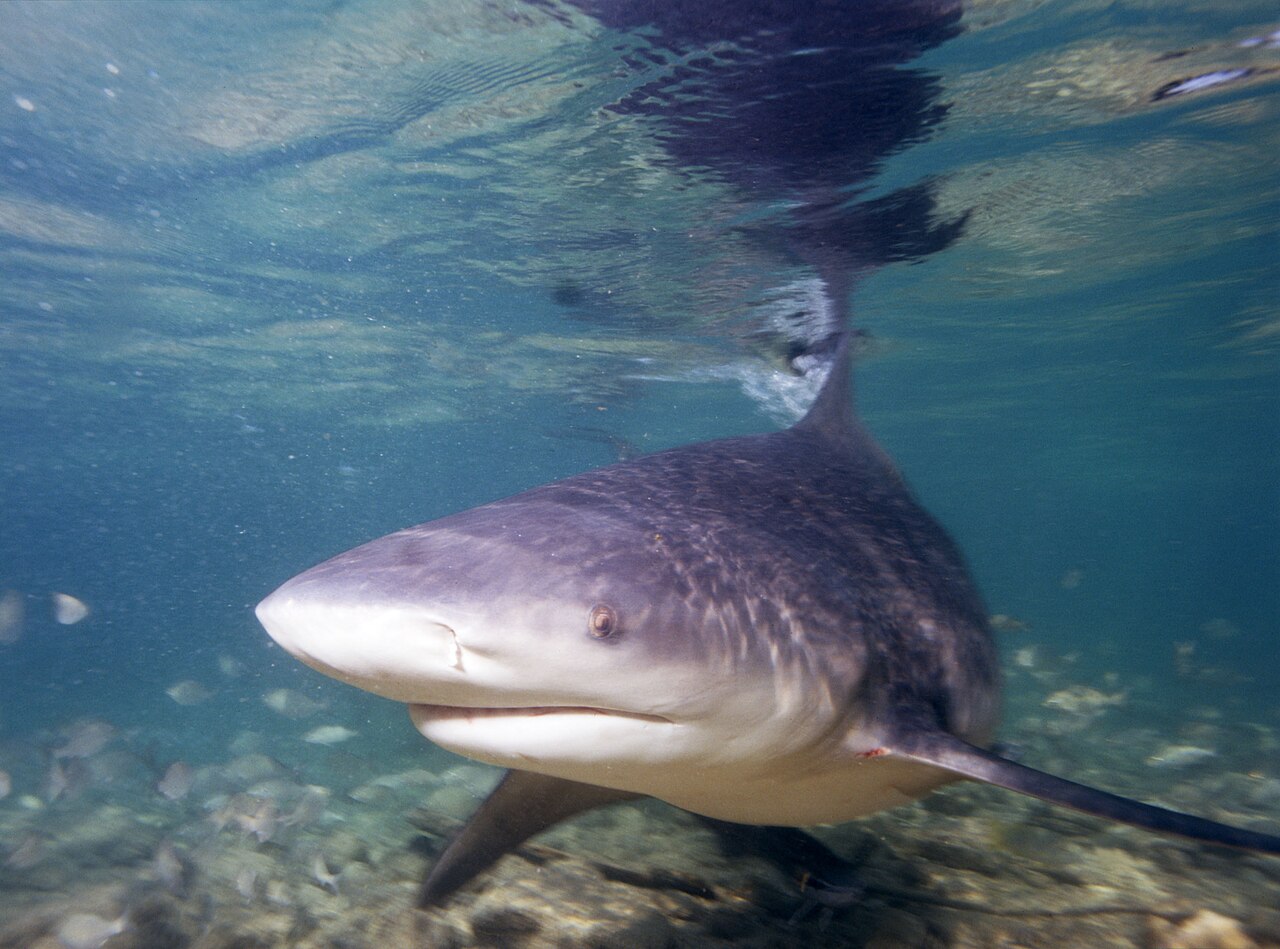
They've been spotted as deep as 150 meters, but they usually stick to waters shallower than 30 meters.[16] Bull sharks have been spotted in the Tigris River as far upstream as Baghdad since at least 1924.[17] They have also been found in the Mississippi River as far as Alton, Illinois, about 700 miles from the ocean.[2]
Human interactions
Bull sharks have attacked swimmers in Sydney Harbour inlets, in the Ganges and other Indian rivers, and off the coast of Florida.[18][19] The bull shark is not currently legally protected in any part of its range.[7] Along with tiger sharks and great whites, bull sharks are the species most often involved in biting humans.[3] Bigger bull sharks are responsible for a lot of the shark attacks that happen near shore, and they might be the culprit in many attacks where the shark species was never identified.[13]
It's possible that one or more bull sharks were behind the 1916 Jersey Shore shark attacks, although a white shark was also caught nearby with human remains in its stomach.[20][7] The IUCN Red List says bull sharks are vulnerable, and their numbers are dropping.[1][21] These sharks face threats from getting tangled in fishing nets, being overfished for their oil, skin, and meat, having their habitat polluted, and being targeted in shark-culling programs near beaches.[1][21]
Taxonomy and phylogeny
Bull sharks and river sharks from the genus Glyphis both live in freshwater, but they belong to different branches of the family Carcharhinidae.[22] That means their similar abilities evolved separately, not from a shared ancestor.[23] Their fossils become much more common in rock layers around the world starting in the Middle Miocene.[24]
References
- Wikipedia, "Bull shark" (CC BY-SA 4.0), which cites: O'Connell, Craig Patrick; Gressle, Juliet; Crews, Julia; King, Andre A.; He, Pingguo (2022-01). "Evaluating the effects of a SharkSafe Barrier™ shoreline deploy (we also read that source) en.wikipedia.org
- Wikipedia, "Bull shark" (CC BY-SA 4.0), which cites: Sharks In Illinois. In-Fisherman (16 July 2012). Retrieved on 30 November 2013. (we also read that source) en.wikipedia.org
- Wikipedia, "Bull shark" (CC BY-SA 4.0), which cites: Crist, Rick, "Carcharhinus leucas", University of Michigan Museum of Zoology, Animal Diversity Web; "Bull shark", National Geographic (original not read by us) en.wikipedia.org
- Wikipedia, "Bull shark" (CC BY-SA 4.0), which cites: "Shark Species; Bull Sharks", Shark Diver Magazine, 2003, p. 34 (original not read by us) en.wikipedia.org
- Wikipedia, "Bull shark" (CC BY-SA 4.0), which cites: "Bull shark", Florida Museum of Natural History; "The Biggest Bull Shark…Ever?", The Rosenstiel School of Marine & Atmospheric Science, 2012-07-18; "9 Biggest Sharks Ever Caught", Total Pro Sports.com, 4 August 2011; Purushottama, "First record of Bull shark, Carcharhinus leucas (Valenciennes, 1839) in commercial landings from New Ferry Wharf, Mumbai, Maharashtra", Marine Fisheries Information Service, 2013, p. 12–15; McCord, "Catching and tracking the world's largest Zambezi (bull) shark Carcharhinus leucas in the Breede Estuary, South Afri en.wikipedia.org
- Wikipedia, "Bull shark" (CC BY-SA 4.0), which cites: "Bull shark", National Geographic (original not read by us) en.wikipedia.org
- "Bull shark", Florida Museum of Natural History. facts only, no text reused. floridamuseum.ufl.edu
- Wikipedia, "Bull shark" (CC BY-SA 4.0), which cites: Rigby, C.L., "Carcharhinus leucas", 2021; Kindersley, Dorling (2001) in Animal, David Burnie and Don E. Wilson (eds.) London & New York: Smithsonian Institution, .; Snelson, "Food Habits, Occurrence, and Population Structure of the Bull Shark, Carcharhinus leucas, in Florida Coastal Lagoons", Bulletin of Marine Science, 1 January 1984, p. 71–80 (original not read by us) en.wikipedia.org
- Wikipedia, "Bull shark" (CC BY-SA 4.0), which cites: Bull Sharks, Carcharhinus leucas. Marinebio.org (14 January 2013). Retrieved on 30 November 2013.; Life of Bull Shark | Life of Sea . Life-sea.blogspot.com (15 November 2011). (original not read by us) en.wikipedia.org
- Wikipedia, "Bull shark" (CC BY-SA 4.0), which cites: Fact Sheet: Bull Sharks. Sharkinfo.ch (15 October 1999). Retrieved on 30 November 2013.; "Bull shark", Florida Museum of Natural History (we also read that source) en.wikipedia.org
- Wikipedia, "Bull shark" (CC BY-SA 4.0), which cites: McAuley, "Distribution and reproductive biology of the sandbar shark, Carcharhinus plumbeus (Nardo), in Western Australian waters", Marine and Freshwater Research, 2007, p. 116–126; Pacific Shark Research Center » Featured Elasmobranch – Bull Shark . Psrc.mlml.calstate.edu (16 February 2009). Retrieved on 30 November 2013.; McAuley, "Distribution and reproductive biology of the sandbar shark, Carcharhinus plumbeus (Nardo), in Western Australian waters", Marine and Freshwater Research, 2007, p. 116–126; Fact Sheet: Bull Sharks. Sharkinfo.ch ( en.wikipedia.org
- Wikipedia, "Bull shark" (CC BY-SA 4.0), which cites: Fact Sheet: Bull Sharks. Sharkinfo.ch (15 October 1999). Retrieved on 30 November 2013. (original not read by us) en.wikipedia.org
- Wikipedia, "Bull shark" (CC BY-SA 4.0), which cites: "Bull shark", Florida Museum of Natural History (we also read that source) en.wikipedia.org
- Wikipedia, "Bull shark" (CC BY-SA 4.0), which cites: "No Bull: Saltwater Crocodile Eats Shark", UnderwaterTimes.com, 13 August 2007; "FLMNH Ichthyology Department: Bull Shark", www.flmnh.ufl.edu (original not read by us) en.wikipedia.org
- Wikipedia, "Bull shark" (CC BY-SA 4.0), which cites: McAuley, "Distribution and reproductive biology of the sandbar shark, Carcharhinus plumbeus (Nardo), in Western Australian waters", Marine and Freshwater Research, 2007, p. 116–126 (original not read by us) en.wikipedia.org
- Wikipedia, "Bull shark" (CC BY-SA 4.0), which cites: Crist, Rick, "Carcharhinus leucas", University of Michigan Museum of Zoology, Animal Diversity Web (original not read by us) en.wikipedia.org
- Wikipedia, "Bull shark" (CC BY-SA 4.0), which cites: Coad, B. W. (2015). Review of the Freshwater Sharks of Iran (Family Carcharhinidae). International Journal of Aquatic Biology, 3(4), 218. (original not read by us) en.wikipedia.org
- Wikipedia, "Bull shark" (CC BY-SA 4.0), which cites: Quinn, "Shark attacks bring panic to Sydney's shore", The Guardian, 15 March 2009; "Warning of bull shark activity in Sydney Harbour as bite victim recovers from surgery", ABC News, 2024-01-30 (original not read by us) en.wikipedia.org
- Wikipedia, "Bull shark" (CC BY-SA 4.0), which cites: Frantz, "Bull Sharks Attacks Commonly in Warm, Shallow Waters", accuweather, 18 July 2011 (original not read by us) en.wikipedia.org
- Wikipedia, "Bull shark" (CC BY-SA 4.0), which cites: Handwerk, Brian, "Great Whites May Be Taking the Rap for Bull Shark Attacks", National Geographic News; "Elasmobranch biodiversity, conservation, and management: Proceedings of the international seminar and workshop", IUCN, 1997; Purushottama, "First record of Bull shark, Carcharhinus leucas (Valenciennes, 1839) in commercial landings from New Ferry Wharf, Mumbai, Maharashtra", Marine Fisheries Information Service, 2013, p. 12–15 (original not read by us) en.wikipedia.org
- Wikipedia, "Bull shark" (CC BY-SA 4.0), which cites: "Carcharhinus leucas: Rigby, C.L., Espinoza, M., Derrick, D., Pacoureau, N. & Dicken, M.", IUCN Red List, 2020-11-24 (original not read by us) en.wikipedia.org
- Wikipedia, "Bull shark" (CC BY-SA 4.0), which cites: "Elasmobranch biodiversity, conservation, and management: Proceedings of the international seminar and workshop", IUCN, 1997 (original not read by us) en.wikipedia.org
- Wikipedia, "Bull shark" (CC BY-SA 4.0), which cites: Vélez-Zuazo, "Shark tales: A molecular species-level phylogeny of sharks (Selachimorpha, Chondrichthyes)", Molecular Phylogenetics and Evolution, 2011-02-01, p. 207–217 (original not read by us) en.wikipedia.org
- Wikipedia, "Bull shark" (CC BY-SA 4.0), which cites: Höltke, "A Review of the Paleobiology of Some Neogene Sharks and the Fossil Records of Extant Shark Species", Diversity, 2024-02-26, p. 147 (original not read by us) en.wikipedia.org
Each numbered sentence above was checked against the source it cites before publication. Sentences citing Wikipedia adapt text from the English Wikipedia article Bull shark (contributors), used under CC BY-SA 4.0; this entry is available under the same licence. Other sources were used for facts only; no text or images are copied from them.
More in Reef sharks
Elsewhere in Sharks
Test yourself
Three questions drawn from this entry’s sources. Pick an answer to check it.
Answers checked against the source article
Sources
Compiled from Wikipedia and the sources listed below. Text from Wikipedia is available under CC BY-SA 4.0; this entry is adapted from it.
- Wikipedia: Bull shark (CC BY-SA 4.0).
- Classification: the source article's taxobox; order, family and genus checked against WoRMS, the World Register of Marine Species (CC BY 4.0).
- Conservation status: IUCN Red List assessment.
- Word definitions: the Codexery glossary, each quoted from its Wikipedia article.
Spotted an error? Know more?
Reader corrections go straight into our review queue. Suggest an edit · How this site is sourced