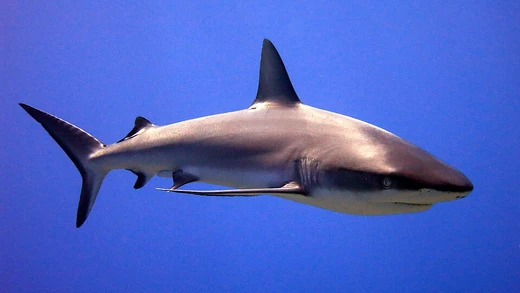
Great hammerhead
Critically endangered by overfishing for its fins
Last updated

Albert kok · via Wikipedia: Great hammerhead · CC BY-SA 4.0
Great hammerheads live in tropical waters around the world, from shallow inshore areas down to about 80 meters offshore.[1] People heavily fish this shark for its large fins, driving its populations into a steep decline worldwide.[2] Great hammerheads have a streamlined body and a wide, flattened head called a cephalofoil.[3]
Scientific classification
- KingdomAnimalia
- PhylumChordata
- ClassChondrichthyes
- SubclassElasmobranchii
- DivisionSelachii
- OrderCarcharhiniformes
- FamilySphyrnidae
- GenusSphyrna
- SpeciesSphyrna mokarran
Named by (Rüppell, 1837)
Sources: Wikipedia taxobox: Great hammerhead (CC BY-SA 4.0) · order, family and genus agree with WoRMS AphiaID 105817 (CC BY 4.0)
Conservation status
Critically Endangered (CR)
- LC
- NT
- VU
- EN
- CR▲ this species
- EW
- EX
Source: IUCN Red List assessment · GBIF copy of the Red List category
How big is it?
Largest length in the source, 6.2 m, next to a 1.8 m person.
Diagram: drawn by Codexery, schematic shapes to scale (not a likeness). Length: Wikipedia: Great hammerhead
Where the great hammerhead has been recorded
Each dot is a place where the species has been observed and reported (27,169 records, half-degree grid) — not a modelled range. 32 inland records left out (institution coordinates).
Map: drawn by Codexery. Data: GBIF occurrence search (records CC0 / CC BY) · Natural Earth basemap (public domain) · place coordinates: Wikipedia (CC BY-SA 4.0)
Description
Adults can be told apart from other hammerheads by the nearly straight front edge of their cephalofoil, which has clear notches in the middle and at the sides.[3] Their pelvic fins are sickle-shaped, with concave rear margins.[4] The upper jaw has 17 tooth rows on each side, plus two or three teeth at the midline. The lower jaw has 16 to 17 rows on each side, with one to three at the midline.[3] The cephalofoil's width measures between 23 and 27 percent of the shark's total body length.[3]
Small, closely placed tooth-like scales called dermal denticles cover the skin—they're diamond-shaped.[4] A small number of great hammerheads, mostly females, grow much larger than the typical size.[4]
Biology and ecology
Observations show the shark may knock a ray to the bottom with a powerful blow, pin it with its head, and take large bites from each side of the ray's pectoral fin.[5][6] A 2016 study found that great hammerheads reduce drag and save energy by swimming on their side, a posture called "rolled swimming."[7] Like other hammerheads, great hammerheads give birth to live young.[8] Females breed once every two years, with a gestation period of 11 months.[8]
The young measure 50 to 70 centimeters at birth.[8] Several species of copepods parasitize the great hammerhead.[9] Great hammerheads are solitary and roam widely, and other reef sharks tend to give them plenty of space.[9] They mostly hunt at dawn or dusk, swinging their heads over the seafloor to pick up the electrical signals of buried stingrays using electroreceptors on the underside of their cephalofoil.[10]
Distribution and habitat
In the Atlantic, it ranges from North Carolina to Uruguay, including the Gulf of Mexico and the Caribbean Sea, and from Morocco to Senegal, including the Mediterranean Sea.[1]
Human interactions
Great hammerheads are extremely vulnerable to overfishing because they have low overall numbers and a long generation time.[11] Countries like the United States, Australia, and the European Union, along with international bodies, have banned shark finning, which should reduce fishing pressure on the great hammerhead.[11]
Taxonomy and phylogeny
Older studies based on body shape put the great hammerhead as one of the more evolved members of its family, but DNA analyses have overturned that view.[12] These genetic studies found that the great hammerhead and the smooth hammerhead form a group that sits at the base of the hammerhead family tree, meaning they split off early from all other Sphyrna species.[12] German naturalist Eduard Rüppell first described the great hammerhead as Zygaena mokarran in 1837.[3]
References
- Wikipedia, "Great hammerhead" (CC BY-SA 4.0), which cites: Bester, Cathleen. Biological Profiles: Great Hammerhead. Florida Museum of Natural History Ichthyology Department. Retrieved on October 18, 2008.; Rigby, C.L., "Sphyrna mokarran", 2019 (we also read that source) en.wikipedia.org
- Wikipedia, "Great hammerhead" (CC BY-SA 4.0), which cites: Ebert, "Sharks of the World: A Complete Guide", Princeton University Press, 20 July 2021, p. 569; Márquez, "U.S. Government Decides Against Adding Great Hammerhead Shark To Endangered Species List", Forbes; "Federal Register", Office of the Federal Register, National Archives and Records Service, General Services Administration, April 2013, p. 24703; Rigby, C.L., "Sphyrna mokarran", 2019 (we also read that source) en.wikipedia.org
- Wikipedia, "Great hammerhead" (CC BY-SA 4.0), which cites: Bester, Cathleen. Biological Profiles: Great Hammerhead. Florida Museum of Natural History Ichthyology Department. Retrieved on October 18, 2008. (original not read by us) en.wikipedia.org
- Wikipedia, "Great hammerhead" (CC BY-SA 4.0), which cites: Bester, Cathleen. Biological Profiles: Great Hammerhead. Florida Museum of Natural History Ichthyology Department. Retrieved on October 18, 2008.; Compagno, L.J.V., "Sharks of the World: An Annotated and Illustrated Catalogue of Shark Species Known to Date", Food and Agricultural Organization, 1984, p. 548–549 (we also read that source) en.wikipedia.org
- Wikipedia, "Great hammerhead" (CC BY-SA 4.0), which cites: Strong, W.R., "Hammerhead Shark Predation on Stingrays: An Observation of Prey Handling by Sphyrna mokarran", Copeia, September 19, 1990, p. 836–840 (original not read by us) en.wikipedia.org
- Wikipedia, "Great hammerhead" (CC BY-SA 4.0), which cites: "A further observation of the prey-handling behavior of the great hammerhead shark, Sphyrna mokarran: predation upon the spotted eagle ray, Aetobatus narinari", Bulletin of Marine Science, May 2002, p. 947–952; Roemer, "Shallow water tidal flat use and associated specialized foraging behavior of the great hammerhead shark (Sphyrna mokarran)", Marine and Freshwater Behaviour and Physiology, 29 April 2016, p. 235–249 (original not read by us) en.wikipedia.org
- Wikipedia, "Great hammerhead" (CC BY-SA 4.0), which cites: Payne, "Great hammerhead sharks swim on their side to reduce transport costs", Nature Communications, 2016 (we also read that source) en.wikipedia.org
- Wikipedia, "Great hammerhead" (CC BY-SA 4.0), which cites: Bester, Cathleen. Biological Profiles: Great Hammerhead. Florida Museum of Natural History Ichthyology Department. Retrieved on October 18, 2008.; Rigby, C.L., "Sphyrna mokarran", 2019; Bester, Cathleen. Biological Profiles: Great Hammerhead. Florida Museum of Natural History Ichthyology Department. Retrieved on October 18, 2008.; "Record Hammerhead Pregnant With 55 Pups", Discovery News, July 1, 2006 (we also read that source) en.wikipedia.org
- Wikipedia, "Great hammerhead" (CC BY-SA 4.0), which cites: Martin, R.A., "A review of shark agonistic displays: comparison of display features and implications for shark–human interactions", Marine and Freshwater Behaviour and Physiology, March 2007, p. 3–34; Bester, Cathleen. Biological Profiles: Great Hammerhead. Florida Museum of Natural History Ichthyology Department. Retrieved on October 18, 2008.; Great Hammerhead. Elasmodiver.com. Retrieved on October 18, 2008.; Stafford-Deitsch, J., "Red Sea Sharks", Trident Press Ltd., 1999, p. 92–93; Bester, Cathleen. Biological Profiles: en.wikipedia.org
- Wikipedia, "Great hammerhead" (CC BY-SA 4.0), which cites: Hammerschlag, Rick. Sandy Plains: Great Hammerhead Shark. ReefQuest Centre for Shark Research. Retrieved on October 18, 2008.; Compagno, L.J.V., "Sharks of the World: An Annotated and Illustrated Catalogue of Shark Species Known to Date", Food and Agricultural Organization, 1984, p. 548–549 (we also read that source) en.wikipedia.org
- Wikipedia, "Great hammerhead" (CC BY-SA 4.0), which cites: Rigby, C.L., "Sphyrna mokarran", 2019 (we also read that source) en.wikipedia.org
- Wikipedia, "Great hammerhead" (CC BY-SA 4.0), which cites: "Phylogeny of hammerhead sharks (Family Sphyrnidae) inferred from mitochondrial and nuclear genes", Molecular Phylogenetics and Evolution, 2010, p. 572–579; Cavalcanti, M.J., "A Phylogenetic Supertree of the Hammerhead Sharks (Carcharhiniformes: Sphyrnidae)", Zoological Studies, 2007, p. 6–11 (we also read that source) en.wikipedia.org
Each numbered sentence above was checked against the source it cites before publication. Sentences citing Wikipedia adapt text from the English Wikipedia article Great hammerhead (contributors), used under CC BY-SA 4.0; this entry is available under the same licence. Other sources were used for facts only; no text or images are copied from them.
More in Hammerhead sharks
Elsewhere in Sharks
Test yourself
Three questions drawn from this entry’s sources. Pick an answer to check it.
Answers checked against the source article
Sources
Compiled from Wikipedia and the sources listed below. Text from Wikipedia is available under CC BY-SA 4.0; this entry is adapted from it.
- Wikipedia: Great hammerhead (CC BY-SA 4.0).
- Classification: the source article's taxobox; order, family and genus checked against WoRMS, the World Register of Marine Species (CC BY 4.0).
- Conservation status: IUCN Red List assessment.
- Occurrence records: GBIF (CC0 / CC BY). Basemap: Natural Earth (public domain).
- Word definitions: the Codexery glossary, each quoted from its Wikipedia article.
Spotted an error? Know more?
Reader corrections go straight into our review queue. Suggest an edit · How this site is sourced