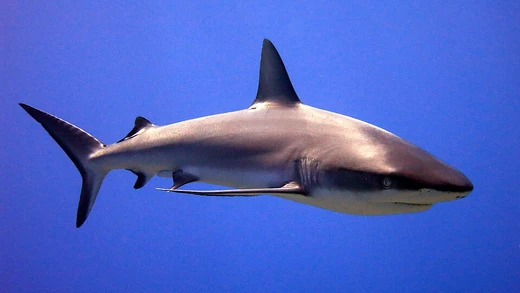
Shortfin mako
Fastest shark species, reaching 74 km/h in bursts.
Last updated

出羽雀台 · CC BY-SA 4.0
Shortfin makos live in temperate and tropical seas around the world.[1] They are one of the very few warm-blooded sharks, which helps them stay active in cooler waters.[2][3]
Scientific classification
- KingdomAnimalia
- PhylumChordata
- ClassChondrichthyes
- SubclassElasmobranchii
- DivisionSelachii
- OrderLamniformes
- FamilyLamnidae
- GenusIsurus
- SpeciesIsurus oxyrinchus
Named by Rafinesque, 1810
Sources: Wikipedia taxobox: Shortfin mako shark (CC BY-SA 4.0) · order, family and genus agree with WoRMS AphiaID 105839 (CC BY 4.0)
Conservation status
Endangered (EN)
- LC
- NT
- VU
- EN▲ this species
- CR
- EW
- EX
Source: IUCN Red List assessment · GBIF copy of the Red List category
How big is it?
Largest length in the source, 4.45 m, next to a 1.8 m person.
Diagram: drawn by Codexery, schematic shapes to scale (not a likeness). Length: Wikipedia: Shortfin mako shark
Description
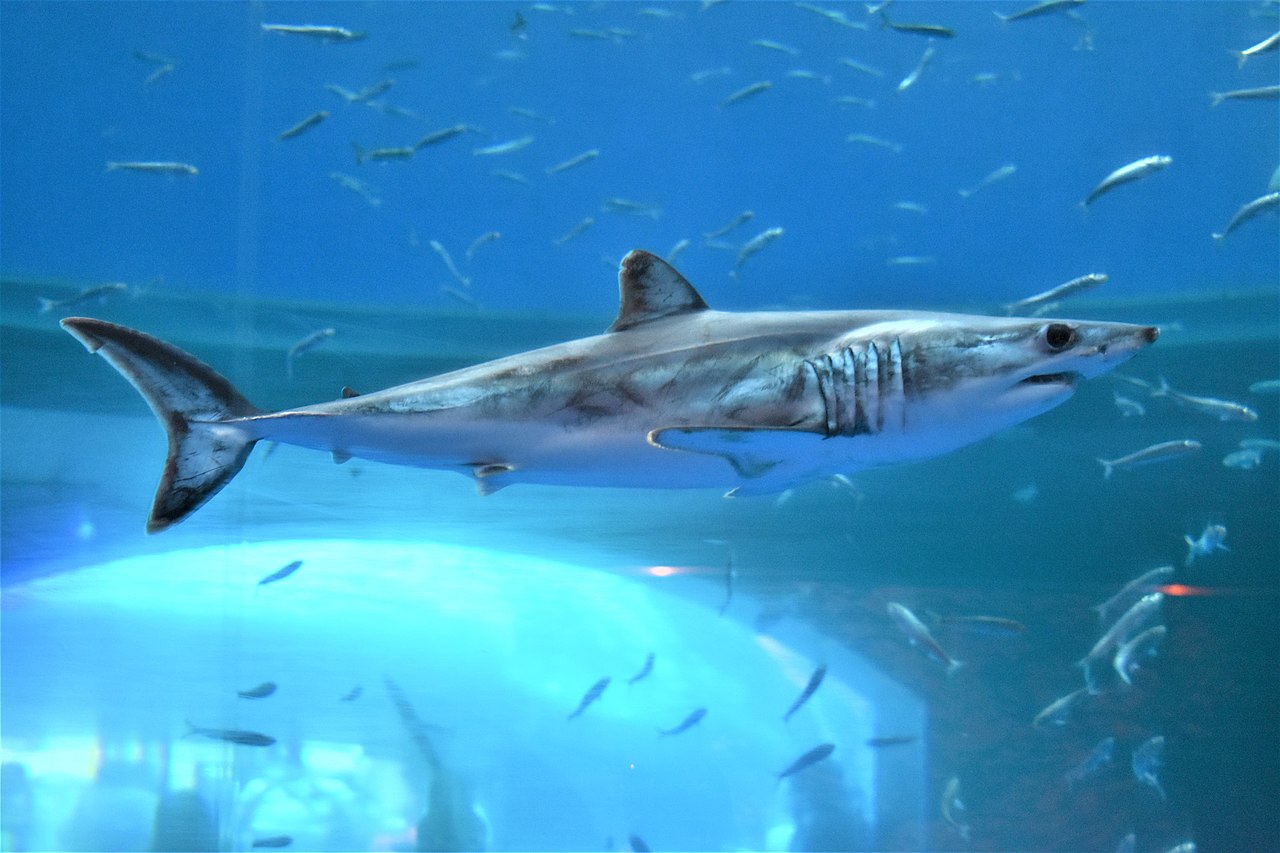
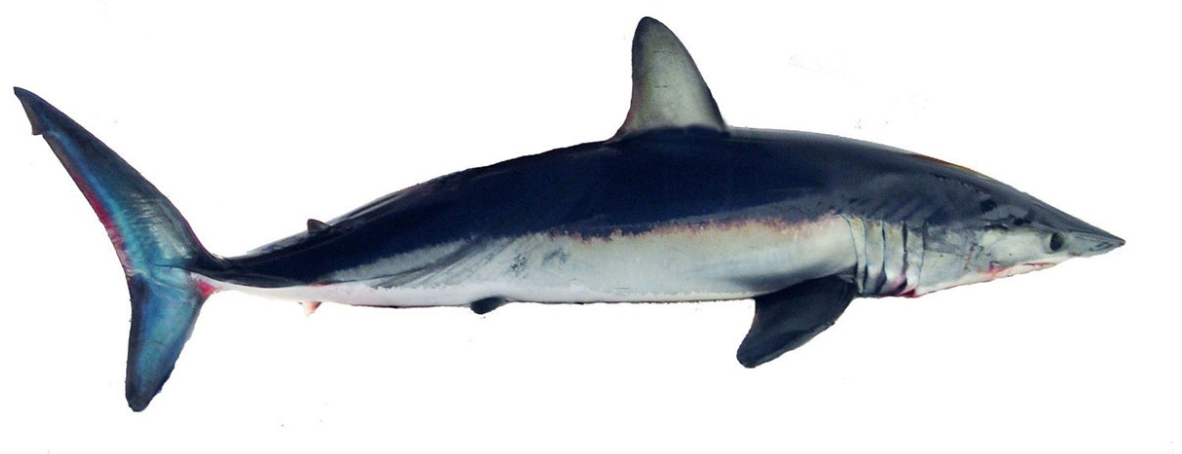
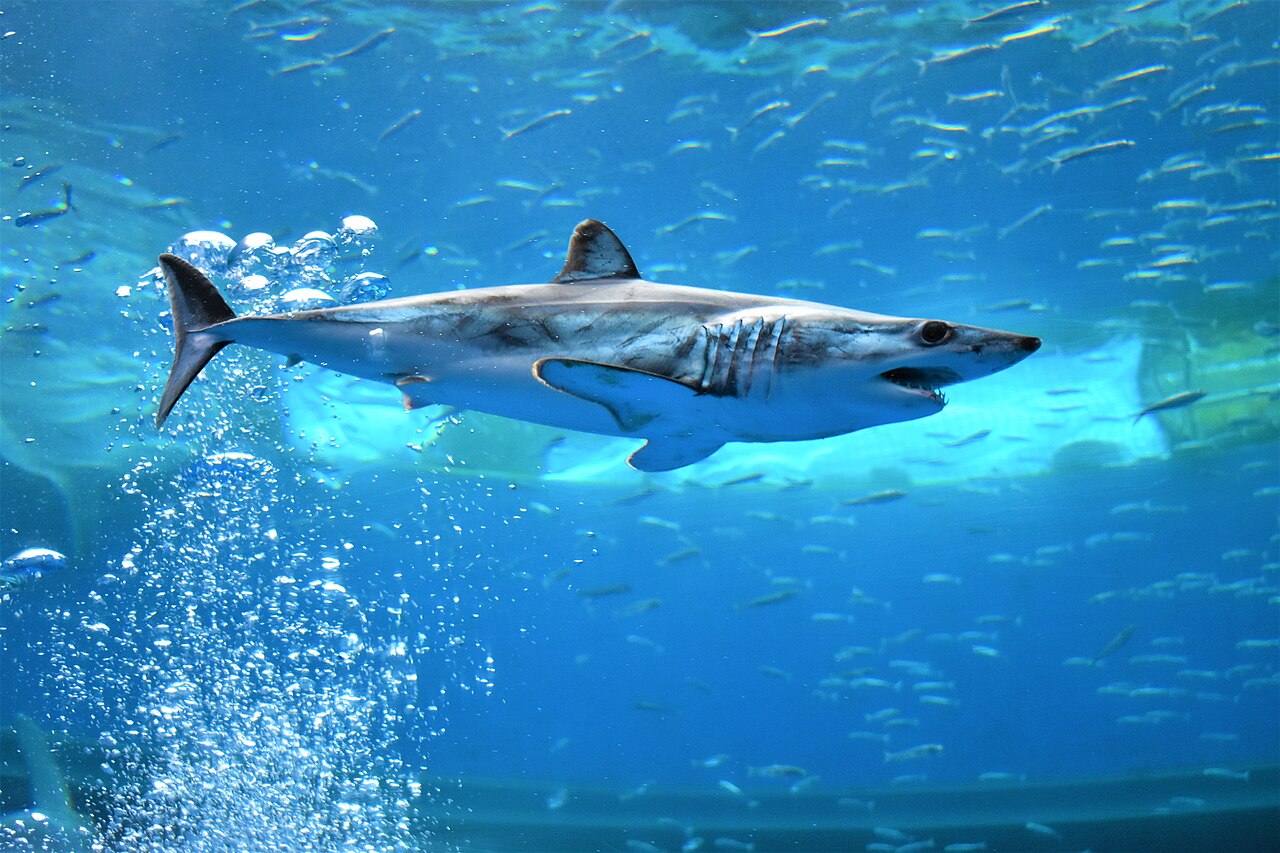
Shortfin makos have a streamlined, spindle-shaped body with a pointed snout and a tail whose two lobes are nearly equal in length.[4][5] Its back is a brilliant metallic blue, its underside is white, and the line between the two colors is sharp.[4] The underside of the snout and the area around the mouth are usually white, though larger sharks often have darker coloring there.[4] Females are generally larger than males.[6]
The largest one caught on hook-and-line weighed 600 kilograms and was caught off California on June 3, 2013, though the species can reach up to 4.45 meters in length.[6] A specimen caught off Italy in 1881 was reported to weigh 1000 kilograms at 4 meters. Another fish caught off Marmaris, Turkey in the late 1950s was estimated at 5.7 to 6.19 meters, though that estimate came from photos and must be treated with caution.[7] Shortfin makos look similar to longfin makos, but longfins have much larger pectoral fins, darker coloring around the mouth, and bigger eyes.[8] A single, very noticeable keel sticks out sideways along the tail's base.[4]
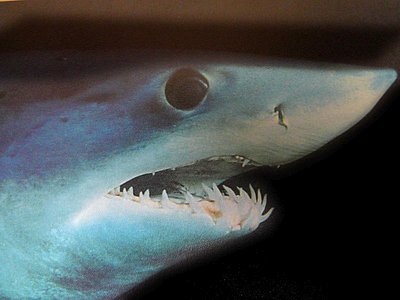
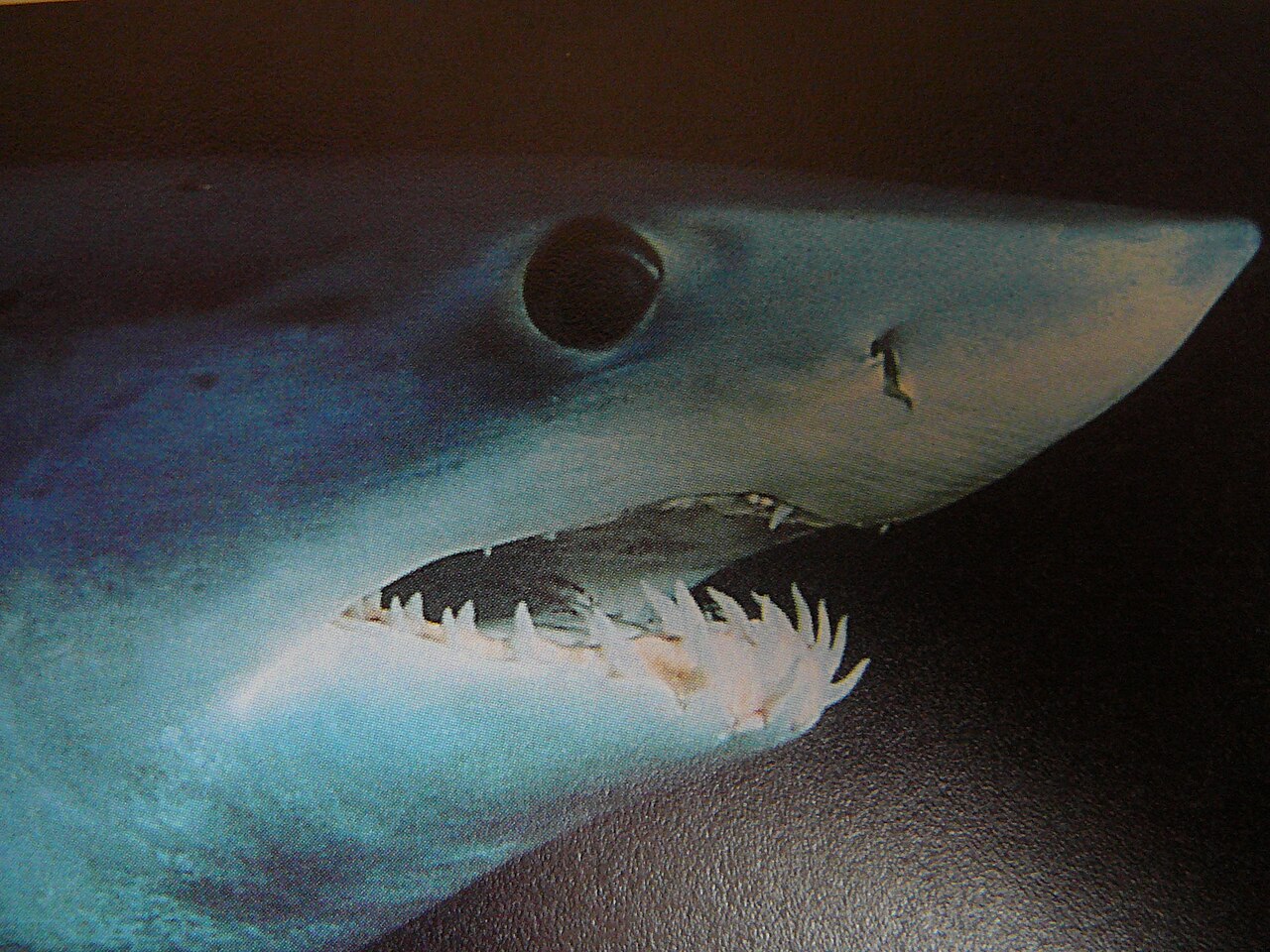
You can tell them apart from porbeagle sharks by their single keel on the tail and no side cusps on their teeth.[8]
Biology and ecology
Shortfin makos feed mainly on squid, other cephalopods, and bony fish such as bluefish, mackerel, tuna, and billfish.[9] It may also eat other sharks, porpoises, dolphins, sea turtles, seabirds, and crustaceans.[9] From Cape Hatteras to the Grand Banks, bluefish make up 77.5% of the mako's diet by volume.[10] Makos over 3 meters have wider, flatter interior teeth that let them tackle larger prey like dolphins and other sharks.[11]
Reproduction
Shortfin makos hold the record for the strongest bite ever measured for any shark, recorded at Mayor Island, New Zealand, in 2020.[12] Shortfin makos are ovoviviparous, meaning the young develop inside the mother and are born live.[13] A common mating strategy is polyandry, where a single brood has multiple fathers.[13][14] Scientists age makos by counting growth bands in their vertebrae.[15]
Lifespan
Until 2006, ages were badly underestimated because researchers thought two bands formed each year.[15] A landmark study proved only one band forms per year. It gave validated ages: males reach 50% sexual maturity at 8 years, females at 18 years. Maximum age is 29 years for males and 32 years for females.[15] Similar findings in New Zealand waters show median maturity at 7 to 9 years for males and 19 to 21 years for females, with lifespans around 28 to 29 years.[16] Shortfin makos do not rely on electroreception when hunting, unlike great white sharks, but instead use smell, hearing, and especially vision.[17]
When hunting, this shark shoots upward from below and rips chunks out of its prey's sides and fins.[9] Makos like to swim underneath their prey so they can spot it from below and get to it before the prey even knows they're there.[18] They'll also help themselves to fish that are already caught on longlines or tangled in nets.[19] Females may take an 18-month break after giving birth before they mate again, so they usually have young only once every three years.[13]
Distribution and habitat
Shortfin makos are seldom found in waters colder than 16 °C.[2] In the western Atlantic, they range from Argentina and the Gulf of Mexico up to Browns Bank off of Nova Scotia.[20] Swordfish are a good sign that makos are around, because makos eat them and like the same kinds of conditions.[21]
Human interactions
Some hooked makos have even jumped into boats.[22] Mako fishing is a popular sport worldwide.[23] Their speed and acrobatic leaps make them an exciting catch for anglers.[23] One of the world's three known mako rookeries is in San Diego, California, where catch-and-release fly fishing has become common.[23]
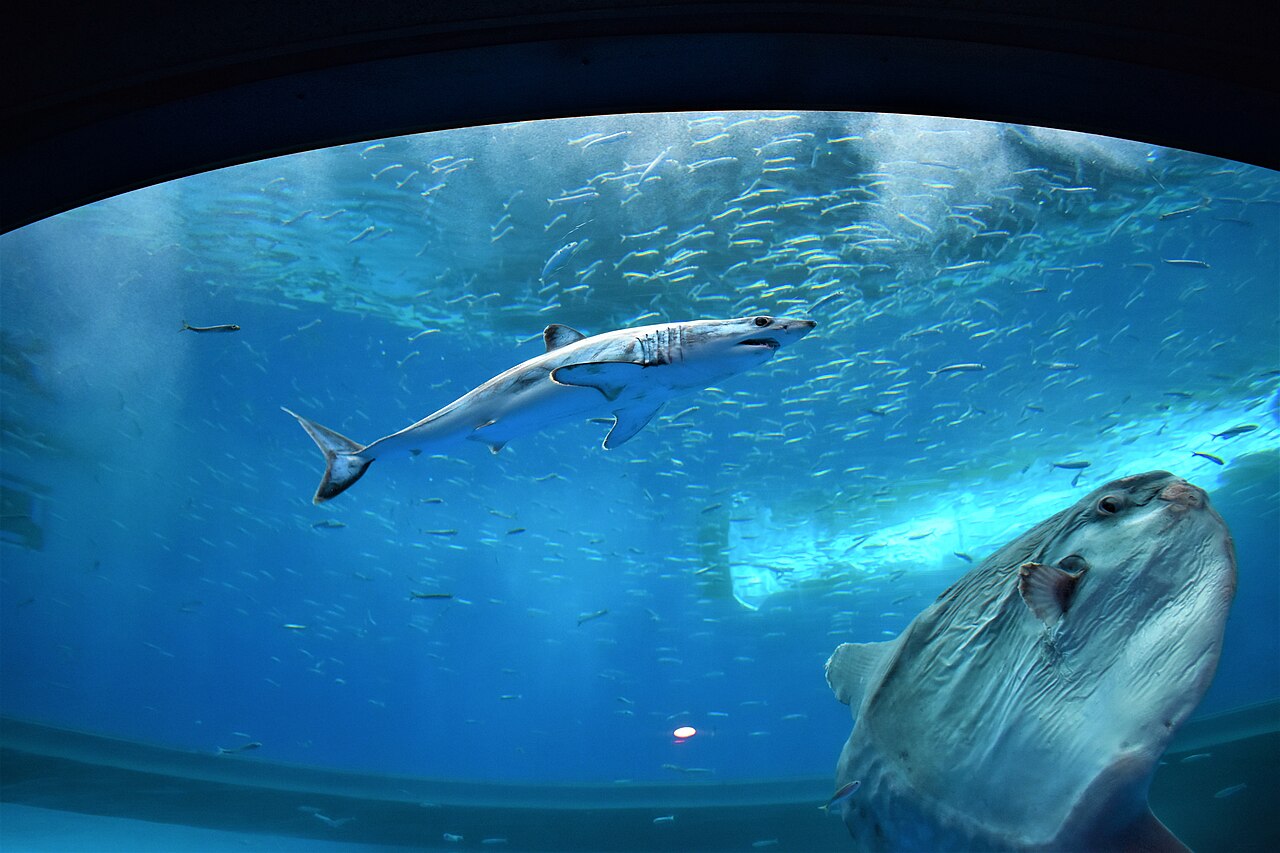
Shortfin makos have fared the worst of any pelagic shark in captivity.[24] The sharks refused to feed, had trouble navigating aquarium walls, and quickly died.[24][25]
Taxonomy and phylogeny
In 1809, Constantine Rafinesque gave the shortfin mako the scientific name Isurus oxyrinchus.[5] The genus name Isurus comes from the Ancient Greek for "equal tail," referring to the nearly equal lobes of the tail fin.[5] The species name oxyrinchus means "sharp nose," describing its pointed snout.[5] The word "mako" may have originated from a dialectal variation, similar to words for shark in other Polynesian languages.[26]
The first written use was in 1820, where it simply meant "a certain fish."[27] In English, "mako" works as both singular and plural.[26] Fossil teeth from the extinct species Isurus desori look a lot like those of the shortfin mako, and it's still unclear if they're actually the same species.[28]
References
- Wikipedia, "Shortfin mako shark" (CC BY-SA 4.0), which cites: Roberts, "The fishes of New Zealand", Te Papa Press, 2015, p. 72 (original not read by us) en.wikipedia.org
- Wikipedia, "Shortfin mako shark" (CC BY-SA 4.0), which cites: McEachran, "Fishes of the Gulf of Mexico, Vol. 1: Myxiniformes to Gasterosteiformes", University of Texas Press, 1998, p. 43; "The Shark Gallery – Shortfin Mako Shark (Isurus oxyrinchus)", The Shark Trust; "Shortfin Mako sharks(Isurus oxyrinchus)", Shark Foundation / Hai-Stiftung, 29 August 2005 (we also read that source) en.wikipedia.org
- Wikipedia, "Shortfin mako shark" (CC BY-SA 4.0), which cites: McGrouther, "Shortfin Mako", Australian Museum, May 2007; "Shortfin Mako Shark", 2008 Discovery Communications, LLC, October 30, 2007; Passarelli, "SHORTFIN MAKO", Florida Museum of Natural History (original not read by us) en.wikipedia.org
- Wikipedia, "Shortfin mako shark" (CC BY-SA 4.0), which cites: Moreno, "Comparative study of the Genus Isurus (Rafinesque, 1810), and description of a form (Marrajo Criollo) apparently endemic to the Azores", Marine and Freshwater Research, 1 February 1992, p. 109–122 (we also read that source) en.wikipedia.org
- Wikipedia, "Shortfin mako shark" (CC BY-SA 4.0), which cites: "Isurus oxyrinchus, Shortfin mako" (original not read by us) en.wikipedia.org
- Wikipedia, "Shortfin mako shark" (CC BY-SA 4.0), which cites: FLMNH Ichthyology Department: Shortfin Mako. Flmnh.ufl.edu. Retrieved on 2012-08-22.; "1,323-pound shark caught off coast of Huntington Beach", KABC TV (we also read that source) en.wikipedia.org
- Wikipedia, "Shortfin mako shark" (CC BY-SA 4.0), which cites: Kabasakal, H. and De Maddalena, A. (2011) A huge shortfin mako shark Isurus oxyrinchus Rafinesque, 1810 (Chondrichthyes: Lamnidae) from the waters of Marmaris, ; Kabasakal, "A Huge Shortfin Mako Isurus oxyrinchus rafinesque, 1810 (Chondrichthyes: Lamnidae) From the Waters of Marmaris, Turkey", Annales, January 2011, p. 21–24 (original not read by us) en.wikipedia.org
- Wikipedia, "Shortfin mako shark" (CC BY-SA 4.0), which cites: "Shark Identification for Cooperative Shark Tagging Program (S-W)", NOAA Fisheries, 3 September 2025 (original not read by us) en.wikipedia.org
- Wikipedia, "Shortfin mako shark" (CC BY-SA 4.0), which cites: "Isurus oxyrinchus (Mackerel porbeagle)", Animal Diversity Web; Wikipedia, et al. “UWI the Online Guide to the Animals of Trinidad and Tobago Ecology.” UWI the Online Guide to the Animals of Trinidad and Tobago Ecology, 1 Ma; Isurus Oxyrinchus | Shark-References. shark-references.com/species/view/Isurus-oxyrinchus. (original not read by us) en.wikipedia.org
- Wikipedia, "Shortfin mako shark" (CC BY-SA 4.0), which cites: Stillwell, "Food, Feeding Habits, and Estimates of Daily Ration of the Shortfin Mako (Isurus oxyrinchus ) in the Northwest Atlantic.", Canadian Journal of Fisheries and Aquatic Sciences, 1982, p. 407–414 (we also read that source) en.wikipedia.org
- Wikipedia, "Shortfin mako shark" (CC BY-SA 4.0), which cites: R. Aidan Martin, "Open Ocean: the Blue DesertShortfin Mako", ReefQuest Centre for Shark Research, 2003 (original not read by us) en.wikipedia.org
- Wikipedia, "Shortfin mako shark" (CC BY-SA 4.0), which cites: "Most powerful shark bite ever recorded measured by scientists", Newsweek, 14 August 2020 (we also read that source) en.wikipedia.org
- Wikipedia, "Shortfin mako shark" (CC BY-SA 4.0), which cites: Last, "Sharks and Rays of Australia", CSIRO (Commonwealth Scientific and Industrial Research Organisation), 2012 (we also read that source) en.wikipedia.org
- Wikipedia, "Shortfin mako shark" (CC BY-SA 4.0), which cites: Nasby-Lucas, N., Dewar, H., Sosa-Nishizaki, O., Wilson, C., Hyde, J. R., Vetter, R. D., Wraith, J., Block, B. A., Kinney, M. J., Sippel, T., Holts, D. B., & Koh (original not read by us) en.wikipedia.org
- Wikipedia, "Shortfin mako shark" (CC BY-SA 4.0), which cites: Natanson, "Validated age and growth estimates for the shortfin mako, Isurus oxyrhinchus, in the North Atlantic Ocean.", Environmental Biology of Fishes, 2006, p. 367–383 (we also read that source) en.wikipedia.org
- Wikipedia, "Shortfin mako shark" (CC BY-SA 4.0), which cites: Bishop, "Age, growth, maturity, longevity and natural mortality of the shortfin mako shark (Isurus oxyrinchus) in New Zealand waters", Marine and Freshwater Research, 2006, p. 143–154 (original not read by us) en.wikipedia.org
- Wikipedia, "Shortfin mako shark" (CC BY-SA 4.0), which cites: "Mako – Swift, Smart & Deadly" (we also read that source) en.wikipedia.org
- Wikipedia, "Shortfin mako shark" (CC BY-SA 4.0), which cites: "The Shark Gallery – Shortfin Mako Shark (Isurus oxyrinchus)", The Shark Trust (we also read that source) en.wikipedia.org
- Wikipedia, "Shortfin mako shark" (CC BY-SA 4.0), which cites: Fergusson, "Shortfin Mako Shark (Isurus oxyrinchus)" (original not read by us) en.wikipedia.org
- Wikipedia, "Shortfin mako shark" (CC BY-SA 4.0), which cites: McEachran, "Fishes of the Gulf of Mexico, Vol. 1: Myxiniformes to Gasterosteiformes", University of Texas Press, 1998, p. 43 (we also read that source) en.wikipedia.org
- Wikipedia, "Shortfin mako shark" (CC BY-SA 4.0), which cites: Campana, "Shortfin Mako", The Canadian Shark Research Laboratory, 2 October 2008; (original not read by us) en.wikipedia.org
- Wikipedia, "Shortfin mako shark" (CC BY-SA 4.0), which cites: "Monstrous mako shark hops on boat, gets itself stuck, dramatic video shows", Fox News, 2017-07-28 (original not read by us) en.wikipedia.org
- Wikipedia, "Shortfin mako shark" (CC BY-SA 4.0), which cites: "San Diego Shark Fishing Charter TheFlyStop.com"; "San Diego Offshore | California Fly Fishing Reports & Conditions" (we also read that source) en.wikipedia.org
- Wikipedia, "Shortfin mako shark" (CC BY-SA 4.0), which cites: "Shortfin mako (Isurus oxyrinchus) in Captivity", January 2019; "Shortfin mako (Isurus oxyrinchus) in Captivity", January 2019 (we also read that source) en.wikipedia.org
- Wikipedia, "Shortfin mako shark" (CC BY-SA 4.0), which cites: Elasmobranch Research around Monterey Bay (original not read by us) en.wikipedia.org
- Wikipedia, "Shortfin mako shark" (CC BY-SA 4.0), which cites: H. W. Williams, "Dictionary of the Maori Language", 1971; H. W. Williams, "Dictionary of the Maori Language", 1971 (original not read by us) en.wikipedia.org
- Wikipedia, "Shortfin mako shark" (CC BY-SA 4.0), which cites: "Oxford: The Dictionary of New Zealand English: New Zealand words and their origins", 1997; "Online Etymology Dictionary"; Richard Taylor, "A leaf from the natural history of New Zealand", 1848, p. xiii (original not read by us) en.wikipedia.org
- Wikipedia, "Shortfin mako shark" (CC BY-SA 4.0), which cites: Höltke, "A Review of the Paleobiology of Some Neogene Sharks and the Fossil Records of Extant Shark Species", Diversity, 2024-02-26, p. 147 (we also read that source) en.wikipedia.org
Each numbered sentence above was checked against the source it cites before publication. Sentences citing Wikipedia adapt text from the English Wikipedia article Shortfin mako shark (contributors), used under CC BY-SA 4.0; this entry is available under the same licence. Other sources were used for facts only; no text or images are copied from them.
More in Mackerel sharks
Elsewhere in Sharks
Test yourself
Three questions drawn from this entry’s sources. Pick an answer to check it.
Answers checked against the source article
Sources
Compiled from Wikipedia and the sources listed below. Text from Wikipedia is available under CC BY-SA 4.0; this entry is adapted from it.
- Wikipedia: Shortfin mako shark (CC BY-SA 4.0).
- Classification: the source article's taxobox; order, family and genus checked against WoRMS, the World Register of Marine Species (CC BY 4.0).
- Conservation status: IUCN Red List assessment.
- Word definitions: the Codexery glossary, each quoted from its Wikipedia article.
Spotted an error? Know more?
Reader corrections go straight into our review queue. Suggest an edit · How this site is sourced