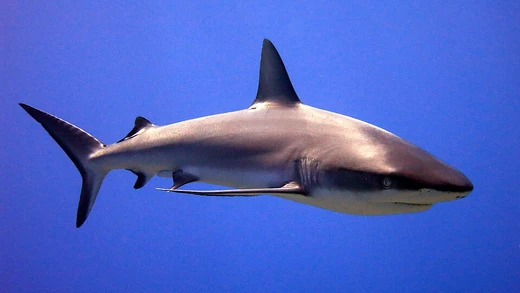
Smalltail shark
A slim, critically endangered requiem shark of the western Atlantic.
Last updated

SEFSC Pascagoula Laboratory; Collection of Brandi Noble, NOAA/NMFS/SEFSC · via Wikipedia: Smalltail shark · Public domain
The smalltail shark is a slender requiem shark—a type of shark that gives live birth—and it lives in coastal waters from the northern Gulf of Mexico down to southern Brazil.[1]
Scientific classification
- KingdomAnimalia
- PhylumChordata
- ClassChondrichthyes
- SubclassElasmobranchii
- DivisionSelachii
- OrderCarcharhiniformes
- FamilyCarcharhinidae
- GenusCarcharhinus
- SpeciesCarcharhinus porosus
Named by (Ranzani, 1839)
Close relatives
Other species of Carcharhinus with a Codexery entry.
- Blacknose shark Carcharhinus acronotus
- Blackspot shark Carcharhinus sealei
- Daggernose shark Carcharhinus oxyrhynchus
- Finetooth shark Carcharhinus isodon
- Whitecheek shark Carcharhinus dussumieri
- Australian blackspot shark Carcharhinus coatesi
- Australian blacktip shark Carcharhinus tilstoni
- Bignose shark Carcharhinus altimus
Sources: Wikipedia taxobox: Smalltail shark (CC BY-SA 4.0) · order, family and genus agree with WoRMS AphiaID 217342 (CC BY 4.0)
Conservation status
Critically Endangered (CR)
- LC
- NT
- VU
- EN
- CR▲ this species
- EW
- EX
Source: IUCN Red List assessment · GBIF copy of the Red List category
How big is it?
Largest length in the source, 1.5 m, next to a 1.8 m person.
Diagram: drawn by Codexery, schematic shapes to scale (not a likeness). Length: Wikipedia: Smalltail shark
Where the smalltail shark has been recorded
Each dot is a place where the species has been observed and reported (774 records, half-degree grid) — not a modelled range. 81 inland records left out (institution coordinates). 1 isolated far-off record not drawn.
Map: drawn by Codexery. Data: GBIF occurrence search (records CC0 / CC BY) · Natural Earth basemap (public domain) · place coordinates: Wikipedia (CC BY-SA 4.0)
Description
This shark has a fairly long, pointed snout and a slender body.[2] Each nostril has a narrow, pointed lobe sticking out from its front edge.[2] Behind those big, round eyes—which have nictitating membranes—you'll see a row of noticeable pores.[2] In adults, the first dorsal fin is broad and looks almost like an equilateral triangle, with a blunt tip.[3]
The biggest smalltail shark ever recorded was 1.5 m long, but most are between 0.9 and 1.1 m.[4]
Biology and ecology
Off northern Brazil, the most important prey are two types of croaker fish.[5] Litter size increases with the size of the female.[6] Adults also hunt young sharpnose sharks, hammerhead sharks, and stingrays.[5] This shark also eats shrimp, crabs, and squid.[5]
Like other members of its family, this shark gives live birth: after the embryos use up their yolk, the yolk sac turns into a placental connection so the mom can keep feeding them.[6] Females have litters of two to nine pups, usually four to six, every other year.[6] Males reach maturity at 70 to 93 cm long, and females at 71 to 85 cm, which happens around six years old for both sexes.[7]
Distribution and habitat
Off northern Brazil, tides can reach 7 m high and flow at 7.5 knots.[8] Salinity there fluctuates between 14 ppt in the rainy season and 34 ppt in the dry season, and temperature ranges from 25 to 32 °C.[8] It favors estuarine areas with muddy bottoms.[8]
Human interactions
The IUCN Red List lists the smalltail shark as Critically Endangered.[9]
Taxonomy and phylogeny
Italian naturalist Camillo Ranzani described the smalltail shark in an 1839 scientific paper.[10] Nobody's really sure how the smalltail shark is related to other sharks.[11] A 2011 genetic study showed the smalltail shark is closely related to the daggernose shark, the blacknose shark, and the finetooth shark.[11] Scientists used to think the Pacific smalltail shark was the same species, but in 2011 José Castro showed it's a separate species.[11]
There's an unnamed species from Southeast Asia that looks a lot like the smalltail shark.[11]
References
- Wikipedia, "Smalltail shark" (CC BY-SA 4.0), which cites: "Fishes of the Gulf of Mexico: Myxinformes to Gasterosteiformes", University of Texas Press, 1998, p. 87; Pollom, R., "Carcharhinus porosus", 2020; "Population structure and reproductive biology of the smalltail shark (Carcharhinus porosus) off Maranhão, Brazil", Marine and Freshwater Research, 1999, p. 383–388; Castro, J.H., "The Sharks of North America", Oxford University Press, 2011, p. 459–462 (we also read that source) en.wikipedia.org
- Wikipedia, "Smalltail shark" (CC BY-SA 4.0), which cites: Compagno, L.J.V., "Sharks of the World: An Annotated and Illustrated Catalogue of Shark Species Known to Date", Food and Agricultural Organization of the United Nations, 1984, p. 496–497; Castro, J.H., "The Sharks of North America", Oxford University Press, 2011, p. 459–462; "Fishes of the Gulf of Mexico: Myxinformes to Gasterosteiformes", University of Texas Press, 1998, p. 87 (we also read that source) en.wikipedia.org
- Wikipedia, "Smalltail shark" (CC BY-SA 4.0), which cites: Compagno, L.J.V., "Sharks of the World: An Annotated and Illustrated Catalogue of Shark Species Known to Date", Food and Agricultural Organization of the United Nations, 1984, p. 496–497; Castro, J.H., "The Sharks of North America", Oxford University Press, 2011, p. 459–462 (we also read that source) en.wikipedia.org
- Wikipedia, "Smalltail shark" (CC BY-SA 4.0), which cites: Bester, C. Biological Profiles: Smalltail Shark. Florida Museum of Natural History Ichthyology Department. Retrieved on November 5, 2011.; (original not read by us) en.wikipedia.org
- Wikipedia, "Smalltail shark" (CC BY-SA 4.0), which cites: "Analysis of stomach contents of the smalltail shark Carcharhinus porosus from northern Brazil", Cybium, 1997, p. 123–133; Bester, C. Biological Profiles: Smalltail Shark. Florida Museum of Natural History Ichthyology Department. Retrieved on November 5, 2011. (original not read by us) en.wikipedia.org
- Wikipedia, "Smalltail shark" (CC BY-SA 4.0), which cites: Castro, J.H., "The Sharks of North America", Oxford University Press, 2011, p. 459–462; "Population structure and reproductive biology of the smalltail shark (Carcharhinus porosus) off Maranhão, Brazil", Marine and Freshwater Research, 1999, p. 383–388 (we also read that source) en.wikipedia.org
- Wikipedia, "Smalltail shark" (CC BY-SA 4.0), which cites: Castro, J.H., "The Sharks of North America", Oxford University Press, 2011, p. 459–462; "Age determination and growth of the smalltail shark Carcharhinus porosus, from northern Brazil", Marine and Freshwater Research, 1998, p. 705–711 (we also read that source) en.wikipedia.org
- Wikipedia, "Smalltail shark" (CC BY-SA 4.0), which cites: Pollom, R., "Carcharhinus porosus", 2020 (we also read that source) en.wikipedia.org
- IUCN Red List assessment (category and year as redistributed in GBIF's IUCN Red List checklist). IUCN Red List terms: fact (category, year) cited, no text reused. iucnredlist.org
- Wikipedia, "Smalltail shark" (CC BY-SA 4.0), which cites: Ranzani, C., "De novis speciebus piscium", Novi Commentarii, Academiae Scientiarum Instituti Bononiensis, 1839, p. 65–83 (original not read by us) en.wikipedia.org
- Wikipedia, "Smalltail shark" (CC BY-SA 4.0), which cites: Garrick, J.A.F. (1982). Sharks of the genus Carcharhinus. NOAA Technical Report, NMFS CIRC 445.; Compagno, L.J.V., "Sharks of the Order Carcharhiniformes", Princeton University Press, 1988, p. 319–320; Naylor, G.J.P., "The phylogenetic relationships among requiem and hammerhead sharks: inferring phylogeny when thousands of equally most parsimonious trees result", Cladistics, 1992, p. 295–318; "Shark tales: A molecular species-level phylogeny of sharks (Selachimorpha, Chondrichthyes)", Molecular Phylogenetics and Evolution, February 2011 en.wikipedia.org
Each numbered sentence above was checked against the source it cites before publication. Sentences citing Wikipedia adapt text from the English Wikipedia article Smalltail shark (contributors), used under CC BY-SA 4.0; this entry is available under the same licence. Other sources were used for facts only; no text or images are copied from them.
More in Reef sharks
Elsewhere in Sharks
Test yourself
Three questions drawn from this entry’s sources. Pick an answer to check it.
Answers checked against the source article
Sources
Compiled from Wikipedia and the sources listed below. Text from Wikipedia is available under CC BY-SA 4.0; this entry is adapted from it.
- Wikipedia: Smalltail shark (CC BY-SA 4.0).
- Classification: the source article's taxobox; order, family and genus checked against WoRMS, the World Register of Marine Species (CC BY 4.0).
- Conservation status: IUCN Red List assessment.
- Occurrence records: GBIF (CC0 / CC BY). Basemap: Natural Earth (public domain).
- Word definitions: the Codexery glossary, each quoted from its Wikipedia article.
Spotted an error? Know more?
Reader corrections go straight into our review queue. Suggest an edit · How this site is sourced