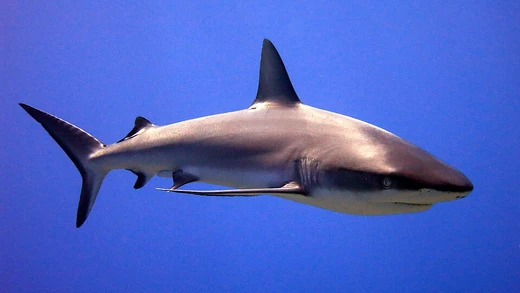
Cookiecutter shark
Small shark that bites round plugs from larger animals.
Last updated

NOAA Observer Project · via Wikipedia: Cookiecutter shark · Public domain
The cookiecutter shark gets its name from the round plugs of flesh it gouges out of larger animals, as if cut with a cookie cutter.[1]
Scientific classification
- KingdomAnimalia
- PhylumChordata
- ClassChondrichthyes
- SubclassElasmobranchii
- DivisionSelachii
- OrderSqualiformes
- FamilyDalatiidae
- GenusIsistius
- SpeciesIsistius brasiliensis
Named by (Quoy & Gaimard, 1824)
Sources: Wikipedia taxobox: Cookiecutter shark (CC BY-SA 4.0) · order, family and genus agree with WoRMS AphiaID 215612 (CC BY 4.0)
Conservation status
Least Concern (LC)
- LC▲ this species
- NT
- VU
- EN
- CR
- EW
- EX
Source: IUCN Red List assessment · GBIF copy of the Red List category
How big is it?
Largest length in the source, 0.56 m, next to a 1.8 m person.
Diagram: drawn by Codexery, schematic shapes to scale (not a likeness). Length: Wikipedia: Cookiecutter shark
Where the cookiecutter shark has been recorded
Each dot is a place where the species has been observed and reported (583 records, half-degree grid) — not a modelled range. 50 inland records left out (institution coordinates).
Map: drawn by Codexery. Data: GBIF occurrence search (records CC0 / CC BY) · Natural Earth basemap (public domain)
Description
This shark's mouth is short and almost straight across, and it's ringed by big, fleshy, suction-cup-like lips.[2] In the upper jaw you'll find 30 to 37 teeth, and in the lower jaw 25 to 31 teeth, with the count going up as the shark gets bigger.[2] The upper teeth are tiny, narrow, and stand straight up, while the lower teeth are way bigger, wider, and shaped like knives, with bases that lock together to form one continuous, saw-like cutting edge.[2]
Biology and ecology
The cookiecutter shark attacks virtually every type of medium- to large-sized oceanic animal that shares its habitat.[3] The cookiecutter shark also regularly hunts and eats entire squid with a mantle length of 15 to 30 cm, as well as bristlemouths, copepods, and other smaller prey.[3] Thanks to heavily calcified skull and lip cartilages, the cookiecutter shark can open its mouth really wide and deliver an incredibly powerful bite.[4] Researchers calculated that one cookiecutter shark shed 15 sets of lower teeth—that's 435 to 465 individual teeth—from the time it was 14 cm long until it reached 50 cm.[5]
Unlike other sharks, the cookiecutter shark's retina has its nerve cells packed in a circular area rather than in a horizontal band across the field of vision.[6] The photophores on the shark's belly help break up its silhouette from below by matching the light coming down from the surface—a trick called counter-illumination.[7] Each individual photophore sits around a denticle and is so tiny you can't see it with the naked eye.[8] The dark, non-glowing collar on the throat, which tapers on both sides, stands out from the glowing belly, and scientists think it might act as a lure by looking like a small fish's silhouette from below.[9]
If the collar really works that way, the cookiecutter shark would be the only known animal that uses the absence of light—rather than light itself—to attract prey.[9] First, the shark locks onto its prey by closing its spiracles and pulling back its tongue to create suction, while its fleshy lips make a tight seal.[10] Finally, the shark twists and spins its body to finish cutting out a perfect circle.[11]
Distribution and habitat
The cookiecutter shark lives in all the world's major tropical and warm-temperate ocean basins, and it's most common between 20°N and 20°S latitude, where the surface water temperature is between 18 and 26 °C.[12] You often find them near islands, maybe because they breed there or because islands attract big groups of large prey.[13]
Human interactions
However, the cookiecutter shark has been linked to a few attacks on humans.[14] A second cookiecutter attack occurred in the same spot three weeks later.[14] A third person, Adherbal Treidler de Oliveira, was bitten in nearly the same part of the channel while attempting the swim on July 29, 2019.[14] He managed to grab both sharks and throw them away before they could seriously hurt him.[15]
During the 1970s, several U.S. Navy submarines had to return to base for repairs because cookiecutter sharks bit the neoprene boots on their sonar domes.[16] At first, people feared an unknown enemy weapon was to blame, but then they figured out the cookiecutter shark was the culprit.[16] Because there aren't any major threats to its population and it lives all over the world, the IUCN lists the cookiecutter shark as Least Concern.[17][18][19]
Taxonomy and phylogeny
Their account was published in 1824 as part of a 13-volume report on the voyage.[20] In 1971, Everet Jones of the U.S. Bureau of Commercial Fisheries figured out that the cigar shark—as the cookiecutter shark was then commonly called—was the one causing those wounds.[21] Ancient Samoan legend contains one of the earliest known descriptions of the wounds this shark leaves on other animals.[21]
References
- Wikipedia, "Cookiecutter shark" (CC BY-SA 4.0), which cites: Sirvid, "The April Fool's Day Files: Blinded by the light", Museum of New Zealand Te Papa Tongarewa, 2025-04-01 (we also read that source) en.wikipedia.org
- Wikipedia, "Cookiecutter shark" (CC BY-SA 4.0), which cites: Ebert, D.A., "Sharks, Rays, and Chimaeras of California", University of California Press, 2003, p. 73–75; Bester, C. Biological Profiles: Cookiecutter Shark . Florida Museum of Natural History Ichthyology Department. Retrieved on January 26, 2010.; Compagno, L.J.V., "Sharks of the World: An Annotated and Illustrated Catalogue of Shark Species Known to Date", Food and Agricultural Organization, 1984, p. 93–95 (we also read that source) en.wikipedia.org
- Wikipedia, "Cookiecutter shark" (CC BY-SA 4.0), which cites: Ebert, D.A., "Sharks, Rays, and Chimaeras of California", University of California Press, 2003, p. 73–75; Martin, R.A. Deep Sea: Cookiecutter Shark . ReefQuest Centre for Shark Research. Retrieved on January 26, 2010.; Martin, R.A. Squaliformes: Dogfish Sharks . ReefQuest Centre for Shark Research. Retrieved on January 26, 2010.; "Observation of an Attack by a Cookiecutter Shark (Isistius brasiliensis) on a White Shark (Carcharodon carcharias)", Pacific Science, 2013, p. 129–134; Strasburg, D.W., "The Diet and Dentition o en.wikipedia.org
- Wikipedia, "Cookiecutter shark" (CC BY-SA 4.0), which cites: Widder, E.A., "A predatory use of counterillumination by the squaloid shark, Isistius brasiliensis", Environmental Biology of Fishes, November 1998, p. 267–273; Compagno, L.J.V., "Sharks of the World: An Annotated and Illustrated Catalogue of Shark Species Known to Date", Food and Agricultural Organization, 1984, p. 93–95; Milius, S. (August 1, 1998). Glow-in-the-dark shark has killer smudge . Science News. Retrieved on December 15, 2014. (we also read that source) en.wikipedia.org
- Wikipedia, "Cookiecutter shark" (CC BY-SA 4.0), which cites: Strasburg, D.W., "The Diet and Dentition of Isistius brasiliensis, with Remarks on Tooth Replacement in Other Sharks", Copeia, March 30, 1963, p. 33–40 (we also read that source) en.wikipedia.org
- Wikipedia, "Cookiecutter shark" (CC BY-SA 4.0), which cites: "Retinal ganglion cell topography in elasmobranchs", Brain, Behavior and Evolution, April 2000, p. 191–208 (original not read by us) en.wikipedia.org
- Wikipedia, "Cookiecutter shark" (CC BY-SA 4.0), which cites: Bright, M., "The Private Life of Sharks: The Truth Behind the Myth", Stackpole Books, 2000, p. 215; Martin, R.A. Deep Sea: Cookiecutter Shark . ReefQuest Centre for Shark Research. Retrieved on January 26, 2010.; "Fish Physiology: Reproduction and Growth, Bioluminescence, Pigments, and Poisons", Academic Press, 1969, p. 385; "Guinness World Records", Random House LLC, 2013, p. 63 (we also read that source) en.wikipedia.org
- Wikipedia, "Cookiecutter shark" (CC BY-SA 4.0), which cites: Widder, E.A., "A predatory use of counterillumination by the squaloid shark, Isistius brasiliensis", Environmental Biology of Fishes, November 1998, p. 267–273 (we also read that source) en.wikipedia.org
- Wikipedia, "Cookiecutter shark" (CC BY-SA 4.0), which cites: Widder, E.A., "A predatory use of counterillumination by the squaloid shark, Isistius brasiliensis", Environmental Biology of Fishes, November 1998, p. 267–273; Milius, S. (August 1, 1998). Glow-in-the-dark shark has killer smudge . Science News. Retrieved on December 15, 2014.; Widder, E.A., "A predatory use of counterillumination by the squaloid shark, Isistius brasiliensis", Environmental Biology of Fishes, November 1998, p. 267–273 (we also read that source) en.wikipedia.org
- Wikipedia, "Cookiecutter shark" (CC BY-SA 4.0), which cites: Widder, E.A., "A predatory use of counterillumination by the squaloid shark, Isistius brasiliensis", Environmental Biology of Fishes, November 1998, p. 267–273; Martin, R.A. Deep Sea: Cookiecutter Shark . ReefQuest Centre for Shark Research. Retrieved on January 26, 2010. (we also read that source) en.wikipedia.org
- Wikipedia, "Cookiecutter shark" (CC BY-SA 4.0), which cites: Widder, E.A., "A predatory use of counterillumination by the squaloid shark, Isistius brasiliensis", Environmental Biology of Fishes, November 1998, p. 267–273; Martin, R.A. Attacked by a Dogfish . ReefQuest Centre for Shark Research. Retrieved on January 26, 2010.; Widder, E.A., "A predatory use of counterillumination by the squaloid shark, Isistius brasiliensis", Environmental Biology of Fishes, November 1998, p. 267–273 (we also read that source) en.wikipedia.org
- Wikipedia, "Cookiecutter shark" (CC BY-SA 4.0), which cites: Ebert, D.A., "Sharks, Rays, and Chimaeras of California", University of California Press, 2003, p. 73–75 (we also read that source) en.wikipedia.org
- Wikipedia, "Cookiecutter shark" (CC BY-SA 4.0), which cites: Compagno, L.J.V., "Sharks of the World: An Annotated and Illustrated Catalogue of Shark Species Known to Date", Food and Agricultural Organization, 1984, p. 93–95; Kyne, P.M., "Isistius brasiliensis", 2018; Bester, C. Biological Profiles: Cookiecutter Shark . Florida Museum of Natural History Ichthyology Department. Retrieved on January 26, 2010.; Compagno, L.J.V., "Sharks of the World: An Annotated and Illustrated Catalogue of Shark Species Known to Date", Food and Agricultural Organization, 1984, p. 93–95; Compagno, L.J en.wikipedia.org
- Wikipedia, "Cookiecutter shark" (CC BY-SA 4.0), which cites: Ebert, D.A., "Sharks, Rays, and Chimaeras of California", University of California Press, 2003, p. 73–75; Martin, R.A. Deep Sea: Cookiecutter Shark . ReefQuest Centre for Shark Research. Retrieved on January 26, 2010.; Perry, B. (March 21, 2009). "Cookie-cutter sharks 'sort of a mosquito of the sea'" . The Maui News. Retrieved on January 26, 2010.; "First documented attack on a live human by a cookiecutter shark (Squaliformes, Dalatiidae: Isistius sp.)", Pacific Science, 2011, p. 365–374; "Rare Cookiecutter Shark Bite in Hawaii en.wikipedia.org
- Wikipedia, "Cookiecutter shark" (CC BY-SA 4.0), which cites: McMurray, "Hawaiian swimmer fast-pitches attacking cookiecutter sharks", Tracking Sharks, 2023-04-24 (original not read by us) en.wikipedia.org
- Wikipedia, "Cookiecutter shark" (CC BY-SA 4.0), which cites: Martin, R.A. Squaliformes: Dogfish Sharks . ReefQuest Centre for Shark Research. Retrieved on January 26, 2010.; Johnson, C.S., "Sea Creatures and the Problem of Equipment Damage", U.S. Naval Institute Proceedings, 1978, p. 106–107 (original not read by us) en.wikipedia.org
- Wikipedia, "Cookiecutter shark" (CC BY-SA 4.0), which cites: Kyne, P.M., "Isistius brasiliensis", 2018; Duffy, "Conservation status of New Zealand chondrichthyans (chimaeras, sharks and rays), 2016", Department of Conservation, 2018, p. 10 (we also read that source) en.wikipedia.org
- IUCN, "Isistius brasiliensis: Kyne, P.M.", IUCN Red List of Threatened Species (2017), doi:10.2305/iucn.uk.2018-2.rlts.t41830a2956761.en. OpenAlex metadata CC0; paper not read. doi.org
- IUCN Red List assessment (category and year as redistributed in GBIF's IUCN Red List checklist). IUCN Red List terms: fact (category, year) cited, no text reused. iucnredlist.org
- Wikipedia, "Cookiecutter shark" (CC BY-SA 4.0), which cites: "Voyage autour du Monde...exécuté sur les corvettes de L. M. "L'Uranie" et "La Physicienne," pendant les années 1817, 1818, 1819 et 1820", 1824–1825, p. 192–401; Ebert, D.A., "Sharks, Rays, and Chimaeras of California", University of California Press, 2003, p. 73–75; Gill, T.N., "Synopsis of the eastern American sharks", Proceedings of the Academy of Natural Sciences of Philadelphia, 1865, p. 258–265; Bester, C. Biological Profiles: Cookiecutter Shark . Florida Museum of Natural History Ichthyology Department. Retri en.wikipedia.org
- Wikipedia, "Cookiecutter shark" (CC BY-SA 4.0), which cites: Compagno, L.J.V., "Sharks of the World: An Annotated and Illustrated Catalogue of Shark Species Known to Date", Food and Agricultural Organization, 1984, p. 93–95; Jones, E.C., "Isistius brasiliensis, a Squaloid Shark, the Probable Cause of Crater Wounds on Fishes and Cetaceans", Fisheries Bulletin, 1971, p. 791–798 (original not read by us) en.wikipedia.org
Each numbered sentence above was checked against the source it cites before publication. Sentences citing Wikipedia adapt text from the English Wikipedia article Cookiecutter shark (contributors), used under CC BY-SA 4.0; this entry is available under the same licence. Other sources were used for facts only; no text or images are copied from them.
More in Dogfish sharks and relatives
Elsewhere in Sharks
Test yourself
Three questions drawn from this entry’s sources. Pick an answer to check it.
Answers checked against the source article
Sources
Compiled from Wikipedia and the sources listed below. Text from Wikipedia is available under CC BY-SA 4.0; this entry is adapted from it.
- Wikipedia: Cookiecutter shark (CC BY-SA 4.0).
- Classification: the source article's taxobox; order, family and genus checked against WoRMS, the World Register of Marine Species (CC BY 4.0).
- Conservation status: IUCN Red List assessment.
- Occurrence records: GBIF (CC0 / CC BY). Basemap: Natural Earth (public domain).
- Word definitions: the Codexery glossary, each quoted from its Wikipedia article.
Spotted an error? Know more?
Reader corrections go straight into our review queue. Suggest an edit · How this site is sourced