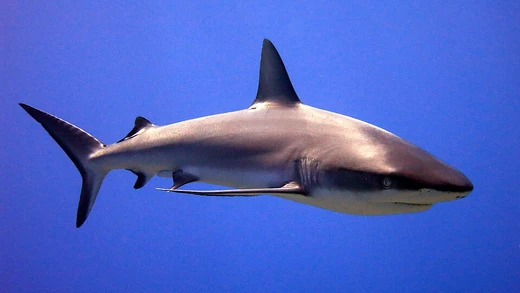
Tiger shark
The tiger shark is the largest member of the order Carcharhiniformes and the second-largest predatory shark, after the great white.
Last updated

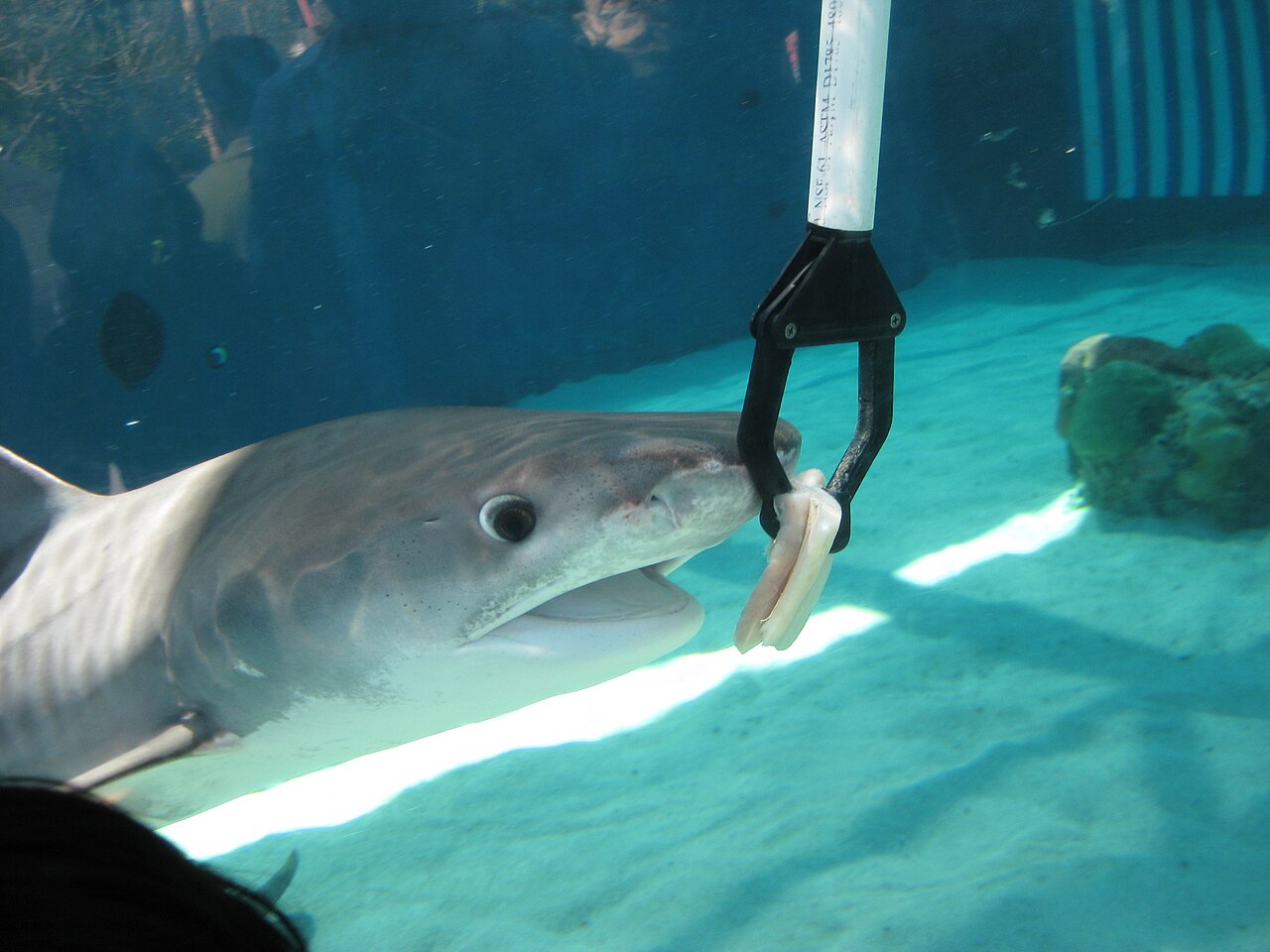
Oregon State University · CC BY-SA 2.0
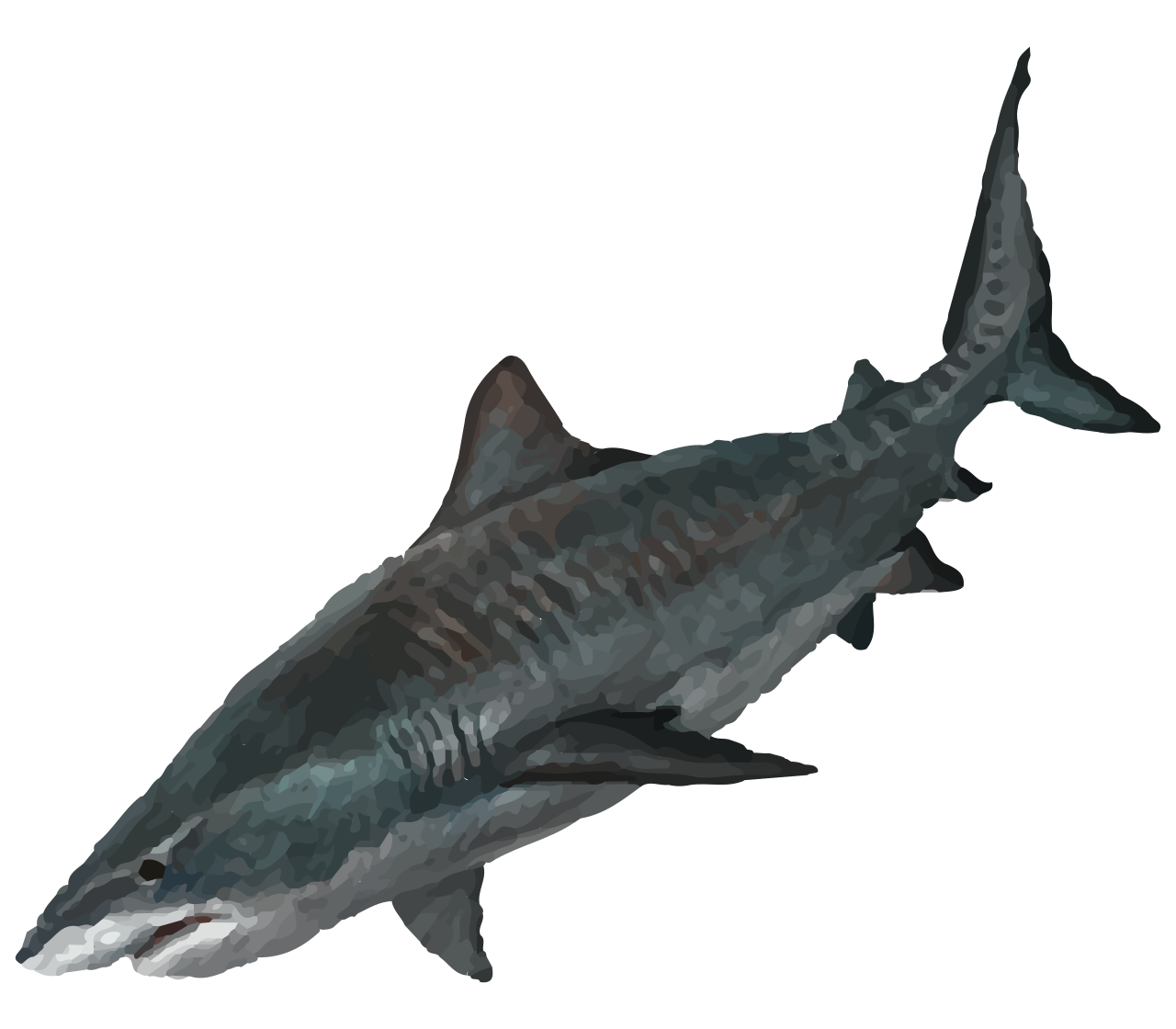
This shark has the widest food spectrum of any shark, eating everything from crustaceans and fish to sea turtles, dolphins, and even inedible man-made objects.[1] These big sharks hunt alone and live in warm and mild waters all over the world, with lots of them hanging out near central Pacific islands.[2][1] Dark stripes down its sides, like a tiger's coat, give this shark its name. They slowly disappear as the animal gets older.[1]
Scientific classification
- KingdomAnimalia
- PhylumChordata
- ClassChondrichthyes
- SubclassElasmobranchii
- DivisionSelachii
- OrderCarcharhiniformes
- FamilyGaleocerdonidae
- GenusGaleocerdo
- SpeciesGaleocerdo cuvier
Named by Péron & Lesueur, 1823
Sources: Wikipedia taxobox: Tiger shark (CC BY-SA 4.0) · order, family and genus agree with WoRMS AphiaID 105799 (CC BY 4.0)
Conservation status
Near Threatened (NT)
- LC
- NT▲ this species
- VU
- EN
- CR
- EW
- EX
Source: IUCN Red List assessment · GBIF copy of the Red List category
How big is it?
Largest length in the source, 4.7 m, next to a 1.8 m person.
Diagram: drawn by Codexery, schematic shapes to scale (not a likeness). Length: Wikipedia: Tiger shark
Where the tiger shark has been recorded
Each dot is a place where the species has been observed and reported (43,160 records, half-degree grid) — not a modelled range. 36 inland records left out (institution coordinates).
Map: drawn by Codexery. Data: GBIF occurrence search (records CC0 / CC BY) · Natural Earth basemap (public domain) · place coordinates: Wikipedia (CC BY-SA 4.0)
Description
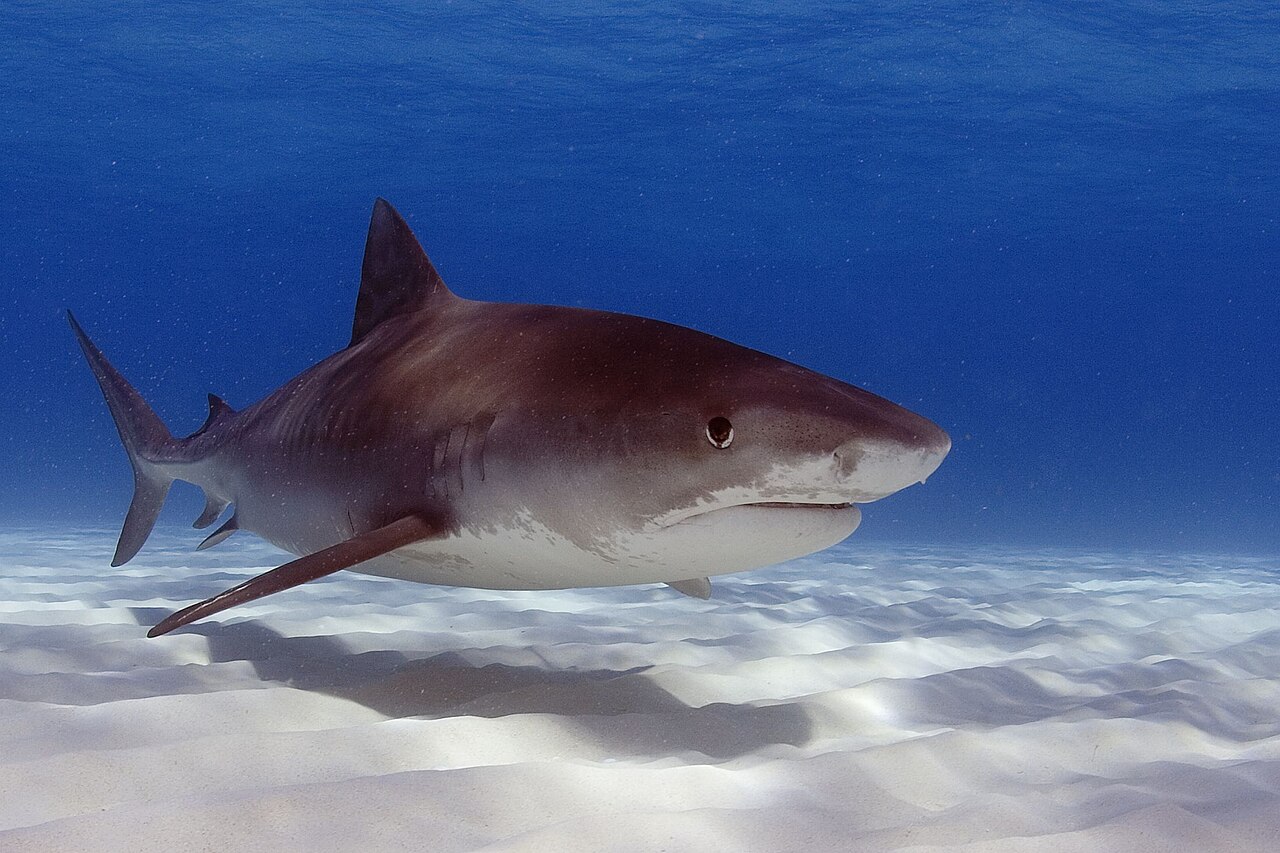
The skin ranges from blue to light green with a white or light-yellow underbelly, a pattern called countershading—dark on top, light below—that camouflages it from prey above and below.[3] Its head is somewhat wedge-shaped, allowing it to turn quickly, and it has small pits on the snout that hold electroreceptors to detect electric fields from prey.[3] A lateral line along its flanks detects minute vibrations in the water, helping it hunt in darkness.[4] The tiger shark has a nictitating membrane—a clear eyelid that covers the eye—and a reflective layer behind the retina that helps it see in low light.[5][6]
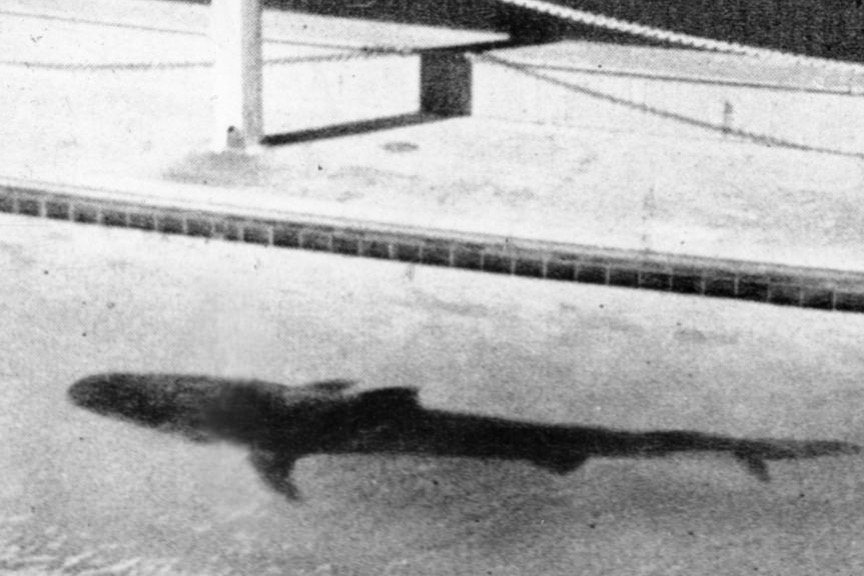
Girls grow bigger than boys: fully grown females usually stretch past 3.7 meters, while males that size are pretty rare.[7] When it comes to average size among living sharks, the tiger shark comes in fourth, behind only the whale shark, basking shark, and great white.[8] Its teeth are one of a kind: super sharp, heavily serrated, and angled sideways, perfect for cutting through flesh, bone, and even turtle shells.[9] Like most of its cousins, the tiger shark keeps growing new rows of teeth throughout its life to replace old ones.[9]
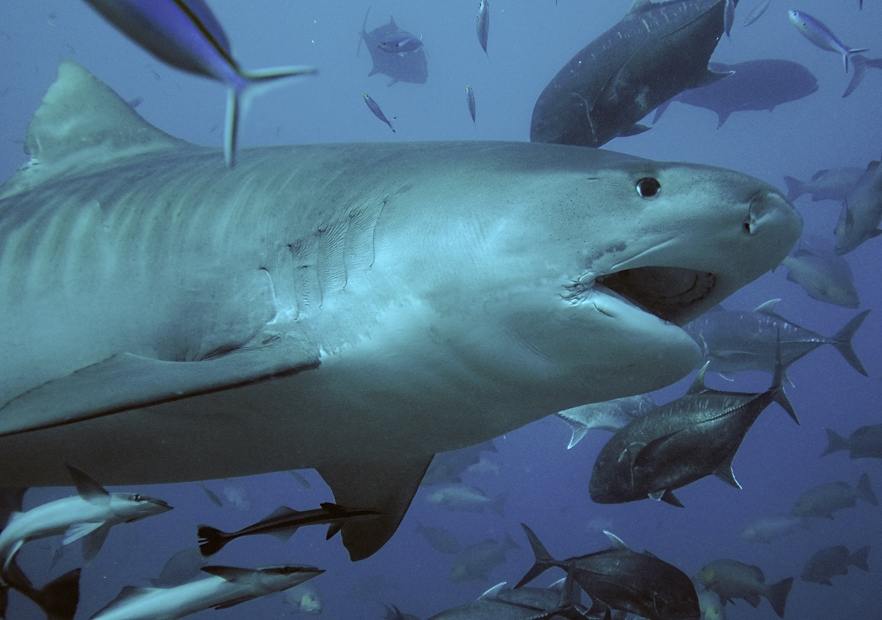
A tiger shark uses its long fins for lift and its long upper tail for quick bursts of speed, and it usually glides along with small, easy movements.[10]

Biology and ecology
The tiger shark is an apex predator and a solitary, mostly nocturnal hunter. It swims close inland to feed at night and moves to deeper waters during the day.[1][11] Young tiger sharks feed mostly on small fish, jellyfish, and mollusks. Around the time they reach 2.3 meters, their diet expands to include much larger animals.[11][12] Adult tiger sharks regularly eat fish, mollusks, crustaceans, sea birds, sea snakes, marine mammals like dolphins and seals, and sea turtles, including the three largest species.[12] Tiger sharks also scavenge, feeding on dead whales and manta rays.[13]
They have been known to eat terrestrial mammals such as horses, goats, and dogs, as well as inedible objects like license plates and tires.[14] It is unique among sharks in using a form of nourishment called embrytrophy—feeding embryos through a fluid in the womb—where they grow in sacks filled with nourishing fluid.[15][16] As tiger sharks grow, their tails become more symmetrical and their heads become broader. Their tails also shrink relative to body size.[17] Scientists found adult sea turtles in up to 20.8 percent of tiger shark stomachs they studied, which suggests these sharks really go for turtles where they're around.[12]
Dolphins tend to steer clear of areas where tiger sharks hang out because the risk of getting eaten is just too high.[18] Babies grow inside mom for up to 16 months, and a single litter can have anywhere from 10 to 80 pups.[19] Newborn tiger sharks measure between 51 and 76 centimeters long.[19] The only natural predator that's been recorded hunting tiger sharks is the orca.[20]
Tiger sharks usually swim slowly, and their sneaky coloring makes them hard for prey to spot, but they're actually among the strongest swimmers in the carcharhinid family.[21]
Distribution and habitat
Tiger sharks often live close to the coast in tropical and subtropical waters throughout the world.[15] These sharks wander a lot, following warm currents, and they stick closer to the equator when the weather gets cold.[15]
Human interactions
Even though shark bites on people are rare, the tiger shark is blamed for a lot of the fatal ones and is considered one of the most dangerous species.[22] Tiger sharks often cruise through shallow reefs, harbors, and canals, which means they can run into people more easily.[22] In Hawaii, only about three to four shark bites happen each year, which is pretty amazing given that thousands of folks swim, surf, and dive there every single day.[22][23] On June 8, 2023, a tiger shark killed a 23-year-old Russian man in the Red Sea near Hurghada, Egypt; it was the third fatal attack in that area since 2022.[24]
From 1959 to 1976, Hawaii killed 4,668 tiger sharks to protect tourism, but that didn't actually lower the number of run-ins between sharks and people.[25] Feeding sharks is against the law in Hawaii, and officials also discourage things like cage diving with them.[26] People catch and kill tiger sharks for their fins, meat, liver, and skin.[27][15] Shark liver is packed with vitamin A, which companies use to make vitamin oils.[15]
Fisheries catch tiger sharks on purpose and by accident, and some populations have dropped a lot where fishing is heavy.[27] If the demand for fins keeps up, those numbers could drop even more.[27] The International Union for Conservation of Nature lists the tiger shark as near-threatened because people fish and fin them too much.[20][27]
References
- Wikipedia, "Tiger shark" (CC BY-SA 4.0), which cites: Ritter, "Fact Sheet: Tiger Sharks", Shark Info, 15 December 1999 (we also read that source) en.wikipedia.org
- Wikipedia, "Tiger shark" (CC BY-SA 4.0) en.wikipedia.org
- Wikipedia, "Tiger shark" (CC BY-SA 4.0), which cites: Ritter, "Fact Sheet: Tiger Sharks", Shark Info, 15 December 1999; Canadian Shark Research Laboratory, Tiger Shark – Bedford Institute of Oceanography; Accessed July, 2011. (we also read that source) en.wikipedia.org
- Wikipedia, "Tiger shark" (CC BY-SA 4.0), which cites: Tiger Shark – The Province of New Brunswick Canada . New Brunswick. Retrieved 2011-06-09. (original not read by us) en.wikipedia.org
- Wikipedia, "Tiger shark" (CC BY-SA 4.0), which cites: Gilbert, "Studies on the anatomy, physiology, and behavior of sharks", Mote Marine Laboratory, 1970 (original not read by us) en.wikipedia.org
- Wikipedia, "Tiger shark" (CC BY-SA 4.0), which cites: Hart, "Communication in Fishes", Science Publishers, 2006, p. 346–347 (we also read that source) en.wikipedia.org
- Wikipedia, "Tiger shark" (CC BY-SA 4.0), which cites: Knickle, "Tiger Shark Biological Profile", Florida Museum of Natural History Ichthyology Department, 8 May 2017; Marin-Osorno, R., Ezcurra, J. M., & O'Sullivan, J. B. (2017). Husbandry of the Tiger shark, Galeocerdo cuvier, at the Acuario de Veracruz, México. The elasmobra; Meyer, C. G., O'Malley, J. M., Papastamatiou, Y. P., Dale, J. J., Hutchinson, M. R., Anderson, J. M., Royer, M. A. & Holland, K. N. (2014). Growth and maximum s; Randall, J. E. (1986). Sharks of Arabia. University of California. (we also read that source) en.wikipedia.org
- Wikipedia, "Tiger shark" (CC BY-SA 4.0), which cites: "Tiger shark", Web.archive.org, 2021-04-21; Knickle, "Tiger Shark Biological Profile", Florida Museum of Natural History Ichthyology Department, 8 May 2017; Wood, "The Guinness Book of Animal Facts and Feats", Guinness Superlatives, 1983; "Record Hammerhead Pregnant With 55 Pups", Associated Press via Discovery News, July 1, 2006 (we also read that source) en.wikipedia.org
- Wikipedia, "Tiger shark" (CC BY-SA 4.0), which cites: Accessed July, 2011.; Randall, J. E. (1992). Review of the biology of the tiger shark (Galeocerdo cuvier). Marine and Freshwater Research, 43(1), 21–31. (original not read by us) en.wikipedia.org
- Wikipedia, "Tiger shark" (CC BY-SA 4.0), which cites: "Tiger Shark", ladywildlife.com (original not read by us) en.wikipedia.org
- Wikipedia, "Tiger shark" (CC BY-SA 4.0), which cites: Heithaus, "The Biology of Tiger Sharks, Galeocerdo cuvier, in Shark Bay, Western Australia: Sex Ratio, Size Distribution, Diet, and Seasonal Changes in Catch Rates", Environmental Biology of Fishes, May 2001, p. 25–36; Knickle, "Tiger Shark Biological Profile", Florida Museum of Natural History Ichthyology Department, 8 May 2017; Tiger Sharks, Galeocerdo cuvier . marinebio.org (we also read that source) en.wikipedia.org
- Wikipedia, "Tiger shark" (CC BY-SA 4.0), which cites: Lowe, "Ontogenetic dietary shifts and feeding behavior of the tiger shark, Galeocerdo cuvier, in Hawaiian waters", Environmental Biology of Fishes, 1996, p. 203; Heithaus, "Habitat use and foraging behavior of tiger sharks (Galeocerdo cuvier) in a seagrass ecosystem", Marine Biology, 2004, p. 237–248; Heithaus, "Food availability and tiger shark predation risk influence bottlenose dolphin habitat use", Ecology, 2002, p. 480–491; Maldini, "Evidence of predation by a tiger shark (Galeocerdo cuvier) on a spotted dolphin (Stenella attenuata) of en.wikipedia.org
- Wikipedia, "Tiger shark" (CC BY-SA 4.0), which cites: Office of National Marine Sanctuaries, "Humpback Whale Shark Attack: A Natural Phenomenon Caught on Camera", 2012-08-07; Dudley, "Concurrent scavenging off a whale carcass by great white sharks, Carcharodon carcharias, and tiger sharks, Galeocerdo cuvier", Fishery Bulletin, 2000, p. 646–649; "TigerShark Whale", YouTube, February 2019; "Tiger Sharks feeding on Manta", YouTube, 31 January 2019 (original not read by us) en.wikipedia.org
- Wikipedia, "Tiger shark" (CC BY-SA 4.0), which cites: Lowe, "Ontogenetic dietary shifts and feeding behavior of the tiger shark, Galeocerdo cuvier, in Hawaiian waters", Environmental Biology of Fishes, 1996, p. 203; Mikula, P., "Fish and amphibians as bat predators", European Journal of Ecology, 2015, p. 71–80; Wind, "Tiger shark regurgitates whole echidna, leaving Australian scientists 'stunned'", The Guardian, 5 June 2024; Ritter, "Fact Sheet: Tiger Sharks", Shark Info, 15 December 1999 (we also read that source) en.wikipedia.org
- Wikipedia, "Tiger shark" (CC BY-SA 4.0), which cites: Knickle, "Tiger Shark Biological Profile", Florida Museum of Natural History Ichthyology Department, 8 May 2017 (we also read that source) en.wikipedia.org
- Wikipedia, "Tiger shark" (CC BY-SA 4.0), which cites: Castro, "A novel mode of embryonic nutrition in the tiger shark, Galeocerdo cuvier", Marine Biology Research, January 2016, p. 200–205 (original not read by us) en.wikipedia.org
- Wikipedia, "Tiger shark" (CC BY-SA 4.0), which cites: Fu, "Ontogeny of head and caudal fin shape of an apex marine predator: The tiger shark (Galeocerdo cuvier)", Journal of Morphology, May 2016, p. 556–564 (we also read that source) en.wikipedia.org
- Wikipedia, "Tiger shark" (CC BY-SA 4.0), which cites: Heithaus, "Predator–prey and competitive interactions between sharks (order Selachii) and dolphins (suborder Odontoceti): a review", Journal of Zoology, January 2001, p. 53–68; Heithaus, "Food Availability and Tiger Shark Predation Risk Influence Bottlenose Dolphin Habitat Use", Ecology, February 2002, p. 480–491 (we also read that source) en.wikipedia.org
- Wikipedia, "Tiger shark" (CC BY-SA 4.0), which cites: Knickle, "Tiger Shark Biological Profile", Florida Museum of Natural History Ichthyology Department, 8 May 2017; Knickle, "Tiger Shark Biological Profile", Florida Museum of Natural History Ichthyology Department, 8 May 2017; Ritter, "Fact Sheet: Tiger Sharks", Shark Info, 15 December 1999 (we also read that source) en.wikipedia.org
- Wikipedia, "Tiger shark" (CC BY-SA 4.0), which cites: Terrapon, "Killer Whale Predation on a Giant Manta Ray (Mobula birostris), a Sicklefin Devil Ray (Mobula tarapacana) and a Tiger Shark (Galeocerdo cuvier) in the Southwest Indian Ocean", African Journal of Ecology, 2024; Ferreira, L.C., "Galeocerdo cuvier", 2019 (we also read that source) en.wikipedia.org
- Wikipedia, "Tiger shark" (CC BY-SA 4.0), which cites: Heithaus, "Predator–prey and competitive interactions between sharks (order Selachii) and dolphins (suborder Odontoceti): a review", Journal of Zoology, January 2001, p. 53–68 (we also read that source) en.wikipedia.org
- Wikipedia, "Tiger shark" (CC BY-SA 4.0), which cites: "ISAF Statistics on Attacking Species of Shark", International Shark Attack File; Ritter, "Which shark species are really dangerous?", Shark Info, 15 February 1999; Ritter, "Fact Sheet: Tiger Sharks", Shark Info, 15 December 1999; Knickle, "Tiger Shark Biological Profile", Florida Museum of Natural History Ichthyology Department, 8 May 2017; Accessed July, 2011.; Knickle, "Tiger Shark Biological Profile", Florida Museum of Natural History Ichthyology Department, 8 May 2017; "ISAF Statistics on Attacking Species of Shark", International Shar en.wikipedia.org
- Wikipedia, "Tiger shark" (CC BY-SA 4.0), which cites: "Tiger Shark Research Program", Shark & Reef Fish Research; Main, "Hawaii tiger shark migration in fall coincides with rise in bites", CBS Science News, September 10, 2013 (original not read by us) en.wikipedia.org
- Wikipedia, "Tiger shark" (CC BY-SA 4.0), which cites: "Man mauled to death by tiger shark off Egypt's Red Sea coast", NBC News, 9 June 2023 (we also read that source) en.wikipedia.org
- Wikipedia, "Tiger shark" (CC BY-SA 4.0), which cites: "Hawaii Tiger Shark Research" (original not read by us) en.wikipedia.org
- Wikipedia, "Tiger shark" (CC BY-SA 4.0), which cites: "Prohibition of Shark Feeding", Hawaii Department of Land and Natural Resources, Hawaii Department of Agriculture; "Federal Fishery Managers Vote To Prohibit Shark Feeding", Western Pacific Regional Fishery Management Council (original not read by us) en.wikipedia.org
- Wikipedia, "Tiger shark" (CC BY-SA 4.0), which cites: Ferreira, L.C., "Galeocerdo cuvier", 2019; Duffy, "Conservation status of New Zealand chondrichthyans (chimaeras, sharks and rays), 2016", Department of Conservation, 2018, p. 10 (we also read that source) en.wikipedia.org
Each numbered sentence above was checked against the source it cites before publication. Sentences citing Wikipedia adapt text from the English Wikipedia article Tiger shark (contributors), used under CC BY-SA 4.0; this entry is available under the same licence. Other sources were used for facts only; no text or images are copied from them.
More in Reef sharks
Elsewhere in Sharks
Test yourself
Three questions drawn from this entry’s sources. Pick an answer to check it.
Answers checked against the source article
Sources
Compiled from Wikipedia and the sources listed below. Text from Wikipedia is available under CC BY-SA 4.0; this entry is adapted from it.
- Wikipedia: Tiger shark (CC BY-SA 4.0).
- Classification: the source article's taxobox; order, family and genus checked against WoRMS, the World Register of Marine Species (CC BY 4.0).
- Conservation status: IUCN Red List assessment.
- Occurrence records: GBIF (CC0 / CC BY). Basemap: Natural Earth (public domain).
- Word definitions: the Codexery glossary, each quoted from its Wikipedia article.
Spotted an error? Know more?
Reader corrections go straight into our review queue. Suggest an edit · How this site is sourced