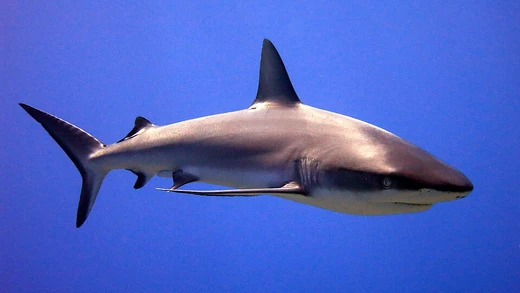
Carcharhinus tjutjot
A requiem shark once confused with the whitecheek shark.
Last updated

出羽雀台 · via Wikipedia: Carcharhinus tjutjot · CC BY-SA 4.0
People used to think this shark was the whitecheek shark, C. dussumieri, but that's changed recently.[1]
Scientific classification
- KingdomAnimalia
- PhylumChordata
- ClassChondrichthyes
- SubclassElasmobranchii
- DivisionSelachii
- OrderCarcharhiniformes
- FamilyCarcharhinidae
- GenusCarcharhinus
- SpeciesCarcharhinus tjutjot
Named by Bleeker, 1852
Close relatives
Other species of Carcharhinus with a Codexery entry.
- Blackspot shark Carcharhinus sealei
- Whitecheek shark Carcharhinus dussumieri
- Australian blackspot shark Carcharhinus coatesi
- Australian blacktip shark Carcharhinus tilstoni
- Bignose shark Carcharhinus altimus
- Blacknose shark Carcharhinus acronotus
- Blacktip reef shark Carcharhinus melanopterus
- Blacktip shark Carcharhinus limbatus
Sources: Wikipedia taxobox: Carcharhinus tjutjot (CC BY-SA 4.0) · order, family and genus agree with WoRMS AphiaID 217348 (CC BY 4.0)
Conservation status
Vulnerable (VU)
- LC
- NT
- VU▲ this species
- EN
- CR
- EW
- EX
Source: IUCN Red List assessment · GBIF copy of the Red List category
Where the carcharhinus tjutjot has been recorded
Each dot is a place where the species has been observed and reported (22 records, half-degree grid) — not a modelled range. 7 inland records left out (institution coordinates).
Map: drawn by Codexery. Data: GBIF occurrence search (records CC0 / CC BY) · Natural Earth basemap (public domain)
Description
This shark gets mixed up with the blackspot shark (C. sealei) all the time because their bodies look so alike.[2] To tell them apart, look for a dark mark on the second dorsal fin, a pretty long snout, and a first dorsal fin that stands up straight and triangular.[2] The upper front teeth lean to the side, and they have rough, blade-like little points (called cusplets) next to them.[3] When the young are born, they measure between 34 and 38 cm long.[3]
Distribution and habitat
This shark hangs out in shallow waters near the coast, right on the seafloor, from the surface down to 170 meters deep.[4]
Human interactions
The IUCN Red List says this shark—also called the Indonesian whaler shark—is Vulnerable.[4][5] Most of the sharks caught off the Malaysian Peninsula and the coast of Borneo are young ones, some even smaller than newborn size.[4] Because its nursery areas are right where people fish, this species is in real danger of dying out.[4] Long-range fishing boats often scoop up small sharks by accident, and sometimes they're sold without fins because people will eat them.[4]
Taxonomy and phylogeny
Bleeker first gave this shark its scientific name, Carcharhinus tjutjot, in 1852.[6][7] Scientists first thought it was the same as Carcharhinus dussumieri, but they identified it as a separate species in 2012.[8] That identification used physical traits like the number of vertebrae, the shape of the dorsal and pectoral fins, and the fin color.[8]
References
- Wikipedia, "Carcharhinus tjutjot" (CC BY-SA 4.0), which cites: White, W.T. (2012): A redescription of Carcharhinus dussumieri and C. sealei, with resurrection of C. coatesi and C. tjutjot as valid species (Chondrichthyes: C; White, "Lost before found: A new species of whaler shark Carcharhinus obsolerus from the Western Central Pacific known only from historic records", PLOS ONE, 2019-01-02; Arai, "Diversity, occurrence and conservation of sharks in the southern South China Sea", PLOS ONE, 2019-03-22 (we also read that source) en.wikipedia.org
- Wikipedia, "Carcharhinus tjutjot" (CC BY-SA 4.0), which cites: White, W.T. (2012): A redescription of Carcharhinus dussumieri and C. sealei, with resurrection of C. coatesi and C. tjutjot as valid species (Chondrichthyes: C; Azri, "Molecular and morphological evidence for the identity of the blackspot shark, Carcharhinus sealei, and the Indonesian whaler shark, C. tjutjot, with notes on their population structures", Environmental Biology of (we also read that source) en.wikipedia.org
- Wikipedia, "Carcharhinus tjutjot" (CC BY-SA 4.0), which cites: "Carcharhinus tjutjot", www.fishbase.de (original not read by us) en.wikipedia.org
- Wikipedia, "Carcharhinus tjutjot" (CC BY-SA 4.0), which cites: Arai, "Diversity, occurrence and conservation of sharks in the southern South China Sea", PLOS ONE, 2019-03-22 (we also read that source) en.wikipedia.org
- IUCN Red List assessment (category and year as redistributed in GBIF's IUCN Red List checklist). IUCN Red List terms: fact (category, year) cited, no text reused. iucnredlist.org
- World Register of Marine Species, Carcharhinus tjutjot (AphiaID 217348). CC BY 4.0. marinespecies.org
- GBIF Backbone Taxonomy and occurrence index, Carcharhinus tjutjot (taxon key 2418196). CC BY 4.0 (backbone); counts are facts. gbif.org
- Wikipedia, "Carcharhinus tjutjot" (CC BY-SA 4.0), which cites: White, "A redescription of Carcharhinus dussumieri and C. sealei, with resurrection of C. coatesi and C. tjutjot as valid species (Chondrichthyes: Carcharhinidae)", Zootaxa, 2012-03-21, p. 1–34 (we also read that source) en.wikipedia.org
Each numbered sentence above was checked against the source it cites before publication. Sentences citing Wikipedia adapt text from the English Wikipedia article Carcharhinus tjutjot (contributors), used under CC BY-SA 4.0; this entry is available under the same licence. Other sources were used for facts only; no text or images are copied from them.
More in Reef sharks
Elsewhere in Sharks
Sources
Compiled from Wikipedia and the sources listed below. Text from Wikipedia is available under CC BY-SA 4.0; this entry is adapted from it.
- Wikipedia: Carcharhinus tjutjot (CC BY-SA 4.0).
- Classification: the source article's taxobox; order, family and genus checked against WoRMS, the World Register of Marine Species (CC BY 4.0).
- Conservation status: IUCN Red List assessment.
- Occurrence records: GBIF (CC0 / CC BY). Basemap: Natural Earth (public domain).
- Word definitions: the Codexery glossary, each quoted from its Wikipedia article.
Spotted an error? Know more?
Reader corrections go straight into our review queue. Suggest an edit · How this site is sourced