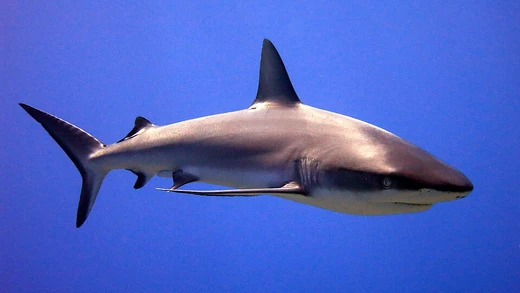
Finetooth shark
A slender, schooling requiem shark of shallow western Atlantic waters.
Last updated

SEFSC Pascagoula Laboratory; Collection of Brandi Noble, NOAA/NMFS/SEFSC · via Wikipedia: Finetooth shark · Public domain
The finetooth shark is a slender, fast-moving requiem shark that lives in shallow coastal waters of the western Atlantic.[1][2][3] It's common from North Carolina to the northern Gulf of Mexico, and it often forms large schools and hunts small fish near the surf.[4][2]
Scientific classification
- KingdomAnimalia
- PhylumChordata
- ClassChondrichthyes
- SubclassElasmobranchii
- DivisionSelachii
- OrderCarcharhiniformes
- FamilyCarcharhinidae
- GenusCarcharhinus
- SpeciesCarcharhinus isodon
Named by (J. P. Müller & Henle, 1839)
Close relatives
Other species of Carcharhinus with a Codexery entry.
- Blacknose shark Carcharhinus acronotus
- Blacktip shark Carcharhinus limbatus
- Night shark Carcharhinus signatus
- Smalltail shark Carcharhinus porosus
- Spinner shark Carcharhinus brevipinna
- Australian blackspot shark Carcharhinus coatesi
- Australian blacktip shark Carcharhinus tilstoni
- Bignose shark Carcharhinus altimus
Sources: Wikipedia taxobox: Finetooth shark (CC BY-SA 4.0) · order, family and genus agree with WoRMS AphiaID 105791 (CC BY 4.0)
Conservation status
Near Threatened (NT)
- LC
- NT▲ this species
- VU
- EN
- CR
- EW
- EX
Source: IUCN Red List assessment · GBIF copy of the Red List category
How big is it?
Largest length in the source, 1.9 m, next to a 1.8 m person.
Diagram: drawn by Codexery, schematic shapes to scale (not a likeness). Length: Wikipedia: Finetooth shark
Where the finetooth shark has been recorded
Each dot is a place where the species has been observed and reported (1,023 records, half-degree grid) — not a modelled range. 79 inland records left out (institution coordinates).
Map: drawn by Codexery. Data: GBIF occurrence search (records CC0 / CC BY) · Natural Earth basemap (public domain) · place coordinates: Wikipedia (CC BY-SA 4.0)
Description
The finetooth shark has a long, pointed snout and large, round eyes with protective third eyelids.[1] The pectoral fins are small and sickle-shaped, and the skin is covered in tiny, overlapping tooth-like scales called dermal denticles, each with three horizontal ridges.[1] This shark has a slim, sleek body, a wide mouth, and noticeable furrows at the corners of its mouth.[1] The first dorsal fin is tall and shaped like a triangle, while the second dorsal fin is fairly big and starts above the anal fin.[1]
You won't find a ridge connecting the two dorsal fins.[1] On average, males reach about 1.6 meters long and females about 1.7 meters, with the biggest one ever recorded measuring 1.9 meters.[5]
Biology and ecology
They also eat spot croaker, Spanish mackerel, mullet, shrimp, and in one case a juvenile Atlantic sharpnose shark that may have been scavenged.[6] They swallow the menhaden whole, but first they bite off the head.[6] Bigger sharks might prey on the finetooth shark.[6] Like other requiem sharks, finetooth sharks give birth to live young: the developing babies get nourishment from a yolk for the first 15 weeks, and then the empty yolk sac turns into a placental connection to the mom.[7]
To hold the female still for mating, the male bites her.[7] Sharks in the northwestern Atlantic population get larger and start reproducing later than those in the Gulf of Mexico population.[8] The oldest males are thought to live at least 9 years, and the oldest females at least 14 years.[9]
Distribution and habitat
In Central and South American waters, it's rare but might be more widespread than we know. There are reports off Trinidad and Guyana, a few sightings in the Caribbean Sea, and off southern Brazil.[4] We don't know how the other populations move around.[10]
Human interactions
There's never been a recorded case of a finetooth shark attacking a person.[11] Outside of the southeastern United States, this shark isn't very important for fishing because it's small, lives in water too shallow for most fisheries, and is usually too fast for shrimp trawlers to catch.[12] Because it reproduces slowly and lives close to shore, the finetooth shark is vulnerable to overfishing and to damage to its habitat.[12] Stock assessments in 2002 suggested that U.S. populations weren't overfished yet, but the catch rate wasn't sustainable; however, assessments in 2007 decided that catch rates were okay and the populations were stable.[13]
Taxonomy and phylogeny
In 1988, Leonard Compagno put this species in a group with the spinner shark, blacktip shark, graceful shark, and smooth tooth blacktip shark, based on their body features.[14]
References
- Wikipedia, "Finetooth shark" (CC BY-SA 4.0), which cites: Compagno, L.J.V., "Sharks of the World: An Annotated and Illustrated Catalogue of Shark Species Known to Date", Food and Agricultural Organization, 1984, p. 477–478 (we also read that source) en.wikipedia.org
- Wikipedia, "Finetooth shark" (CC BY-SA 4.0), which cites: Compagno, L.J.V., "Sharks of the World: An Annotated and Illustrated Catalogue of Shark Species Known to Date", Food and Agricultural Organization, 1984, p. 477–478; Goldstein, R.J., "Coastal fishing in the Carolinas: From Surf, Pier, and Jetty", John F. Blair, 2000, p. 129 (we also read that source) en.wikipedia.org
- Wikipedia, "Finetooth shark" (CC BY-SA 4.0), which cites: Castro, J.I., "The biology of the finetooth shark, Carcharhinus isodon", Environmental Biology of Fishes, 1993, p. 219–232; Vines, R.A., "Trees of Central Texas", University of Texas Press, 1984, p. 133 (we also read that source) en.wikipedia.org
- Wikipedia, "Finetooth shark" (CC BY-SA 4.0), which cites: Carlson, J., "Carcharhinus isodon", 2021; Castro, J.I., "The biology of the finetooth shark, Carcharhinus isodon", Environmental Biology of Fishes, 1993, p. 219–232; Compagno, L.J.V., "Sharks of the World: An Annotated and Illustrated Catalogue of Shark Species Known to Date", Food and Agricultural Organization, 1984, p. 477–478 (we also read that source) en.wikipedia.org
- Wikipedia, "Finetooth shark" (CC BY-SA 4.0), which cites: Bester, C. Biological Profiles: Finetooth Shark . Florida Museum of Natural History Ichthyology Department. Retrieved on May 5, 2009.; Grace, M.A. (2001). "Field guide to requiem sharks (Elasmobranchiomorphi: Carcharhinidae) of the Western North Atlantic." NOAA Technical Report NMFS 153. pp. 21; Bester, C. Biological Profiles: Finetooth Shark . Florida Museum of Natural History Ichthyology Department. Retrieved on May 5, 2009. (original not read by us) en.wikipedia.org
- Wikipedia, "Finetooth shark" (CC BY-SA 4.0), which cites: Castro, J.I., "The biology of the finetooth shark, Carcharhinus isodon", Environmental Biology of Fishes, 1993, p. 219–232; Bester, C. Biological Profiles: Finetooth Shark . Florida Museum of Natural History Ichthyology Department. Retrieved on May 5, 2009.; "Erection of a new onchobothriid genus (Cestoda: Tetraphyllidea) and the description of five new species from whaler sharks (Carcharhinidae)", Journal of Parasitology, 2009, p. 924–940; "Characterization of a diversity of tetraphyllidean and rhinebothriidean cestode larval typ en.wikipedia.org
- Wikipedia, "Finetooth shark" (CC BY-SA 4.0), which cites: Compagno, L.J.V., "Sharks of the World: An Annotated and Illustrated Catalogue of Shark Species Known to Date", Food and Agricultural Organization, 1984, p. 477–478; Castro, J.I., "The biology of the finetooth shark, Carcharhinus isodon", Environmental Biology of Fishes, 1993, p. 219–232; Ulrich, G.F. Finetooth Shark Carcharhinus isodon . South Carolina Department of Natural Resources. Retrieved on May 5, 2009. (we also read that source) en.wikipedia.org
- Wikipedia, "Finetooth shark" (CC BY-SA 4.0), which cites: Carlson, J.K., "Life history and population dynamics of the finetooth shark (Carcharhinus isodon) in the northeastern Gulf of Mexico", Fisheries Bulletin, 2003, p. 281–292 (original not read by us) en.wikipedia.org
- Wikipedia, "Finetooth shark" (CC BY-SA 4.0), which cites: Carlson, J., "Carcharhinus isodon", 2021; Carlson, J.K., Drymon, J.M. and Neer, J.A. (2007). "Life history parameters for finetooth sharks, Carcharhinus isodon, from the United States South Atlantic Oce; Carlson, J.K., "Life history and population dynamics of the finetooth shark (Carcharhinus isodon) in the northeastern Gulf of Mexico", Fisheries Bulletin, 2003, p. 281–292 (we also read that source) en.wikipedia.org
- Wikipedia, "Finetooth shark" (CC BY-SA 4.0), which cites: Castro, J.I., "The biology of the finetooth shark, Carcharhinus isodon", Environmental Biology of Fishes, 1993, p. 219–232 (we also read that source) en.wikipedia.org
- Wikipedia, "Finetooth shark" (CC BY-SA 4.0), which cites: Bester, C. Biological Profiles: Finetooth Shark . Florida Museum of Natural History Ichthyology Department. Retrieved on May 5, 2009.; Parsons, G.R., "Sharks, Skates, and Rays of the Gulf of Mexico: A Field Guide", University Press of Mississippi, 2006, p. 64 (original not read by us) en.wikipedia.org
- Wikipedia, "Finetooth shark" (CC BY-SA 4.0), which cites: Castro, J.I., "The biology of the finetooth shark, Carcharhinus isodon", Environmental Biology of Fishes, 1993, p. 219–232; Carlson, J., "Carcharhinus isodon", 2021 (we also read that source) en.wikipedia.org
- Wikipedia, "Finetooth shark" (CC BY-SA 4.0), which cites: Carlson, J.K., "Life history and population dynamics of the finetooth shark (Carcharhinus isodon) in the northeastern Gulf of Mexico", Fisheries Bulletin, 2003, p. 281–292; Ulrich, G.F. Finetooth Shark Carcharhinus isodon . South Carolina Department of Natural Resources. Retrieved on May 5, 2009.; Carlson, J., "Carcharhinus isodon", 2021; Carlson, J.K., "Life history and population dynamics of the finetooth shark (Carcharhinus isodon) in the northeastern Gulf of Mexico", Fisheries Bulletin, 2003, p. 281–292 (we also read tha en.wikipedia.org
- Wikipedia, "Finetooth shark" (CC BY-SA 4.0), which cites: Naylor, G.J.P., "The phylogenetic relationships among requiem and hammerhead sharks: inferring phylogeny when thousands of equally most parsimonious trees result", Cladistics, 1992, p. 295–318; Dosay-Akbulut, M., "The phylogenetic relationship within the genus Carcharhinus", Comptes Rendus Biologies, 2008, p. 500–509 (we also read that source) en.wikipedia.org
Each numbered sentence above was checked against the source it cites before publication. Sentences citing Wikipedia adapt text from the English Wikipedia article Finetooth shark (contributors), used under CC BY-SA 4.0; this entry is available under the same licence. Other sources were used for facts only; no text or images are copied from them.
More in Reef sharks
Elsewhere in Sharks
Test yourself
Three questions drawn from this entry’s sources. Pick an answer to check it.
Answers checked against the source article
Sources
Compiled from Wikipedia and the sources listed below. Text from Wikipedia is available under CC BY-SA 4.0; this entry is adapted from it.
- Wikipedia: Finetooth shark (CC BY-SA 4.0).
- Classification: the source article's taxobox; order, family and genus checked against WoRMS, the World Register of Marine Species (CC BY 4.0).
- Conservation status: IUCN Red List assessment.
- Occurrence records: GBIF (CC0 / CC BY). Basemap: Natural Earth (public domain).
- Word definitions: the Codexery glossary, each quoted from its Wikipedia article.
Spotted an error? Know more?
Reader corrections go straight into our review queue. Suggest an edit · How this site is sourced