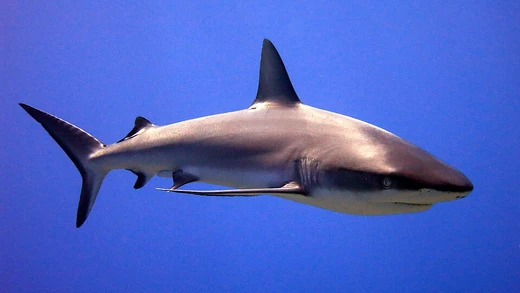
Lost shark
A possibly extinct requiem shark known from only three old specimens.
Last updated
The lost shark is a whaler shark known from only three preserved specimens, all collected over 80 years ago.[1][2] It lived in coastal waters of the western Pacific, near Borneo, Vietnam, and Thailand.[1][2] No living individual has been seen in decades, and the species may already be extinct.[3][4]
Scientific classification
- KingdomAnimalia
- PhylumChordata
- ClassChondrichthyes
- SubclassElasmobranchii
- DivisionSelachii
- OrderCarcharhiniformes
- FamilyCarcharhinidae
- GenusCarcharhinus
- SpeciesCarcharhinus obsoletus
Named by White, Kyne, & Harris, 2019
Close relatives
Other species of Carcharhinus with a Codexery entry.
- Borneo shark Carcharhinus borneensis
- Smalltail shark Carcharhinus porosus
- Australian blackspot shark Carcharhinus coatesi
- Australian blacktip shark Carcharhinus tilstoni
- Bignose shark Carcharhinus altimus
- Blacknose shark Carcharhinus acronotus
- Blackspot shark Carcharhinus sealei
- Blacktip reef shark Carcharhinus melanopterus
Sources: Wikipedia taxobox: Lost shark (CC BY-SA 4.0) · order, family and genus agree with WoRMS AphiaID 1523902 (CC BY 4.0)
Conservation status
Critically Endangered (CR)
- LC
- NT
- VU
- EN
- CR▲ this species
- EW
- EX
Source: IUCN Red List assessment · GBIF copy of the Red List category
Where the lost shark has been recorded
Map: drawn by Codexery. Data: Natural Earth basemap (public domain) · place coordinates: Wikipedia (CC BY-SA 4.0)
Quick Facts
- Scientific name
- Carcharhinus obsoletus
- Family
- Carcharhinidae
- Known specimens
- 3
- Known locations
- Borneo, Vietnam, Thailand
- Region
- Western Central Pacific Ocean, southern South China Sea
- Conservation status
- Critically Endangered or Possibly Extinct (IUCN Red List, 2020)
Facts from the source article.
Description
The three known specimens were originally thought to be smalltail sharks, but subtle differences in their body shape showed they belonged to a separate species.[1] One of the three specimens was an embryo.[2] The lost shark differs from other whaler sharks in where its second dorsal fin sits compared to its anal fin, and it has fewer vertebrae than its relatives.[1]
Biology and ecology
Like other members of its subgroup, the lost shark likely had limited fecundity, meaning it probably gave birth to few young at a time.[3] It probably lived in shallow waters that are easily reached by fishermen.[3]
Human interactions
The lost shark belongs to a group of whaler sharks that are economically important for fisheries around the world.[2] Its shallow-water habitat and low reproduction rate put it at heavy risk of extinction from overfishing.[3] Surveys of fish markets over the past few decades have never turned up a lost shark.[2] There is still a small hope it may survive, because a related species, the Borneo shark, was rediscovered in 2004 after a long period with no sightings.[3]
Taxonomy and phylogeny
The lost shark was formally described as a new species in 2019 by scientists William T. White, Peter M. Kyne, and Mark Harris.[5][6]
References
- Wikipedia, "Lost shark" (CC BY-SA 4.0), which cites: Harris, "Lost before found: A new species of whaler shark Carcharhinus obsolerus from the Western Central Pacific known only from historic records", PLOS ONE, 2019-01-02; Gabbatiss, "New 'lost' shark species may already be extinct due to overfishing", The Independent, 4 January 2019 (we also read that source) en.wikipedia.org
- Gabbatiss, "New 'lost' shark species may already be extinct due to overfishing", The Independent, 4 January 2019. facts only, no text reused. independent.co.uk
- Wikipedia, "Lost shark" (CC BY-SA 4.0), which cites: Harris, "Lost before found: A new species of whaler shark Carcharhinus obsolerus from the Western Central Pacific known only from historic records", PLOS ONE, 2019-01-02; "European bison recovering, 31 species declared Extinct – IUCN Red List", IUCN, 2020-12-10 (we also read that source) en.wikipedia.org
- "European bison recovering, 31 species declared Extinct – IUCN Red List", IUCN, 2020-12-10. facts only, no text reused. iucn.org
- William T. White, "Lost before found: A new species of whaler shark Carcharhinus obsolerus from the Western Central Pacific known only from historic records", PLoS ONE (2019), doi:10.1371/journal.pone.0209387. OpenAlex metadata CC0; paper not read. doi.org
- World Register of Marine Species, Carcharhinus obsoletus (AphiaID 1523902). CC BY 4.0. marinespecies.org
Each numbered sentence above was checked against the source it cites before publication. Sentences citing Wikipedia adapt text from the English Wikipedia article Lost shark (contributors), used under CC BY-SA 4.0; this entry is available under the same licence. Other sources were used for facts only; no text or images are copied from them.
More in Reef sharks
Elsewhere in Sharks
Test yourself
Three questions drawn from this entry’s sources. Pick an answer to check it.
Answers checked against the source article
Sources
Compiled from Wikipedia and the sources listed below. Text from Wikipedia is available under CC BY-SA 4.0; this entry is adapted from it.
- Wikipedia: Lost shark (CC BY-SA 4.0).
- Classification: the source article's taxobox; order, family and genus checked against WoRMS, the World Register of Marine Species (CC BY 4.0).
- Conservation status: IUCN Red List assessment.
- Occurrence records: GBIF (CC0 / CC BY). Basemap: Natural Earth (public domain).
- Word definitions: the Codexery glossary, each quoted from its Wikipedia article.
Spotted an error? Know more?
Reader corrections go straight into our review queue. Suggest an edit · How this site is sourced