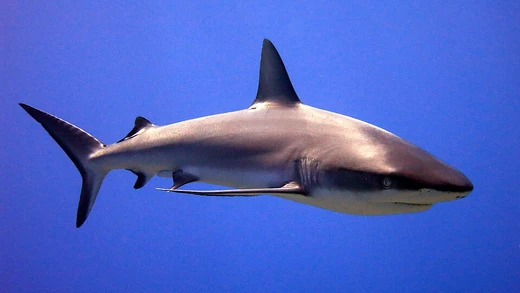
Galapagos shark
A large, abundant reef shark of tropical oceanic islands.
Last updated

Dr. Dwayne Meadows, NOAA/NMFS/OPR · via Wikipedia: Galapagos shark · Public domain
It is often the most abundant shark in shallow island waters.[1] This big requiem shark mostly hangs out around tropical oceanic islands all over the world.[2]
Scientific classification
- KingdomAnimalia
- PhylumChordata
- ClassChondrichthyes
- SubclassElasmobranchii
- DivisionSelachii
- OrderCarcharhiniformes
- FamilyCarcharhinidae
- GenusCarcharhinus
- SpeciesCarcharhinus galapagensis
Named by (Snodgrass & Heller, 1905)
Close relatives
Other species of Carcharhinus with a Codexery entry.
- Bignose shark Carcharhinus altimus
- Blacktip shark Carcharhinus limbatus
- Caribbean reef shark Carcharhinus perezi
- Dusky shark Carcharhinus obscurus
- Grey reef shark Carcharhinus amblyrhynchos
- Sandbar shark Carcharhinus plumbeus
- Silky shark Carcharhinus falciformis
- Silvertip shark Carcharhinus albimarginatus
Sources: Wikipedia taxobox: Galapagos shark (CC BY-SA 4.0) · order, family and genus agree with WoRMS AphiaID 105790 (CC BY 4.0)
Conservation status
Least Concern (LC)
- LC▲ this species
- NT
- VU
- EN
- CR
- EW
- EX
Source: IUCN Red List assessment · GBIF copy of the Red List category
Where the galapagos shark has been recorded
Each dot is a place where the species has been observed and reported (2,782 records, half-degree grid) — not a modelled range. 3 inland records left out (institution coordinates).
Map: drawn by Codexery. Data: GBIF occurrence search (records CC0 / CC BY) · Natural Earth basemap (public domain) · place coordinates: Wikipedia (CC BY-SA 4.0)
Description
Galapagos sharks are among the biggest in their genus, and they usually grow to about 3.0 meters long.[3] Like other requiem sharks, this species has a sleek, streamlined body.[3] Its snout is broad and rounded, and the nasal flaps up front are pretty faint.[2] A low ridge runs along the middle of the back from the first dorsal fin to the second one.[2]
The fin edges are a bit darker, but nothing too flashy.[2] You can tell Galapagos sharks from similar species like dusky sharks and grey reef sharks by counting their backbone bones before the tail: Galapagos sharks have 58, dusky sharks have 86–97, and grey reef sharks have 110–119.[4] But honestly, spotting those differences in the wild can be tricky.[4]
Biology and ecology
Galapagos sharks mostly munch on bottom-dwelling bony fish like eels, sea bass, flatfish, flatheads, and triggerfish, plus octopuses.[5] As these sharks get bigger, they start eating more rays, smaller sharks (including their own kind), and crustaceans, along with weird stuff like leaves, coral, rocks, and trash.[5] Around the Galapagos Islands, folks have seen them going after Galapagos fur seals, sea lions, and marine iguanas.[5] If they feel cornered or threatened, these sharks might put on a show: they swim in an exaggerated, rolling motion, arch their back, drop their pectoral fins, puff out their gills, and open their mouth wide.[2]
Like other requiem sharks, Galapagos sharks give birth to live young, and the developing babies get nutrients through a placental connection that forms from the used-up yolk sac.[6] Mating happens from January to March, and that's when you'll see bite scars on the females from the males' courtship nips.[6] Newborns are usually 61 to 80 centimeters long, but folks have spotted free-swimming youngsters as small as 57 centimeters in the eastern Pacific, so birth size probably varies by location.[6]
Distribution and habitat
In the Pacific Ocean, they show up around Lord Howe Island, the Marianas Islands, the Marshall Islands, the Kermadec Islands, Tupai, the Tuamotu Archipelago, the Juan Fernández Islands, the Hawaiian Islands, the Galapagos Islands, Cocos Island, the Revillagigedo Islands, Clipperton Island, and Malpelo.[2]
Human interactions
Inquisitive and persistent, excited Galapagos sharks are not easily deterred.[7][8] Galapagos sharks will swim right up to swimmers, checking out their fins or hands, and fishing activities can attract them in big numbers.[7] If you try to physically push one away, it'll just circle back and get others to follow, and using weapons on them could set off a feeding frenzy.[8] As of 2008, scientists have confirmed that Galapagos sharks attacked two people: one fatal attack at Magens Bay on the north shore of St. Thomas in the Virgin Islands, and a non-fatal attack off Bermuda.[9]
In February 2018, there was a non-fatal shark attack in the Galapagos islands that shark photographer Jeremy Stafford-Deitsch thought might have been a Galapagos shark, but nobody's sure what species it was.[9] Nobody has specific data on how many are caught, but commercial fisheries definitely scoop them up across much of their range.[10] People say the meat tastes excellent.[10] They're still common in places like Hawaii, but Galapagos sharks may have disappeared from some spots around Central America, and their scattered distribution means other local populations could be in trouble too.[10]
Taxonomy and phylogeny
Later scientists moved this shark into the genus Carcharhinus.[11][12] Robert Evans Snodgrass and Edmund Heller first described the Galapagos shark back in 1905, calling it Carcharias galapagensis.[11] That group included the bignose shark, Caribbean reef shark, sandbar shark, dusky shark, and oceanic whitetip shark—all big sharks with triangular teeth and a ridge between their two dorsal fins.[13]
References
- Wikipedia, "Galapagos shark" (CC BY-SA 4.0), which cites: Compagno, L.J.V., "Sharks of the World: An Annotated and Illustrated Catalogue of Shark Species Known to Date", Food and Agricultural Organization, 1984, p. 473–475; "Papers from the Hopkins-Stanford Galapagos Expedition, 1898–1899. XVII. Shore fishes of the Revillagigedo, Clipperton, Cocos and Galapagos Islands.", Proceedings of the Washington Academy is of Science, January 31; "The Shark Population of Saint Paul's Rocks", Copeia, February 23, 1982, p. 223–225; Compagno, L.J.V., "Sharks of the World: An Annotated and en.wikipedia.org
- Wikipedia, "Galapagos shark" (CC BY-SA 4.0), which cites: Compagno, L.J.V., "Sharks of the World: An Annotated and Illustrated Catalogue of Shark Species Known to Date", Food and Agricultural Organization, 1984, p. 473–475 (we also read that source) en.wikipedia.org
- Wikipedia, "Galapagos shark" (CC BY-SA 4.0), which cites: "Galapagos shark", FishBase; Castro, J.I., "The Sharks of North America", Oxford University Press, 2011, p. 417–420 (we also read that source) en.wikipedia.org
- Wikipedia, "Galapagos shark" (CC BY-SA 4.0), which cites: Bester, C. Biological Profiles: Galapagos Shark . Florida Museum of Natural History Ichthyology Department. Retrieved on April 26, 2009.; Compagno, L.J.V., "Sharks of the World: An Annotated and Illustrated Catalogue of Shark Species Known to Date", Food and Agricultural Organization, 1984, p. 473–475 (we also read that source) en.wikipedia.org
- Wikipedia, "Galapagos shark" (CC BY-SA 4.0), which cites: Compagno, L.J.V., "Sharks of the World: An Annotated and Illustrated Catalogue of Shark Species Known to Date", Food and Agricultural Organization, 1984, p. 473–475; Wetherbee, B.M., "Biology of the Galapagos shark, Carcharhinus galapagensis, in Hawaiʻi", Environmental Biology of Fishes, 1996, p. 299–310; Bester, C. Biological Profiles: Galapagos Shark . Florida Museum of Natural History Ichthyology Department. Retrieved on April 26, 2009. (we also read that source) en.wikipedia.org
- Wikipedia, "Galapagos shark" (CC BY-SA 4.0), which cites: Wetherbee, B.M., "Biology of the Galapagos shark, Carcharhinus galapagensis, in Hawaiʻi", Environmental Biology of Fishes, 1996, p. 299–310; Bester, C. Biological Profiles: Galapagos Shark . Florida Museum of Natural History Ichthyology Department. Retrieved on April 26, 2009. (we also read that source) en.wikipedia.org
- Wikipedia, "Galapagos shark" (CC BY-SA 4.0), which cites: "The Shark Population of Saint Paul's Rocks", Copeia, February 23, 1982, p. 223–225 (we also read that source) en.wikipedia.org
- Wikipedia, "Galapagos shark" (CC BY-SA 4.0), which cites: Limbaugh, C., "Sharks and Survival", D. C. Heath Canada, Ltd., 1963, p. 63–94; Compagno, L.J.V., "Sharks of the World: An Annotated and Illustrated Catalogue of Shark Species Known to Date", Food and Agricultural Organization, 1984, p. 473–475 (we also read that source) en.wikipedia.org
- Wikipedia, "Galapagos shark" (CC BY-SA 4.0), which cites: Randall, "A fatal attack by the shark Carcharhinus galapagensis at St. Thomas, Virgin Islands", Caribbean Journal of Science, 1963; Compagno, L.J.V., "Sharks of the World: An Annotated and Illustrated Catalogue of Shark Species Known to Date", Food and Agricultural Organization, 1984, p. 473–475; "ISAF Statistics on Attacking Species of Shark", International Shark Attack File, 24 January 2018; Daniel O'Mahony, "London businessman attacked by shark while snorkelling in the Galapagos Islands", 6 February 2018 (we also read that sour en.wikipedia.org
- Wikipedia, "Galapagos shark" (CC BY-SA 4.0), which cites: Kyne, P.M., "Carcharhinus galapagensis", 2019; Bester, C. Biological Profiles: Galapagos Shark . Florida Museum of Natural History Ichthyology Department. Retrieved on April 26, 2009. (we also read that source) en.wikipedia.org
- Wikipedia, "Galapagos shark" (CC BY-SA 4.0), which cites: "Papers from the Hopkins-Stanford Galapagos Expedition, 1898–1899. XVII. Shore fishes of the Revillagigedo, Clipperton, Cocos and Galapagos Islands.", Proceedings of the Washington Academy is of Science, January 31; Bester, C. Biological Profiles: Galapagos Shark . Florida Museum of Natural History Ichthyology Department. Retrieved on April 26, 2009. (original not read by us) en.wikipedia.org
- World Register of Marine Species, Carcharhinus galapagensis (AphiaID 105790). CC BY 4.0. marinespecies.org
- Wikipedia, "Galapagos shark" (CC BY-SA 4.0), which cites: Garrick, J.A.F. (1982). "Sharks of the genus Carcharhinus". NOAA Technical Report, NMFS CIRC-445. (original not read by us) en.wikipedia.org
Each numbered sentence above was checked against the source it cites before publication. Sentences citing Wikipedia adapt text from the English Wikipedia article Galapagos shark (contributors), used under CC BY-SA 4.0; this entry is available under the same licence. Other sources were used for facts only; no text or images are copied from them.
More in Reef sharks
Elsewhere in Sharks
Test yourself
Three questions drawn from this entry’s sources. Pick an answer to check it.
Answers checked against the source article
Sources
Compiled from Wikipedia and the sources listed below. Text from Wikipedia is available under CC BY-SA 4.0; this entry is adapted from it.
- Wikipedia: Galapagos shark (CC BY-SA 4.0).
- Classification: the source article's taxobox; order, family and genus checked against WoRMS, the World Register of Marine Species (CC BY 4.0).
- Conservation status: IUCN Red List assessment.
- Occurrence records: GBIF (CC0 / CC BY). Basemap: Natural Earth (public domain).
- Word definitions: the Codexery glossary, each quoted from its Wikipedia article.
Spotted an error? Know more?
Reader corrections go straight into our review queue. Suggest an edit · How this site is sourced