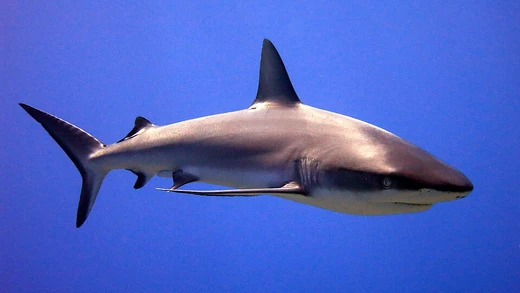
Borneo broadfin shark
Endangered ground shark of turbid estuarine waters.
Last updated

Henry Weed Fowler · via Wikipedia: Borneo broadfin shark · Public domain
Intensive fishing across its range has likely caused a significant population reduction, so it's now listed as Endangered.[1]
Scientific classification
- KingdomAnimalia
- PhylumChordata
- ClassChondrichthyes
- SubclassElasmobranchii
- DivisionSelachii
- OrderCarcharhiniformes
- FamilyCarcharhinidae
- GenusLamiopsis
- SpeciesLamiopsis tephrodes
Named by Fowler, 1905
Close relatives
Other species of Lamiopsis with a Codexery entry.
- Broadfin shark Lamiopsis temminckii
Sources: Wikipedia taxobox: Borneo broadfin shark (CC BY-SA 4.0) · order, family and genus agree with WoRMS AphiaID 712379 (CC BY 4.0)
Conservation status
Endangered (EN)
- LC
- NT
- VU
- EN▲ this species
- CR
- EW
- EX
Source: IUCN Red List assessment · GBIF copy of the Red List category
How big is it?
Largest length in the source, 1.57 m, next to a 1.8 m person.
Diagram: drawn by Codexery, schematic shapes to scale (not a likeness). Length: Wikipedia: Borneo broadfin shark
Description
The species is placental viviparous, meaning the young develop inside the mother and are born alive.[2] Litters typically contain four to eight pups, with eight being the usual number.[2] Pups are born at a length of 40 to 60 centimetres.[3] This shark can grow up to 157 centimeters long from nose to tail.[2]
Males are ready to breed when they hit about 114 centimeters long, while females mature at around 130 centimeters.[2] A pregnancy lasts about eight months.[3]
Biology and ecology
This shark is a marine species that sticks to estuaries and other shallow spots near the coast.[4] It likes muddy, cloudy waters on the continental shelf, usually in areas less than 50 meters deep.[4] Experts think each generation is about 6.5 years long, based on what we know about the similar daggernose shark.[3]
Distribution and habitat
This shark lives in Thailand, Indonesia, and Malaysia, and probably ranges through the Indo-Malay Archipelago up to southern China.[5]
Human interactions
Fishermen catch this shark using all sorts of gear, like bottom trawls and inshore gillnets.[6] Fishing pressure hits this species hard everywhere it lives.[7] Right now, there are no conservation rules that specifically protect this species.[1]
Taxonomy and phylogeny
Fowler first described the Borneo broadfin shark in 1905, calling it Carcharhinus tephrodes.[8] Scientists have recently sorted out the Lamiopsis group, bringing this species back and giving it a fresh description from Southeast Asia.[9]
References
- Wikipedia, "Borneo broadfin shark" (CC BY-SA 4.0), which cites: Dulvy, N.K., "Lamiopsis tephrodes", 2021 (we also read that source) en.wikipedia.org
- Wikipedia, "Borneo broadfin shark" (CC BY-SA 4.0), which cites: Dulvy, N.K., "Lamiopsis tephrodes", 2021; "Sharks and Rays of Borneo", CSIRO Marine and Atmospheric Research, 2010; "Sharks of the World", Wild Nature Press, 2013 (we also read that source) en.wikipedia.org
- Wikipedia, "Borneo broadfin shark" (CC BY-SA 4.0), which cites: "Sharks and Rays of Borneo", CSIRO Marine and Atmospheric Research, 2010; Lessa, "Age and growth of the daggernose shark, Isogomphodon oxyrhynchus, from northern Brazil", Marine and Freshwater Research, 2000-05-01, p. 339–347; Dulvy, N.K., "Lamiopsis tephrodes", 2021 (we also read that source) en.wikipedia.org
- Wikipedia, "Borneo broadfin shark" (CC BY-SA 4.0), which cites: Dulvy, N.K., "Lamiopsis tephrodes", 2021; Weigmann, "Annotated checklist of the living sharks, batoids and chimaeras (Chondrichthyes) of the world, with a focus on biogeographical diversity", Journal of Fish Biology, 2016, p. 837–1037 (we also read that source) en.wikipedia.org
- Wikipedia, "Borneo broadfin shark" (CC BY-SA 4.0), which cites: Dulvy, N.K., "Lamiopsis tephrodes", 2021; Dulvy, N.K., "Lamiopsis tephrodes", 2021; Weigmann, "Annotated checklist of the living sharks, batoids and chimaeras (Chondrichthyes) of the world, with a focus on biogeographical diversity", Journal of Fish Biology, 2016, p. 837–1037 (we also read that source) en.wikipedia.org
- Wikipedia, "Borneo broadfin shark" (CC BY-SA 4.0), which cites: "Sharks and Rays of Borneo", CSIRO Marine and Atmospheric Research, 2010; Dulvy, N.K., "Lamiopsis tephrodes", 2021; Stobutzki, "Decline of demersal coastal fisheries resources in three developing Asian countries", Fisheries Research, 2006, p. 130–142; White, "Sharks and Their Relatives II. Biodiversity, Adaptive Physiology, and Conservation", CRC Press, 2010, p. 159–239 (we also read that source) en.wikipedia.org
- Wikipedia, "Borneo broadfin shark" (CC BY-SA 4.0), which cites: Heileman, "The UNEP Large Marine Ecosystem Report: A perspective on changing conditions in LMEs of the world's Regional Seas", United Nations Environment Programme, 2009; "IUCN situation analysis on East and Southeast Asian intertidal habitats, with particular reference to the Yellow Sea (including the Bohai Sea)", IUCN, 2012; Stobutzki, "Decline of demersal coastal fisheries resources in three developing Asian countries", Fisheries Research, 2006, p. 130–142 (original not read by us) en.wikipedia.org
- Wikipedia, "Borneo broadfin shark" (CC BY-SA 4.0), which cites: "Eschmeyer's Catalog of Fishes: genera, species, references", 3 February 2020 (original not read by us) en.wikipedia.org
- Wikipedia, "Borneo broadfin shark" (CC BY-SA 4.0), which cites: White, "Descriptions of new sharks and rays from Borneo", Commonwealth Scientific and Industrial Research Organisation, 2010, p. 49–60; Akhilesh, "Redescription of the rare and endangered Broadfin Shark Lamiopsis temminckii (Müller & Henle, 1839) (Carcharhiniformes:Carcharhinidae) from the northeastern Arabian Sea", Zootaxa, October 12, 2016, p. 155–166; Dulvy, N.K., "Lamiopsis tephrodes", 2021 (we also read that source) en.wikipedia.org
Each numbered sentence above was checked against the source it cites before publication. Sentences citing Wikipedia adapt text from the English Wikipedia article Borneo broadfin shark (contributors), used under CC BY-SA 4.0; this entry is available under the same licence. Other sources were used for facts only; no text or images are copied from them.
More in Reef sharks
Elsewhere in Sharks
Test yourself
Three questions drawn from this entry’s sources. Pick an answer to check it.
Answers checked against the source article
Sources
Compiled from Wikipedia and the sources listed below. Text from Wikipedia is available under CC BY-SA 4.0; this entry is adapted from it.
- Wikipedia: Borneo broadfin shark (CC BY-SA 4.0).
- Classification: the source article's taxobox; order, family and genus checked against WoRMS, the World Register of Marine Species (CC BY 4.0).
- Conservation status: IUCN Red List assessment.
- Word definitions: the Codexery glossary, each quoted from its Wikipedia article.
Spotted an error? Know more?
Reader corrections go straight into our review queue. Suggest an edit · How this site is sourced