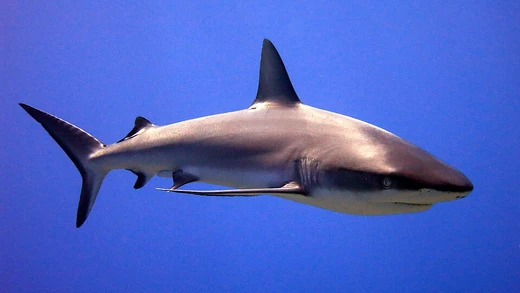
Blue shark
A widespread, migratory shark of temperate and tropical oceans.
Last updated

Diego Delso · via Wikipedia: Blue shark · CC BY-SA 4.0
Blue sharks are requiem sharks that live in deep waters across the world’s temperate and tropical oceans.[1] Fisheries haul in huge numbers of these open-ocean sharks as accidental catches on longlines and in nets.[2]
Scientific classification
- KingdomAnimalia
- PhylumChordata
- ClassChondrichthyes
- SubclassElasmobranchii
- DivisionSelachii
- OrderCarcharhiniformes
- FamilyCarcharhinidae
- GenusPrionace
- SpeciesPrionace glauca
Named by (Linnaeus, 1758)
Sources: Wikipedia taxobox: Blue shark (CC BY-SA 4.0) · order, family and genus agree with WoRMS AphiaID 105801 (CC BY 4.0)
Conservation status
Near Threatened (NT)
- LC
- NT▲ this species
- VU
- EN
- CR
- EW
- EX
Source: IUCN Red List assessment · GBIF copy of the Red List category
How big is it?
Largest length in the source, 3.1 m, next to a 1.8 m person.
Diagram: drawn by Codexery, schematic shapes to scale (not a likeness). Length: Wikipedia: Blue shark
Where the blue shark has been recorded
Each dot is a place where the species has been observed and reported (226,064 records, half-degree grid) — not a modelled range. 42 inland records left out (institution coordinates).
Map: drawn by Codexery. Data: GBIF occurrence search (records CC0 / CC BY) · Natural Earth basemap (public domain)
Description
The blue shark is ectothermic, meaning its body temperature is regulated by the surrounding water.[3] This shark has a slender build and notably long pectoral fins.[4] Their coloring is a classic countershading pattern: a deep blue back, lighter flanks, and a white belly.[4] Mature males usually measure between 1.82 and 2.82 meters long. Females are typically bigger, ranging from 2.2 to 3.3 meters.[4]
Really big individuals can reach lengths of 3.8 meters.[4] Males typically weigh from 27 to 55 kg, and large females from 93 to 182 kg.[4]
Biology and ecology
Squid are the most important prey, but their diet also includes cuttlefish, octopuses, lobster, shrimp, crab, many bony fishes, small sharks, mammalian carrion, and occasional sea birds.[5] They give birth to 4 to 135 pups per litter after a gestation period of 9 to 12 months.[6] People have watched them team up like a pack to round up prey into a tight bunch.[5] Even though they're usually sluggish, they can swim fast when they need to.[2]
After birth, the pups are left to fend for themselves in special nursery areas that are separate from where the adults hang out.[6] Nobody knows for sure how long they can live, but experts think they might make it to 20 years.[2] Killer whales and bigger sharks, like tiger sharks and great whites, are known to prey on them.[2]
Distribution and habitat
In temperate seas, they might come close to shore where divers can see them, but in tropical waters they stick to deeper areas.[7]
Human interactions
Blue shark meat is edible but not widely sought after. People eat it fresh, dried, smoked, or salted, or turn it into fishmeal.[8] The IUCN lists blue sharks as Near Threatened.[9][10] It's very rare for a blue shark to bite a person.[11] About 85 to 90 percent of all sharks and rays accidentally caught by open-ocean fisheries are blue sharks.[9]
Taxonomy and phylogeny
The blue shark is classified as Prionace glauca, with the authority Linnaeus, 1758.[12][13]
References
- Wikipedia, "Blue shark" (CC BY-SA 4.0), which cites: Silva, "Current knowledge on biology, fishing and conservation of the blue shark (Prionace glauca)", Neotropical Biology and Conservation, 2021-01-21, p. 71–88; Mount, J.D., "Late Pliocene vertebrates from the Newport Bay area, Orange County, California.", Bulletin of the Southern California Paleontological Society, 1969, p. 2-3; Compagno, Leonard J.V., "Sharks of the World: An annotated and illustrated catalogue of shark species known to date", Food and Agriculture Organization of the United Nations, 1984, p. 521–524, 555–561, 590 (we also en.wikipedia.org
- Wikipedia, "Blue shark" (CC BY-SA 4.0), which cites: Fertl, "A report of killer whales (Orcinus orca) feeding on a carcharhinid shark in Costa Rica", Marine Mammal Science, 1996, p. 606–611; Sharks – Greenland (Somniosus microcephalus), Shortfin Mako (Isurus oxyrinchus), Blue Shark (Prionace glauca), Basking Shark (Cetorhinus maximus), and Porbeagle; Nakano, H., & Stevens, J.D. (2008). The biology and ecology of the blue shark, Prionace glauca. Sharks of the open ocean: Biology, fisheries and conservation, 1 (we also read that source) en.wikipedia.org
- Wikipedia, "Blue shark" (CC BY-SA 4.0), which cites: . elasmollet.org (March 2008); Flindt, "Amazing Numbers in Biology", Springer Science & Business Media, 21 December 2006, p. 12; Berger, "Ocean: Reflections on a Century of Exploration", University of California Press, 6 May 2009, p. 264 (original not read by us) en.wikipedia.org
- Wikipedia, "Blue shark" (CC BY-SA 4.0), which cites: FLMNH Ichthyology Department: Blue Shark . Flmnh.ufl.edu. Retrieved on 2012-12-19.; Blue Shark (Prionace glauca) – Ireland's Wildlife . Irelandswildlife.com (2011-07-21). Retrieved on 2012-12-19.; Sharks – Greenland (Somniosus microcephalus), Shortfin Mako (Isurus oxyrinchus), Blue Shark (Prionace glauca), Basking Shark (Cetorhinus maximus), and Porbeagle; Sea Angling in Ireland – Blue Shark. Sea-angling-ireland.org (2006-10-21). Retrieved on 2012-12-19. (we also read that source) en.wikipedia.org
- Wikipedia, "Blue shark" (CC BY-SA 4.0), which cites: "Prionace glauca (Blue Shark)", Animal Diversity Web; Compagno, Leonard J.V., "Sharks of the World: An annotated and illustrated catalogue of shark species known to date", Food and Agriculture Organization of the United Nations, 1984, p. 521–524, 555–561, 590 (we also read that source) en.wikipedia.org
- Wikipedia, "Blue shark" (CC BY-SA 4.0), which cites: Compagno, Leonard J.V., "Sharks of the World: An annotated and illustrated catalogue of shark species known to date", Food and Agriculture Organization of the United Nations, 1984, p. 521–524, 555–561, 590 (we also read that source) en.wikipedia.org
- Wikipedia, "Blue shark" (CC BY-SA 4.0) en.wikipedia.org
- Wikipedia, "Blue shark" (CC BY-SA 4.0), which cites: Lopez, S., "Heavy Metal Concentrations of two highly migratory sharks (Prionace glauca and Isurus oxyrinchus) in the south-eastern Pacific waters: comments on public health and conservation", Tropical Conservation Scienc; Compagno, Leonard J.V., "Sharks of the World: An annotated and illustrated catalogue of shark species known to date", Food and Agriculture Organization of the United Nations, 1984, p. 521–524, 555–561, 590 (we also read that source) en.wikipedia.org
- Wikipedia, "Blue shark" (CC BY-SA 4.0), which cites: da Silva, "Current knowledge on biology, fishing and conservation of the blue shark (Prionace glauca)", Neotropical Biology and Conservation, 2021-01-21, p. 71–88; Duffy, "Conservation status of New Zealand chondrichthyans (chimaeras, sharks and rays), 2016", Department of Conservation, 2018, p. 11; Rigby, C.L., "Prionace glauca", 2019 (we also read that source) en.wikipedia.org
- IUCN Red List assessment (category and year as redistributed in GBIF's IUCN Red List checklist). IUCN Red List terms: fact (category, year) cited, no text reused. iucnredlist.org
- Wikipedia, "Blue shark" (CC BY-SA 4.0), which cites: Species Implicated in Attacks :: Florida Museum of Natural History. Flmnh.ufl.edu. Retrieved on 2016-11-17. (original not read by us) en.wikipedia.org
- World Register of Marine Species, Prionace glauca (AphiaID 105801). CC BY 4.0. marinespecies.org
- GBIF Backbone Taxonomy and occurrence index, Prionace glauca (taxon key 2417940). CC BY 4.0 (backbone); counts are facts. gbif.org
Each numbered sentence above was checked against the source it cites before publication. Sentences citing Wikipedia adapt text from the English Wikipedia article Blue shark (contributors), used under CC BY-SA 4.0; this entry is available under the same licence. Other sources were used for facts only; no text or images are copied from them.
More in Reef sharks
Elsewhere in Sharks
Test yourself
Three questions drawn from this entry’s sources. Pick an answer to check it.
Answers checked against the source article
Sources
Compiled from Wikipedia and the sources listed below. Text from Wikipedia is available under CC BY-SA 4.0; this entry is adapted from it.
- Wikipedia: Blue shark (CC BY-SA 4.0).
- Classification: the source article's taxobox; order, family and genus checked against WoRMS, the World Register of Marine Species (CC BY 4.0).
- Conservation status: IUCN Red List assessment.
- Occurrence records: GBIF (CC0 / CC BY). Basemap: Natural Earth (public domain).
- Word definitions: the Codexery glossary, each quoted from its Wikipedia article.
Spotted an error? Know more?
Reader corrections go straight into our review queue. Suggest an edit · How this site is sourced