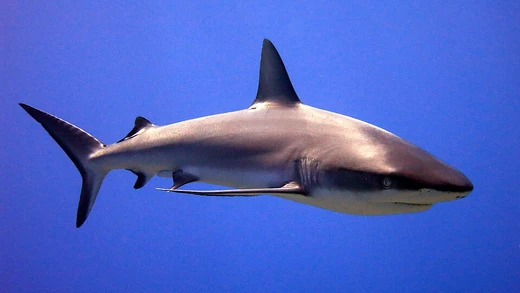
Ganges shark
A rare, poorly known river shark with a disputed range.
Last updated

(Müller and Henle) · via Wikipedia: Ganges shark · Public domain
The Ganges shark is a rare river shark that makes its home in the rivers of eastern and northeastern India.[1][2] People often confuse it with the more common bull shark, which shares the same waters.[3]
Scientific classification
- KingdomAnimalia
- PhylumChordata
- ClassChondrichthyes
- SubclassElasmobranchii
- DivisionSelachii
- OrderCarcharhiniformes
- FamilyCarcharhinidae
- GenusGlyphis
- SpeciesGlyphis gangeticus
Named by (J. P. Müller & Henle, 1839)
Close relatives
Other species of Glyphis with a Codexery entry.
- Northern river shark Glyphis garricki
- Speartooth shark Glyphis glyphis
Sources: Wikipedia taxobox: Ganges shark (CC BY-SA 4.0) · order, family and genus agree with WoRMS AphiaID 277183 (CC BY 4.0)
Conservation status
Critically Endangered (CR)
- LC
- NT
- VU
- EN
- CR▲ this species
- EW
- EX
Source: IUCN Red List assessment · GBIF copy of the Red List category
How big is it?
Largest length in the source, 2.04 m, next to a 1.8 m person.
Diagram: drawn by Codexery, schematic shapes to scale (not a likeness). Length: Wikipedia: Ganges shark
Where the ganges shark has been recorded
Map: drawn by Codexery. Data: Natural Earth basemap (public domain) · place coordinates: Wikipedia (CC BY-SA 4.0)
Description
Its eyes are minute, which may be an adaptation for living in turbid water with poor visibility.[3] The upper jaw has 32 to 37 tooth rows, and the lower jaw has 31 to 34.[4] This shark is stocky, with two dorsal fins without spines and an anal fin—pretty typical for a requiem shark.[3] The second dorsal fin is only about half as tall as the first, and that's a good way to tell this shark from others.[3][5]
You'll find a long pit running along the upper part of the tail base, but there's no ridge between the two dorsal fins.[3] Newborn pups are 56 to 61 cm long. They reach about 178 cm when mature, and the biggest ones can get to roughly 204 cm.[6]
Biology and ecology
The Ganges shark is probably viviparous—that means the young grow inside the mother with a yolk-sac placenta.[3] Nobody really knows what they eat.[2]
Distribution and habitat
In theory, it could turn up in shallow marine estuaries, but nobody has ever confirmed a sighting in the sea.[7]
Human interactions
One attack from 1868 might have been by this species.[8] We know very little about how real river sharks behave, and the Ganges shark is critically endangered, so it almost never meets people.[8] Compared to the bull shark, the Ganges shark has much narrower, taller upper teeth and slender lower teeth—great for spearing fish, not so good for tearing tough mammal prey.[5] The main dangers include overfishing, pollution that messes up their habitat, more river traffic, and building dams and barrages.[9]
People doubt this measure works well because enforcing it is tough.[10] Compagno suggests a thorough survey of fishing camps and landing sites to find out how this shark is doing now.[11] Expeditions in 2010 and 2011 failed to find any.[12]
Taxonomy and phylogeny
Müller and Henle gave this shark the scientific name Glyphis gangeticus in 1839.[13] The genus name Glyphis comes from the Greek word for "carving."[14] Scientists used to think the Borneo river shark and the Irrawaddy river shark were separate species, but recent genetic studies suggest they may actually be the same species as the Ganges shark.[12] Glyphis species have a very slow rate of genetic change, which makes them even more vulnerable to extinction.[15]
Scientists have only ever found the Borneo river shark in the Kinabatangan River in Borneo, and they know of just 13 specimens, all collected in 1996.[12] Scientists know the Irrawaddy river shark from just one museum specimen, caught at the mouth of the Irrawaddy River in Myanmar back in the 19th century.[16]
References
- Wikipedia, "Ganges shark" (CC BY-SA 4.0), which cites: "Glyphis gangeticus", Carnivora forum; Jabado, "A rare contemporary record of the Critically Endangered Ganges shark Glyphis gangeticus", Journal of Fish Biology, May 2018, p. 1663–1669 (original not read by us) en.wikipedia.org
- Wikipedia, "Ganges shark" (CC BY-SA 4.0), which cites: Compagno, "Threatened fishes of the world: Glyphis gangeticus (Muller & Henle, 1839) (Carcharnidae)", Environmental Biology of Fishes, 1997, p. 400; Martin, "The Mysterious, Endangered River Sharks (Glyphis spp.)", ReefQuest Centre for Shark Research; Compagno, "FAO Species Catalogue. Vol. 4. Sharks of the world. An annotated and illustrated catalogue of shark species known to date. Part 2 - Carcharhiniformes.", FAO Fisheries Synopsis, 1984, p. 251–655; Roberts, "'Debunking the mythology of the so-called freshwater shark of the Ganges. Gly en.wikipedia.org
- Wikipedia, "Ganges shark" (CC BY-SA 4.0), which cites: Compagno, "Threatened fishes of the world: Glyphis gangeticus (Muller & Henle, 1839) (Carcharnidae)", Environmental Biology of Fishes, 1997, p. 400 (we also read that source) en.wikipedia.org
- Wikipedia, "Ganges shark" (CC BY-SA 4.0), which cites: Compagno, "FAO Species Catalogue. Vol. 4. Sharks of the world. An annotated and illustrated catalogue of shark species known to date. Part 2 - Carcharhiniformes.", FAO Fisheries Synopsis, 1984, p. 251–655 (original not read by us) en.wikipedia.org
- Wikipedia, "Ganges shark" (CC BY-SA 4.0), which cites: "Glyphis gangeticus", Marine Species Identification Portal (original not read by us) en.wikipedia.org
- Wikipedia, "Ganges shark" (CC BY-SA 4.0), which cites: Martin, "Conservation of freshwater and euryhaline elasmobranchs: a review", Journal of the Marine Biological Association of the United Kingdom, 2005, p. 1049–1073; Compagno, "'Ganges shark Glyphis gangeticus'. In: Fowler, S.L., Cavanagh, R.D., Camhi, M., Burgess, G.H., Cailliet, G.M., Fordham, S.V., Simpfendorfer, C.A. and Musick, J.A. (eds). Sharks, rays and chimaeras: the status ; "Vol.4. Sharks of the world An annotated and illustrated catalogue of shark species known to date Part 2. Carcharhiniformes", FOOD AND AGRICULTURE ORGANIZATIO en.wikipedia.org
- Wikipedia, "Ganges shark" (CC BY-SA 4.0), which cites: Compagno, "'Ganges shark Glyphis gangeticus'. In: Fowler, S.L., Cavanagh, R.D., Camhi, M., Burgess, G.H., Cailliet, G.M., Fordham, S.V., Simpfendorfer, C.A. and Musick, J.A. (eds). Sharks, rays and chimaeras: the status (original not read by us) en.wikipedia.org
- Wikipedia, "Ganges shark" (CC BY-SA 4.0), which cites: Courtenay, "Occupational health issues in marine freshwater research", Journal of Occupational Medicine and Toxicology, 2012, p. 4; "How to search GSAF data", www.sharkattackfile.net (original not read by us) en.wikipedia.org
- Wikipedia, "Ganges shark" (CC BY-SA 4.0), which cites: "Shark fisheries in the Bay of Bengal, Bangladesh: Status and potentialities", Support to Sustainable Management of the BOBLME Project, January 2011, p. 76; Compagno, "'Ganges shark Glyphis gangeticus'. In: Fowler, S.L., Cavanagh, R.D., Camhi, M., Burgess, G.H., Cailliet, G.M., Fordham, S.V., Simpfendorfer, C.A. and Musick, J.A. (eds). Sharks, rays and chimaeras: the status ; Adamson, "Rare River Shark Species Not Seen In A Decade Found On Sale In A Fish Market", Tech Times, 2018-04-21 (we also read that source) en.wikipedia.org
- Wikipedia, "Ganges shark" (CC BY-SA 4.0), which cites: "Schedule I, Part II A, Indian Wildlife Protection Act 1972", Government of India Ministry of Environment and Forests, 2006; "Aquatic Fauna of Ganga River: Status and Conservation. Ganga Aqualife", Conservation Monitoring Centre, Wildlife Institute of India, Dehradun (original not read by us) en.wikipedia.org
- Wikipedia, "Ganges shark" (CC BY-SA 4.0), which cites: Rigby, C.L., "Glyphis gangeticus", 2021 (we also read that source) en.wikipedia.org
- Wikipedia, "Ganges shark" (CC BY-SA 4.0), which cites: Li, "DNA capture reveals transoceanic gene flow in endangered river sharks", Proceedings of the National Academy of Sciences, 2015, p. 13302–13307 (we also read that source) en.wikipedia.org
- World Register of Marine Species, Glyphis gangeticus (AphiaID 277183). CC BY 4.0. marinespecies.org
- Wikipedia, "Ganges shark" (CC BY-SA 4.0), which cites: "Common names of Glyphis gangeticus", Fish base (original not read by us) en.wikipedia.org
- Wikipedia, "Ganges shark" (CC BY-SA 4.0), which cites: Martin, "The Mysterious, Endangered River Sharks (Glyphis spp.)", ReefQuest Centre for Shark Research (original not read by us) en.wikipedia.org
- Wikipedia, "Ganges shark" (CC BY-SA 4.0), which cites: ; Martin, "The Mysterious, Endangered River Sharks (Glyphis spp.)", ReefQuest Centre for Shark Research (original not read by us) en.wikipedia.org
Each numbered sentence above was checked against the source it cites before publication. Sentences citing Wikipedia adapt text from the English Wikipedia article Ganges shark (contributors), used under CC BY-SA 4.0; this entry is available under the same licence. Other sources were used for facts only; no text or images are copied from them.
More in Reef sharks
Elsewhere in Sharks
Test yourself
Three questions drawn from this entry’s sources. Pick an answer to check it.
Answers checked against the source article
Sources
Compiled from Wikipedia and the sources listed below. Text from Wikipedia is available under CC BY-SA 4.0; this entry is adapted from it.
- Wikipedia: Ganges shark (CC BY-SA 4.0).
- Classification: the source article's taxobox; order, family and genus checked against WoRMS, the World Register of Marine Species (CC BY 4.0).
- Conservation status: IUCN Red List assessment.
- Occurrence records: GBIF (CC0 / CC BY). Basemap: Natural Earth (public domain).
- Word definitions: the Codexery glossary, each quoted from its Wikipedia article.
Spotted an error? Know more?
Reader corrections go straight into our review queue. Suggest an edit · How this site is sourced