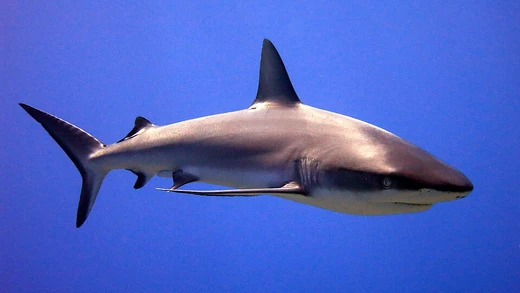
Night shark
A deepwater requiem shark that migrates vertically and is prized for its fins.
Last updated

SEFSC Pascagoula Laboratory; Collection of Brandi Noble, NOAA/NMFS/SEFSC · via Wikipedia: Night shark · Public domain
The night shark is a slender, deepwater shark that lives in the Atlantic Ocean.[1][2] People call it the "night shark" because fishers usually catch it after dark.[3] This shark is quick and lively, and it hunts small fish like mullet, mackerel, and flyingfish.[4] It also sometimes eats squid and shrimp.[4]
The shark does most of its hunting at night, with the most activity happening right around dawn and dusk.[4]
Scientific classification
- KingdomAnimalia
- PhylumChordata
- ClassChondrichthyes
- SubclassElasmobranchii
- DivisionSelachii
- OrderCarcharhiniformes
- FamilyCarcharhinidae
- GenusCarcharhinus
- SpeciesCarcharhinus signatus
Named by (Poey, 1868)
Close relatives
Other species of Carcharhinus with a Codexery entry.
- Silky shark Carcharhinus falciformis
- Australian blackspot shark Carcharhinus coatesi
- Australian blacktip shark Carcharhinus tilstoni
- Bignose shark Carcharhinus altimus
- Blacknose shark Carcharhinus acronotus
- Blackspot shark Carcharhinus sealei
- Blacktip reef shark Carcharhinus melanopterus
- Blacktip shark Carcharhinus limbatus
Sources: Wikipedia taxobox: Night shark (CC BY-SA 4.0) · order, family and genus agree with WoRMS AphiaID 105798 (CC BY 4.0)
Conservation status
Endangered (EN)
- LC
- NT
- VU
- EN▲ this species
- CR
- EW
- EX
Source: IUCN Red List assessment · GBIF copy of the Red List category
How big is it?
Largest length in the source, 2 m, next to a 1.8 m person.
Diagram: drawn by Codexery, schematic shapes to scale (not a likeness). Length: Wikipedia: Night shark
Where the night shark has been recorded
Each dot is a place where the species has been observed and reported (738 records, half-degree grid) — not a modelled range. 40 inland records left out (institution coordinates).
Map: drawn by Codexery. Data: GBIF occurrence search (records CC0 / CC BY) · Natural Earth basemap (public domain)
Description
Its eyes are big, round, and green when it's alive, and it has a special clear eyelid called a nictitating membrane that protects them.[5] The upper teeth can be either smooth or have tiny serrations along the edge, while the lower teeth stand straight up and are smooth-edged.[6] The shark's back is a grayish blue or brown color, its belly is whitish, and its fins don't have any special markings.[7]
Biology and ecology
Like other sharks in its family, the night shark gives birth to live young that develop inside the mother.[8] Females give birth to four to 18 pups after a year-long gestation period.[9] Baby night sharks are born measuring between 50 and 72 centimeters long, and they grow quickly during their first year.[9] Males mature at about 1.8 to 1.9 m, and females at 2.0 to 2.1 m.[10]
Potential predators include larger sharks, and known parasites include copepods and tapeworms.[4] The oldest night sharks scientists have found were 17 years old, and based on growth patterns, males might live up to 28 years and females up to 30 years.[10]
Distribution and habitat
The night shark lives near the edges of continental shelves and the upper slopes of the Atlantic Ocean.[2] Its range extends from Massachusetts to Argentina in the west, and from Senegal to northern Namibia in the east.[2]
Human interactions
In U.S. waters, a 2003–2008 assessment found the population has stabilized and may be increasing.[11] Since the night shark lives in deep water, there's no record of it ever being a danger to people.[12] In places like Brazil and other areas, there aren't really any rules managing how many of these sharks are caught.[13]
Taxonomy and phylogeny
A Cuban zoologist named Felipe Poey first described the night shark back in 1868.[1] Nobody has ever picked a single specimen to be the official "type" for this species.[3]
References
- Wikipedia, "Night shark" (CC BY-SA 4.0), which cites: Compagno, L.J.V., "Sharks of the World: An Annotated and Illustrated Catalogue of Shark Species Known to Date", Food and Agricultural Organization, 1984, p. 499–500; Raschi, W., "Hypoprion bigelowi, a Synonym of Carcharhinus signatus (Pisces: Carcharhinidae), with a Description of Ontogenetic Heterodonty in This Species and Notes on Its Natural History", Copeia, February 23, 1982, p. (we also read that source) en.wikipedia.org
- Wikipedia, "Night shark" (CC BY-SA 4.0), which cites: Carlson, J., "The Status of the United States Population of Night Shark, Carcharhinus signatus", Marine Fisheries Review, 2008, p. 1–13; ; Compagno, L.J.V., "Sharks of the World: An Annotated and Illustrated Catalogue of Shark Species Known to Date", Food and Agricultural Organization, 1984, p. 499–500 (we also read that source) en.wikipedia.org
- Wikipedia, "Night shark" (CC BY-SA 4.0), which cites: Compagno, L.J.V., "Sharks of the World: An Annotated and Illustrated Catalogue of Shark Species Known to Date", Food and Agricultural Organization, 1984, p. 499–500; Barzan, K. Biological Profiles: Night Shark. Florida Museum of Natural History Ichthyology Department. Retrieved on September 14, 2009. (we also read that source) en.wikipedia.org
- Wikipedia, "Night shark" (CC BY-SA 4.0), which cites: Compagno, L.J.V., "Sharks of the World: An Annotated and Illustrated Catalogue of Shark Species Known to Date", Food and Agricultural Organization, 1984, p. 499–500; Raschi, W., "Hypoprion bigelowi, a Synonym of Carcharhinus signatus (Pisces: Carcharhinidae), with a Description of Ontogenetic Heterodonty in This Species and Notes on Its Natural History", Copeia, February 23, 1982, p.; Carlson, J., Charvet, P., Blanco-Parra, MP, Briones Bell-lloch, A., Cardenosa, D., Crysler, Z., Espinoza, E., Herman, K., Morales-Saldaña, J.M., Naranjo en.wikipedia.org
- Wikipedia, "Night shark" (CC BY-SA 4.0), which cites: Compagno, L.J.V., "Sharks of the World: An Annotated and Illustrated Catalogue of Shark Species Known to Date", Food and Agricultural Organization, 1984, p. 499–500; "Fishes of the Gulf of Mexico: Myxiniformes to Gasterosteiformes", University of Texas Press, 1998, p. 86 (we also read that source) en.wikipedia.org
- Wikipedia, "Night shark" (CC BY-SA 4.0), which cites: Barzan, K. Biological Profiles: Night Shark. Florida Museum of Natural History Ichthyology Department. Retrieved on September 14, 2009.; Raschi, W., "Hypoprion bigelowi, a Synonym of Carcharhinus signatus (Pisces: Carcharhinidae), with a Description of Ontogenetic Heterodonty in This Species and Notes on Its Natural History", Copeia, February 23, 1982, p.; Compagno, L.J.V., "Sharks of the World: An Annotated and Illustrated Catalogue of Shark Species Known to Date", Food and Agricultural Organization, 1984, p. 499–500; "Fishes of the en.wikipedia.org
- Wikipedia, "Night shark" (CC BY-SA 4.0), which cites: Compagno, L.J.V., "Sharks of the World: An Annotated and Illustrated Catalogue of Shark Species Known to Date", Food and Agricultural Organization, 1984, p. 499–500; "Fishes of the Gulf of Mexico: Myxiniformes to Gasterosteiformes", University of Texas Press, 1998, p. 86; Barzan, K. Biological Profiles: Night Shark. Florida Museum of Natural History Ichthyology Department. Retrieved on September 14, 2009.; Raschi, W., "Hypoprion bigelowi, a Synonym of Carcharhinus signatus (Pisces: Carcharhinidae), with a Description of Ontogenetic He en.wikipedia.org
- Wikipedia, "Night shark" (CC BY-SA 4.0), which cites: Hazin, F.H., "Maturation of the night shark, Carcharhinus signatus, in the south-western equatorial Atlantic Ocean", Bulletin of Marine Science, 2000, p. 173–185 (original not read by us) en.wikipedia.org
- Wikipedia, "Night shark" (CC BY-SA 4.0), which cites: Compagno, L.J.V., "Sharks of the World", Princeton University Press, 2005, p. 306; Hazin, F.H., "Maturation of the night shark, Carcharhinus signatus, in the south-western equatorial Atlantic Ocean", Bulletin of Marine Science, 2000, p. 173–185; Carlson, J., Charvet, P., Blanco-Parra, MP, Briones Bell-lloch, A., Cardenosa, D., Crysler, Z., Espinoza, E., Herman, K., Morales-Saldaña, J.M., Naranjo-Elizondo, B., Pacoureau, N., Pérez Jiménez, J.C., Schneider, E.V.C.; Carlson, J., "The Status of the United States Population of Night Shark, en.wikipedia.org
- Wikipedia, "Night shark" (CC BY-SA 4.0), which cites: "Age determination and growth of the night shark (Carcharhinus signatus) off the northeastern Brazilian coast", Fishery Bulletin, January 2004, p. 156–167; Carlson, J., "The Status of the United States Population of Night Shark, Carcharhinus signatus", Marine Fisheries Review, 2008, p. 1–13 (original not read by us) en.wikipedia.org
- Wikipedia, "Night shark" (CC BY-SA 4.0), which cites: Cortes, E., "Relative abundance of pelagic sharks in the western North Atlantic Ocean, including the Gulf of Mexico and Caribbean Sea", Gulf and Caribbean Research, August 2007, p. 37–52 (we also read that source) en.wikipedia.org
- Wikipedia, "Night shark" (CC BY-SA 4.0), which cites: Barzan, K. Biological Profiles: Night Shark. Florida Museum of Natural History Ichthyology Department. Retrieved on September 14, 2009.; Compagno, L.J.V., "Sharks of the World: An Annotated and Illustrated Catalogue of Shark Species Known to Date", Food and Agricultural Organization, 1984, p. 499–500 (we also read that source) en.wikipedia.org
- Wikipedia, "Night shark" (CC BY-SA 4.0), which cites: Carlson, J., Charvet, P., Blanco-Parra, MP, Briones Bell-lloch, A., Cardenosa, D., Crysler, Z., Espinoza, E., Herman, K., Morales-Saldaña, J.M., Naranjo-Elizondo, B., Pacoureau, N., Pérez Jiménez, J.C., Schneider, E.V.C. (we also read that source) en.wikipedia.org
Each numbered sentence above was checked against the source it cites before publication. Sentences citing Wikipedia adapt text from the English Wikipedia article Night shark (contributors), used under CC BY-SA 4.0; this entry is available under the same licence. Other sources were used for facts only; no text or images are copied from them.
More in Reef sharks
Elsewhere in Sharks
Test yourself
Three questions drawn from this entry’s sources. Pick an answer to check it.
Answers checked against the source article
Sources
Compiled from Wikipedia and the sources listed below. Text from Wikipedia is available under CC BY-SA 4.0; this entry is adapted from it.
- Wikipedia: Night shark (CC BY-SA 4.0).
- Classification: the source article's taxobox; order, family and genus checked against WoRMS, the World Register of Marine Species (CC BY 4.0).
- Conservation status: IUCN Red List assessment.
- Occurrence records: GBIF (CC0 / CC BY). Basemap: Natural Earth (public domain).
- Word definitions: the Codexery glossary, each quoted from its Wikipedia article.
Spotted an error? Know more?
Reader corrections go straight into our review queue. Suggest an edit · How this site is sourced