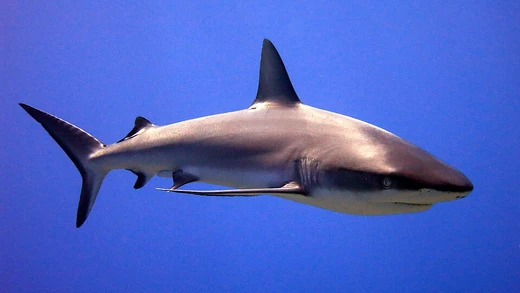
Brazilian sharpnose shark
A small requiem shark vulnerable to overfishing and plastic pollution.
Last updated

D Ross Robertson · via Wikipedia: Brazilian sharpnose shark · Public domain
The Brazilian sharpnose shark is a small requiem shark that lives in warm coastal waters of the western Atlantic Ocean.[1] It belongs to the same family as lemon sharks and bull sharks.[2] People heavily fish this species for food, and it's considered vulnerable in Brazil.[1][3]
Scientific classification
- KingdomAnimalia
- PhylumChordata
- ClassChondrichthyes
- SubclassElasmobranchii
- DivisionSelachii
- OrderCarcharhiniformes
- FamilyCarcharhinidae
- GenusRhizoprionodon
- SpeciesRhizoprionodon lalandii
Named by (J. P. Müller & Henle, 1839)
Close relatives
Other species of Rhizoprionodon with a Codexery entry.
- Atlantic sharpnose shark Rhizoprionodon terraenovae
- Milk shark Rhizoprionodon acutus
- Pacific sharpnose shark Rhizoprionodon longurio
Sources: Wikipedia taxobox: Brazilian sharpnose shark (CC BY-SA 4.0) · order, family and genus agree with WoRMS AphiaID 271326 (CC BY 4.0)
Conservation status
Vulnerable (VU)
- LC
- NT
- VU▲ this species
- EN
- CR
- EW
- EX
Source: IUCN Red List assessment · GBIF copy of the Red List category
How big is it?
Largest length in the source, 0.8 m, next to a 1.8 m person.
Diagram: drawn by Codexery, schematic shapes to scale (not a likeness). Length: Wikipedia: Brazilian sharpnose shark
Where the brazilian sharpnose shark has been recorded
Each dot is a place where the species has been observed and reported (144 records, half-degree grid) — not a modelled range. 26 inland records left out (institution coordinates).
Map: drawn by Codexery. Data: GBIF occurrence search (records CC0 / CC BY) · Natural Earth basemap (public domain) · place coordinates: Wikipedia (CC BY-SA 4.0)
Description
Its tail fin is heterocercal, meaning the upper lobe is longer, and it has a black edge along the tail's profile.[4] This is a relatively small shark, with newborns measuring about 33 to 34 centimeters long.[4] Adults range from 50 to 80 centimeters, with females tending to be slightly larger than males.[4][5] Like all requiem sharks, it has a nictitating membrane, a protective eyelid that shields the eye during feeding.[6]
Its skin is covered in dermal denticles, tooth-like scales that reduce drag and prevent abrasion.[4][6] This shark has a slender, spindle-shaped body, with a grayish-brown back and a white belly.[4] Its eyes are pretty big, its snout is long, and its mouth sits underneath that snout.[4]
Biology and ecology
Like all requiem sharks, it is viviparous, meaning the young develop inside the mother and are born live.[7] Females give birth in shallow, protected coastal nurseries, where the young also grow into juveniles.[7][8] Teleost fish and squid make up the bulk of this shark's diet.[1] Juveniles also eat crustaceans, drum fish, and herring-like fish.[9]
Studies suggest it may be an important hunter of both bottom-dwelling and open-water prey.[1] Up in northeastern South America, these sharks probably mate from March to June, and the pups are born between December and March.[5] Female sharks seem to store extra nutrients in their livers, which they can pass on to newborn pups to help them through their first few months.[8]
Distribution and habitat
These sharks live at depths between 3 and 70 meters, often in bays and shallow coastal waters.[1][10] Its territory stretches from Panama in Central America all the way down to southern Brazil and Uruguay.[10] They like to hang out and hunt over sandy or muddy sea floors.[10]
Human interactions
We don't really know how many of these sharks are out there, so scientists consider the species data deficient.[10] Artisanal fisheries catch this shark very often, and it's a major source of income for local fishers.[11][3] People do eat the meat of this shark, often drying and salting it, but the fins are just too small to be useful.[1] Overfishing is a serious threat, even though these fisheries operate at a small scale.[12]
Toxic metal contamination has also been detected in their electroreceptors, special organs that sense electric fields, which may affect their ability to detect prey and mates.[13] In 2024, cocaine was detected in all thirteen Brazilian sharpnose sharks captured off the coast of Rio de Janeiro.[14] This contamination may affect their health, reproduction, and behavior.[14] In one study, researchers found plastic pellets inside 7 out of 32 Brazilian sharpnose sharks they checked.[15]
Conservation efforts include tracking population health and developing a DNA tool to identify this species from similar sharks.[16]
Taxonomy and phylogeny
The Brazilian sharpnose shark was described by Valenciennes in 1839.[17] Its scientific name is Rhizoprionodon lalandii.[17] It belongs to the family Carcharhinidae, the requiem sharks, which typically thrive in warm waters, give live birth, and often migrate.[2]
References
- Wikipedia, "Brazilian sharpnose shark" (CC BY-SA 4.0), which cites: "Issues in Life Sciences—Aquatic and Marine Life: 2013 Edition", ScholarlyEditions, 2013 (original not read by us) en.wikipedia.org
- Wikipedia, "Brazilian sharpnose shark" (CC BY-SA 4.0), which cites: "Rhizoprionodon lalandii summary page", FishBase (original not read by us) en.wikipedia.org
- Wikipedia, "Brazilian sharpnose shark" (CC BY-SA 4.0), which cites: IUCN, "Rhizoprionodon lalandii: Pollom, R., Barreto, R., Charvet, P., Faria, V., Herman, K., Lasso-Alcalá, O., Marcante, F., Mejía-Falla, P.A., Montealegre-Quijano, S., Motta, F., Navia, A.F., Nunes, J. & Rincon, G.: The; Tavares, "Vulnerability of elasmobranchs caught by artisanal fishery in the Southeastern Caribbean", Regional Studies in Marine Science, 2024-12-20 (original not read by us) en.wikipedia.org
- Wikipedia, "Brazilian sharpnose shark" (CC BY-SA 4.0), which cites: "Rhizoprionodon lalandii Shark-References", shark-references.com (we also read that source) en.wikipedia.org
- Wikipedia, "Brazilian sharpnose shark" (CC BY-SA 4.0), which cites: Macedo, "Latitudinal disparity in the reproductive cycle of sharpnose shark, Rhizoprionodon lalandii (Elasmobranchii: Carcharhinidae), in Atlantic waters off South America", Zoologia (Curitiba), 2012, p. 413–419 (we also read that source) en.wikipedia.org
- Wikipedia, "Brazilian sharpnose shark" (CC BY-SA 4.0), which cites: Laranjeira, "Ultrastructure of dermal denticles in sharpnose shark (Rhizoprionodon lalandii) (Elasmobranchii, Carcharhinidae)", Microscopy Research and Technique, 2015, p. 859–864; Poscai, "Microscopic aspects of the nictitating membrane in Carcharhinidae and Sphyrnidae sharks: a preliminary study", Zoomorphology, 2017-09-01, p. 359–364 (original not read by us) en.wikipedia.org
- Wikipedia, "Brazilian sharpnose shark" (CC BY-SA 4.0), which cites: Andrade, "Reproductive biology and population variables of the Brazilian sharpnose shark Rhizoprionodon lalandii (Müller & Henle, 1839) captured in coastal waters of south-eastern Brazil", Journal of Fish Biology, 2008, ; Motta, "Size and sex compositions, length–weight relationship, and occurrence of the Brazilian sharpnose shark, Rhizoprionodon lalandii, caught by artisanal fishery from southeastern Brazil", Fisheries Research, 2005-08- (we also read that source) en.wikipedia.org
- Wikipedia, "Brazilian sharpnose shark" (CC BY-SA 4.0), which cites: Andrade, "Reproductive biology and population variables of the Brazilian sharpnose shark Rhizoprionodon lalandii (Müller & Henle, 1839) captured in coastal waters of south-eastern Brazil", Journal of Fish Biology, 2008, ; Corsso, "Condition analysis of the Brazilian sharpnose shark Rhizoprionodon lalandii: evidence of maternal investment for initial post-natal life", Journal of Fish Biology, 2018, p. 1038–1045 (we also read that source) en.wikipedia.org
- Wikipedia, "Brazilian sharpnose shark" (CC BY-SA 4.0), which cites: Viana, "Feeding ecology of elasmobranch species in southeastern Brazil", Neotropical Ichthyology, 2017; Viana, "Feeding ecology of elasmobranch species in southeastern Brazil", Neotropical Ichthyology, 2017 (original not read by us) en.wikipedia.org
- Wikipedia, "Brazilian sharpnose shark" (CC BY-SA 4.0), which cites: Cascaes, "Persistent organic pollutants in liver of Brazilian sharpnose shark ( Rhizoprionodon lalandii ) from southeastern coast of Brazil", Marine Pollution Bulletin, September 2014, p. 591–593 (we also read that source) en.wikipedia.org
- Wikipedia, "Brazilian sharpnose shark" (CC BY-SA 4.0), which cites: IUCN, "Rhizoprionodon lalandii: Pollom, R., Barreto, R., Charvet, P., Faria, V., Herman, K., Lasso-Alcalá, O., Marcante, F., Mejía-Falla, P.A., Montealegre-Quijano, S., Motta, F., Navia, A.F., Nunes, J. & Rincon, G.: The (original not read by us) en.wikipedia.org
- Wikipedia, "Brazilian sharpnose shark" (CC BY-SA 4.0), which cites: Tavares, "Vulnerability of elasmobranchs caught by artisanal fishery in the Southeastern Caribbean", Regional Studies in Marine Science, 2024-12-20 (original not read by us) en.wikipedia.org
- Wikipedia, "Brazilian sharpnose shark" (CC BY-SA 4.0), which cites: Willmer, "First report on metal and metalloid contamination of Ampullae of Lorenzini in sharks: A case study employing the Brazilian sharpnose shark Rhizoprionodon lalandii from Southeastern Brazil as an ecotoxicological (original not read by us) en.wikipedia.org
- Wikipedia, "Brazilian sharpnose shark" (CC BY-SA 4.0), which cites: de Farias Araujo, ""Cocaine Shark": First report on cocaine and benzoylecgonine detection in sharks", Science of the Total Environment, 2024-10-20 (we also read that source) en.wikipedia.org
- Wikipedia, "Brazilian sharpnose shark" (CC BY-SA 4.0), which cites: Miranda, "Are we eating plastic-ingesting fish?", Marine Pollution Bulletin, 2016-02-15, p. 109–114 (original not read by us) en.wikipedia.org
- Wikipedia, "Brazilian sharpnose shark" (CC BY-SA 4.0), which cites: Pinhal, "A Streamlined DNA Tool for Global Identification of Heavily Exploited Coastal Shark Species (Genus Rhizoprionodon)", PLOS ONE, 2012-04-09 (we also read that source) en.wikipedia.org
- World Register of Marine Species, Rhizoprionodon lalandii (AphiaID 271326). CC BY 4.0. marinespecies.org
Each numbered sentence above was checked against the source it cites before publication. Sentences citing Wikipedia adapt text from the English Wikipedia article Brazilian sharpnose shark (contributors), used under CC BY-SA 4.0; this entry is available under the same licence. Other sources were used for facts only; no text or images are copied from them.
More in Reef sharks
Elsewhere in Sharks
Test yourself
Three questions drawn from this entry’s sources. Pick an answer to check it.
Answers checked against the source article
Sources
Compiled from Wikipedia and the sources listed below. Text from Wikipedia is available under CC BY-SA 4.0; this entry is adapted from it.
- Wikipedia: Brazilian sharpnose shark (CC BY-SA 4.0).
- Classification: the source article's taxobox; order, family and genus checked against WoRMS, the World Register of Marine Species (CC BY 4.0).
- Conservation status: IUCN Red List assessment.
- Occurrence records: GBIF (CC0 / CC BY). Basemap: Natural Earth (public domain).
- Word definitions: the Codexery glossary, each quoted from its Wikipedia article.
Spotted an error? Know more?
Reader corrections go straight into our review queue. Suggest an edit · How this site is sourced