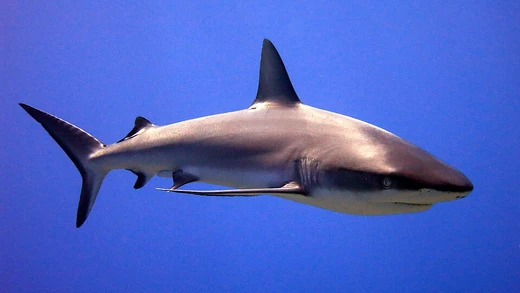
Silky shark
A swift, abundant pelagic shark with a smooth skin.
Last updated

Alex Chernikh · via Wikipedia: Silky shark · CC BY 2.5
It gets its common name from the unusually smooth texture of its skin, which feels almost like silk to the touch.[1] The silky shark roams warm oceans worldwide, preferring waters warmer than 23°C.[2] This shark is one of the three most common pelagic sharks, alongside the blue and oceanic whitetip sharks. Its population numbers at least tens of millions.[3] The silky shark was first scientifically described in 1839 by German biologists Johannes Müller and Jakob Henle.[4][5]
Scientific classification
- KingdomAnimalia
- PhylumChordata
- ClassChondrichthyes
- SubclassElasmobranchii
- DivisionSelachii
- OrderCarcharhiniformes
- FamilyCarcharhinidae
- GenusCarcharhinus
- SpeciesCarcharhinus falciformis
Named by (J. P. Müller & Henle, 1839)
Close relatives
Other species of Carcharhinus with a Codexery entry.
- Bignose shark Carcharhinus altimus
- Blacknose shark Carcharhinus acronotus
- Blackspot shark Carcharhinus sealei
- Blacktip reef shark Carcharhinus melanopterus
- Caribbean reef shark Carcharhinus perezi
- Copper shark Carcharhinus brachyurus
- Dusky shark Carcharhinus obscurus
- Galapagos shark Carcharhinus galapagensis
Sources: Wikipedia taxobox: Silky shark (CC BY-SA 4.0) · order, family and genus agree with WoRMS AphiaID 105789 (CC BY 4.0)
Conservation status
Vulnerable (VU)
- LC
- NT
- VU▲ this species
- EN
- CR
- EW
- EX
Source: IUCN Red List assessment · GBIF copy of the Red List category
How big is it?
Largest length in the source, 2.5 m, next to a 1.8 m person.
Diagram: drawn by Codexery, schematic shapes to scale (not a likeness). Length: Wikipedia: Silky shark
Where the silky shark has been recorded
Each dot is a place where the species has been observed and reported (23,839 records, half-degree grid) — not a modelled range. 27 inland records left out (institution coordinates).
Map: drawn by Codexery. Data: GBIF occurrence search (records CC0 / CC BY) · Natural Earth basemap (public domain)
Description
A slim and streamlined shark, it has a fairly long, rounded snout and medium-sized eyes with protective third eyelids.[6] The first dorsal fin is small and S-shaped, and a narrow ridge runs between the two dorsal fins.[6] Commonly reaching 2.5 meters in length, the largest recorded silky shark measured 3.5 meters and weighed 346 kilograms.[7] Looking at the teeth: the ones on top are triangular with strong serrations and a notch on the back edge, while the bottom teeth are narrow, stand upright, and have smooth edges.[8]
The shark's back shows off a metallic golden-brown to dark gray color, its belly is snowy white, and the tips of its fins get darker—especially noticeable in young sharks.[9][7]
Biology and ecology
It feeds mainly on bony fishes like tuna, mackerel, and sardines, and will also take squid and swimming crabs.[10] Fossil evidence shows it has scavenged on whale carcasses.[10] Young silky sharks hang out in big, loose groups—possibly to protect each other—and more than a thousand of them can come together when they migrate.[11] Bigger sharks and killer whales are known to prey on silky sharks.[12]
Silky sharks give birth to live young: the embryos develop inside the mother, and after they use up their yolk, the yolk sac turns into a placental connection for nourishment.[13] Females carry their pups for about 12 months, then give birth to litters of one to 16 pups, with six to 12 being the usual range.[14] Young sharks grow fast, adding 25 to 30 centimeters in their first year, and they reach sexual maturity at ages between 6 and 12 years—males mature at 6–10 years, females at 7–12+ years.[15][16]
Distribution and habitat
Four distinct populations have been identified in the northwestern Atlantic, the western and central Pacific, the eastern Pacific, and the Indian Ocean.[17] You'll most often find this shark from the surface down to 200 meters deep, but it can dive to 500 meters or more.[18]
Human interactions
Large numbers are caught by commercial fisheries, and even more are taken as bycatch in tuna fisheries.[19] Its fins are highly valued for shark fin soup, and fins from an estimated half a million to one and a half million silky sharks are traded globally each year.[20] Because of its size and teeth, people consider the silky shark potentially dangerous, but it rarely runs into humans since it lives mostly in the open ocean.[21] The United Nations Convention on the Law of the Sea includes the silky shark on its Annex I for highly migratory species, but that hasn't led to any actual management plans yet.[22]
Taxonomy and phylogeny
The type specimen was a 53-centimeter-long female fetus from Cuba, which caused adult silky sharks to be mistakenly described as a separate species in 1943.[4] That mistake was corrected in 1964 when researchers determined the two were the same species.[23] Fossil teeth of the silky shark have been found in North Carolina, Italy, India, and Malta, with the earliest known from the Early Miocene.[24] Some poorly described fossil teeth from the Eocene period (56–34 million years ago) that look like silky shark teeth have been found in Egypt.[25]
References
- Wikipedia, "Silky shark" (CC BY-SA 4.0), which cites: Bonfil, R., "Sharks of the Open Ocean: Biology, Fisheries and Conservation", Blackwell Science, 2008, p. 114–127; Knickle, C. Biological Profiles: Silky Shark. Florida Museum of Natural History Ichthyology Department. Retrieved on August 12, 2009.; (we also read that source) en.wikipedia.org
- Wikipedia, "Silky shark" (CC BY-SA 4.0), which cites: Atlas of Exotic Fishes in the Mediterranean Sea (Carcharhinus falciformis). 2nd Edition. 2021. 366p. CIESM Publishers, Paris, Monaco.https://ciesm.org/atlas/fis (original not read by us) en.wikipedia.org
- Wikipedia, "Silky shark" (CC BY-SA 4.0), which cites: Fowler, S. L., "Sharks, Rays and Chimaeras: The Status of the Chondrichthyan Fishes", International Union for Conservation of Nature and Natural Resources, 2005, p. 288–290 (original not read by us) en.wikipedia.org
- Wikipedia, "Silky shark" (CC BY-SA 4.0), which cites: Compagno, L. J. V., "Sharks of the World: An Annotated and Illustrated Catalogue of Shark Species Known to Date", Food and Agriculture Organization, 1984, p. 470–472; "Systematische Beschreibung der Plagiostomen (volume 2)", Veit und Comp., 1839, p. 47 (we also read that source) en.wikipedia.org
- World Register of Marine Species, Carcharhinus falciformis (AphiaID 105789). CC BY 4.0. marinespecies.org
- Wikipedia, "Silky shark" (CC BY-SA 4.0), which cites: Compagno, L. J. V., "Sharks of the World: An Annotated and Illustrated Catalogue of Shark Species Known to Date", Food and Agriculture Organization, 1984, p. 470–472; "Fishes of the Gulf of Mexico: Myxiniformes to Gasterosteiformes", University of Texas Press, 1998, p. 77 (we also read that source) en.wikipedia.org
- Wikipedia, "Silky shark" (CC BY-SA 4.0), which cites: Compagno, L. J. V., "Sharks of the World: An Annotated and Illustrated Catalogue of Shark Species Known to Date", Food and Agriculture Organization, 1984, p. 470–472; Knickle, C. Biological Profiles: Silky Shark. Florida Museum of Natural History Ichthyology Department. Retrieved on August 12, 2009.; Bane, G. W. (Jr.), "Observations on the Silky shark, Carcharhinus falciformis, in the Gulf of Guinea", Copeia, June 21, 1966, p. 354–356; ; Knickle, C. Biological Profiles: Silky Shark. Florida Museum of Natural History Ichthyology Department. en.wikipedia.org
- Wikipedia, "Silky shark" (CC BY-SA 4.0), which cites: "Coastal Fishes of Oman", University of Hawaii Press, 1995, p. 30–31 (original not read by us) en.wikipedia.org
- Wikipedia, "Silky shark" (CC BY-SA 4.0), which cites: Garrick, J. A. F., "Carcharhinus floridanus, the Silky Shark, a Synonym of C. falciformis", Copeia, June 30, 1964, p. 369–375; Knickle, C. Biological Profiles: Silky Shark. Florida Museum of Natural History Ichthyology Department. Retrieved on August 12, 2009. (original not read by us) en.wikipedia.org
- Wikipedia, "Silky shark" (CC BY-SA 4.0), which cites: Bonfil, R., "Sharks of the Open Ocean: Biology, Fisheries and Conservation", Blackwell Science, 2008, p. 114–127; Compagno, L. J. V., "Sharks of the World: An Annotated and Illustrated Catalogue of Shark Species Known to Date", Food and Agriculture Organization, 1984, p. 470–472; "Two Shark-bitten Whale Skeletons from Coastal Plain Deposits of South Carolina", Southeastern Naturalist, 2009, p. 71–82; Bonfil, R., "Sharks of the Open Ocean: Biology, Fisheries and Conservation", Blackwell Science, 2008, p. 114–127 (we also read that source) en.wikipedia.org
- Wikipedia, "Silky shark" (CC BY-SA 4.0), which cites: Martin, R. A. Open Ocean: Silky Shark. ReefQuest Centre for Shark Research. Retrieved on September 12, 2009.; "Colombia Natural Parks", Villegas Asociados, 2007, p. 335; Knickle, C. Biological Profiles: Silky Shark. Florida Museum of Natural History Ichthyology Department. Retrieved on August 12, 2009.; Strasburg, D. W., "Distribution, abundance, and habits of pelagic sharks in the central Pacific Ocean", Fishery Bulletin, 1958, p. 335–361; Branstetter, S., "Age, growth and reproductive biology of the silky shark, Carcharhinus falciformis, en.wikipedia.org
- Wikipedia, "Silky shark" (CC BY-SA 4.0), which cites: Myrberg, A. A. (Jr.), "The Acoustical Biology of Elasmobranchs", Environmental Biology of Fishes, February 2001, p. 31–46; "Description of Gnathia maculosa and a new record of Gnathia trimaculata (Crustacea, Isopoda, Gnathiidae), ectoparasites of elasmobranchs from Okinawan coastal waters", Zootaxa, May 22, 2009, p. 50–60; Deets, G. B., "Phylogenetic analysis and revision of Kroeyerina Wilson, 1932 (Siphonostomatoida: Kroyeriidae), copepods parasitic on chondrichthyans, with descriptions of four new species and the erection of a new genus,; en.wikipedia.org
- Wikipedia, "Silky shark" (CC BY-SA 4.0), which cites: "The Placenta and Gravid Uterus of Carcharhinus falciformis", Copeia, September 7, 1966, p. 451–457 (we also read that source) en.wikipedia.org
- Wikipedia, "Silky shark" (CC BY-SA 4.0), which cites: Bonfil, R., Mena R. and de Anda, D. (September 1993). Biological parameters of commercially exploited silky sharks, Carcharhinus falciformis, from the Campeche ; Branstetter, S., "Age, growth and reproductive biology of the silky shark, Carcharhinus falciformis, and the scalloped hammerhead, Sphyrna lewini, from the northwestern Gulf of Mexico", Environmental Biology of Fishes, J; Bonfil, R., "Sharks of the Open Ocean: Biology, Fisheries and Conservation", Blackwell Science, 2008, p. 114–127; Rigby, C.L., "Carcharhinus falciformis", 2017; B en.wikipedia.org
- Wikipedia, "Silky shark" (CC BY-SA 4.0), which cites: Bonfil, R., "Sharks of the Open Ocean: Biology, Fisheries and Conservation", Blackwell Science, 2008, p. 114–127; Martin, R. A. Open Ocean: Silky Shark. ReefQuest Centre for Shark Research. Retrieved on September 12, 2009.; Branstetter, S., "Age, growth and reproductive biology of the silky shark, Carcharhinus falciformis, and the scalloped hammerhead, Sphyrna lewini, from the northwestern Gulf of Mexico", Environmental Biology of Fishes, J (we also read that source) en.wikipedia.org
- Wikipedia, "Silky shark" (CC BY-SA 4.0), which cites: Bonfil, R., Mena R. and de Anda, D. (September 1993). Biological parameters of commercially exploited silky sharks, Carcharhinus falciformis, from the Campeche ; Joung, S. J., "Age, growth, and reproduction of silky sharks, Carcharhinus falciformis in northeastern Taiwan waters", Fisheries Research, April 2008, p. 78–85; Bonfil, R., "Sharks of the Open Ocean: Biology, Fisheries and Conservation", Blackwell Science, 2008, p. 114–127; Joung, S. J., "Age, growth, and reproduction of silky sharks, Carcharhinus falciformis in northeastern Taiwan en.wikipedia.org
- Wikipedia, "Silky shark" (CC BY-SA 4.0), which cites: Bonfil, R., "Sharks of the Open Ocean: Biology, Fisheries and Conservation", Blackwell Science, 2008, p. 114–127; Compagno, L. J. V., "Sharks of the World: An Annotated and Illustrated Catalogue of Shark Species Known to Date", Food and Agriculture Organization, 1984, p. 470–472; Bonfil, R., "Sharks of the Open Ocean: Biology, Fisheries and Conservation", Blackwell Science, 2008, p. 114–127 (we also read that source) en.wikipedia.org
- Wikipedia, "Silky shark" (CC BY-SA 4.0), which cites: Compagno, L. J. V., "Sharks of the World: An Annotated and Illustrated Catalogue of Shark Species Known to Date", Food and Agriculture Organization, 1984, p. 470–472; "Primer Seminario-Taller del Estado del Conocimiento de la Condrictiofauna de Costa Rica", INBIO, 2006, p. 17–19; Hoffmayer, E. R., Franks, J. S., Driggers, W. B. (III) and Grace, M. A. (March 26, 2009). "Movements and Habitat Preferences of Dusky (Carcharhinus obscurus) an (we also read that source) en.wikipedia.org
- Wikipedia, "Silky shark" (CC BY-SA 4.0), which cites: Bonfil, R., "Sharks of the Open Ocean: Biology, Fisheries and Conservation", Blackwell Science, 2008, p. 114–127; Camhi, M. D., "The Conservation Status of Pelagic Sharks and Rays: Report of the IUCN Shark Specialist Group Pelagic Shark Red List Workshop", IUCN Species Survival Commission Shark Specialist Group, 2009, p. 24–25, 55–5 (we also read that source) en.wikipedia.org
- Wikipedia, "Silky shark" (CC BY-SA 4.0), which cites: Rigby, C.L., "Carcharhinus falciformis", 2017; Bonfil, R., "Sharks of the Open Ocean: Biology, Fisheries and Conservation", Blackwell Science, 2008, p. 114–127; Compagno, L. J. V., "Sharks of the World: An Annotated and Illustrated Catalogue of Shark Species Known to Date", Food and Agriculture Organization, 1984, p. 470–472; Martin, R. A. Open Ocean: Silky Shark. ReefQuest Centre for Shark Research. Retrieved on September 12, 2009.; Knickle, C. Biological Profiles: Silky Shark. Florida Museum of Natural History Ichthyology Department. Retr en.wikipedia.org
- Wikipedia, "Silky shark" (CC BY-SA 4.0), which cites: Knickle, C. Biological Profiles: Silky Shark. Florida Museum of Natural History Ichthyology Department. Retrieved on August 12, 2009. (original not read by us) en.wikipedia.org
- Wikipedia, "Silky shark" (CC BY-SA 4.0), which cites: Rigby, C.L., "Carcharhinus falciformis", 2017; Bonfil, R., "Sharks of the Open Ocean: Biology, Fisheries and Conservation", Blackwell Science, 2008, p. 114–127; "Trade-Offs in the Design of Fishery Closures: Management of Silky Shark Bycatch in the Eastern Pacific Ocean Tuna Fishery", Conservation Biology, 2009, p. 626–635 (we also read that source) en.wikipedia.org
- Wikipedia, "Silky shark" (CC BY-SA 4.0), which cites: Garrick, J. A. F., "Carcharhinus floridanus, the Silky Shark, a Synonym of C. falciformis", Copeia, June 30, 1964, p. 369–375 (original not read by us) en.wikipedia.org
- Wikipedia, "Silky shark" (CC BY-SA 4.0), which cites: "Two Shark-bitten Whale Skeletons from Coastal Plain Deposits of South Carolina", Southeastern Naturalist, 2009, p. 71–82; Bourdon, J. (May 2009). Fossil Genera: Carcharhinus. The Life and Times of Long Dead Sharks. Retrieved on April 18, 2010.; "The Silky Shark, Carcharhinus falciformis (Bibron, 1841), in the Pliocene of Cava Serredi (Fine Basin, Italy)", Neues Jahrbuch für Geologie und Paläontologie, Abhandlungen, December 2006, p. 357–370; Chaskar, "New record of selachian (shark) fauna from the early Miocene (Aquitanian) of Kachchh regi en.wikipedia.org
- Wikipedia, "Silky shark" (CC BY-SA 4.0), which cites: Bourdon, J. (May 2009). Fossil Genera: Carcharhinus. The Life and Times of Long Dead Sharks. Retrieved on April 18, 2010. (original not read by us) en.wikipedia.org
Each numbered sentence above was checked against the source it cites before publication. Sentences citing Wikipedia adapt text from the English Wikipedia article Silky shark (contributors), used under CC BY-SA 4.0; this entry is available under the same licence. Other sources were used for facts only; no text or images are copied from them.
More in Reef sharks
Elsewhere in Sharks
Test yourself
Three questions drawn from this entry’s sources. Pick an answer to check it.
Answers checked against the source article
Sources
Compiled from Wikipedia and the sources listed below. Text from Wikipedia is available under CC BY-SA 4.0; this entry is adapted from it.
- Wikipedia: Silky shark (CC BY-SA 4.0).
- Classification: the source article's taxobox; order, family and genus checked against WoRMS, the World Register of Marine Species (CC BY 4.0).
- Conservation status: IUCN Red List assessment.
- Occurrence records: GBIF (CC0 / CC BY). Basemap: Natural Earth (public domain).
- Word definitions: the Codexery glossary, each quoted from its Wikipedia article.
Spotted an error? Know more?
Reader corrections go straight into our review queue. Suggest an edit · How this site is sourced