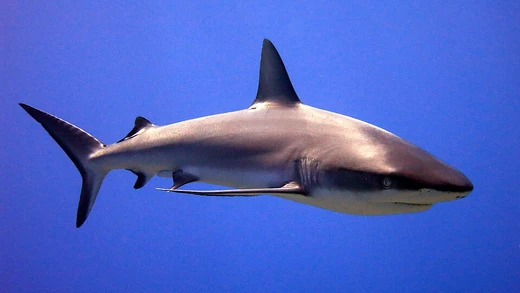
Nervous shark
A timid requiem shark of northern Australian coastal waters.
Last updated

CSIRO National Fish Collection · via Wikipedia: Nervous shark · CC BY 3.0
This shark gets its name from its cautious, skittish behavior around people, and it is harmless to humans.[1][2] You'll find the nervous shark, a small and timid requiem shark, hanging out in the shallow coastal waters around northern Australia and nearby islands.[3][2]
Scientific classification
- KingdomAnimalia
- PhylumChordata
- ClassChondrichthyes
- SubclassElasmobranchii
- DivisionSelachii
- OrderCarcharhiniformes
- FamilyCarcharhinidae
- GenusCarcharhinus
- SpeciesCarcharhinus cautus
Named by (Whitley, 1945)
Close relatives
Other species of Carcharhinus with a Codexery entry.
- Blacknose shark Carcharhinus acronotus
- Blacktip reef shark Carcharhinus melanopterus
- Copper shark Carcharhinus brachyurus
- Dusky shark Carcharhinus obscurus
- Night shark Carcharhinus signatus
- Silky shark Carcharhinus falciformis
- Australian blackspot shark Carcharhinus coatesi
- Australian blacktip shark Carcharhinus tilstoni
Sources: Wikipedia taxobox: Nervous shark (CC BY-SA 4.0) · order, family and genus agree with WoRMS AphiaID 271320 (CC BY 4.0)
Conservation status
Least Concern (LC)
- LC▲ this species
- NT
- VU
- EN
- CR
- EW
- EX
Source: IUCN Red List assessment · GBIF copy of the Red List category
How big is it?
Largest length in the source, 1.5 m, next to a 1.8 m person.
Diagram: drawn by Codexery, schematic shapes to scale (not a likeness). Length: Wikipedia: Nervous shark
Where the nervous shark has been recorded
Each dot is a place where the species has been observed and reported (1,639 records, half-degree grid) — not a modelled range. 14 inland records left out (institution coordinates).
Map: drawn by Codexery. Data: GBIF occurrence search (records CC0 / CC BY) · Natural Earth basemap (public domain) · place coordinates: Wikipedia (CC BY-SA 4.0)
Description
Its mouth holds 25 to 30 upper tooth rows and 23 to 28 lower tooth rows.[4] The first dorsal fin is large and sickle-shaped, and it starts above the rear tips of the pectoral fins.[5] A thin black line runs along the leading edges of the dorsal, pectoral, and upper tail fins, and the lower tail fin and sometimes the pectoral fins are tipped in black.[6] Upper teeth are narrow and angled with coarse serrations along the edges, while lower teeth are more slender and upright with finer serrations.[4]
Right before the upper tail fin starts, you'll see a crescent-shaped notch on the tail stalk.[5] The nervous shark usually grows to between 1.0 and 1.3 meters in length, can reach up to 1.5 meters, and females end up bigger than males.[6]
Biology and ecology
Like other requiem sharks, the nervous shark gives live birth: the young develop inside the mother and are nourished through a placental connection after the yolk sac is depleted.[7] Juveniles grow fast for a shark; males mature at about 84 centimeters in Darwin Harbour and 91 centimeters in Shark Bay, while females mature at about 91 and 101 centimeters, respectively.[7]
Distribution and habitat
You can find the nervous shark over continental and insular shelves off northern Australia, from Shark Bay in the west to Moreton Bay in the east, as well as off Papua New Guinea and around the Solomon Islands.[3] In Shark Bay, mating occurs from late October to early November, and birthing follows about 11 months later, likely due to cooler water temperatures.[7]
Taxonomy and phylogeny
In 1988, Leonard Compagno tentatively grouped the nervous shark and the Australian blackspot shark with the blacknose shark, copper shark, silky shark, and night shark.[8]
References
- Wikipedia, "Nervous shark" (CC BY-SA 4.0), which cites: Whitley, G.P., "New sharks and fishes from Western Australia, Part 2", Australian Zoologist, June 11, 1945, p. 1–42 (original not read by us) en.wikipedia.org
- Wikipedia, "Nervous shark" (CC BY-SA 4.0), which cites: Compagno, L.J.V., "Sharks of the World: An Annotated and Illustrated Catalogue of Shark Species Known to Date", Food and Agricultural Organization of the United Nations, 1984, p. 468–469; "Sharks and Rays of Australia", Harvard University Press, 2009, p. 256–257 (we also read that source) en.wikipedia.org
- Wikipedia, "Nervous shark" (CC BY-SA 4.0), which cites: "Sharks and Rays of Australia", Harvard University Press, 2009, p. 256–257; "The IUCN Red List of Threatened Species"; "Field Guide for Sharks of the Genus Carcharhinus", Verlag Dr. Friedrich Pfeil, 2011, p. 56–57; "The IUCN Red List of Threatened Species"; "Habitat partitioning among four elasmobranch species in nearshore, shallow waters of a subtropical embayment in Western Australia", Marine Biology, October 2004, p. 1023–1032 (we also read that source) en.wikipedia.org
- Wikipedia, "Nervous shark" (CC BY-SA 4.0), which cites: "Sharks and Rays of Australia", Harvard University Press, 2009, p. 256–257; Compagno, L.J.V., "Sharks of the World: An Annotated and Illustrated Catalogue of Shark Species Known to Date", Food and Agricultural Organization of the United Nations, 1984, p. 468–469 (we also read that source) en.wikipedia.org
- Wikipedia, "Nervous shark" (CC BY-SA 4.0), which cites: "Sharks and Rays of Australia", Harvard University Press, 2009, p. 256–257; Compagno, L.J.V., "Sharks of the World: An Annotated and Illustrated Catalogue of Shark Species Known to Date", Food and Agricultural Organization of the United Nations, 1984, p. 468–469; "Field Guide for Sharks of the Genus Carcharhinus", Verlag Dr. Friedrich Pfeil, 2011, p. 56–57 (we also read that source) en.wikipedia.org
- Wikipedia, "Nervous shark" (CC BY-SA 4.0), which cites: "Sharks and Rays of Australia", Harvard University Press, 2009, p. 256–257; "Field Guide for Sharks of the Genus Carcharhinus", Verlag Dr. Friedrich Pfeil, 2011, p. 56–57; "Size and age compositions and reproductive biology of the nervous shark Carcharhinus cautus in a large subtropical embayment, including an analysis of growth during pre- and postnatal life", Marine Biology, December 200 (we also read that source) en.wikipedia.org
- Wikipedia, "Nervous shark" (CC BY-SA 4.0), which cites: "Size and age compositions and reproductive biology of the nervous shark Carcharhinus cautus in a large subtropical embayment, including an analysis of growth during pre- and postnatal life", Marine Biology, December 200; Lyle, J.M., "Observations on the biology of Carcharhinus cautus (Whitley), C. melanopterus (Quoy & Gaimard) and C. fitzroyensis (Whitley) from Northern Australia", Australian Journal of Marine and Freshwater Research, 19 (we also read that source) en.wikipedia.org
- Wikipedia, "Nervous shark" (CC BY-SA 4.0), which cites: Garrick, J.A.F. (1982). Sharks of the genus Carcharhinus. NOAA Technical Report, NMFS CIRC 445.; Compagno, L.J.V., "Sharks of the Order Carcharhiniformes", Princeton University Press, 1988, p. 319–320; Lavery, S., "Electrophoretic analysis of phylogenetic relationships among Australian carcharhinid sharks", Australian Journal of Marine and Freshwater Research, 1992, p. 97–108; "Shark tales: A molecular species-level phylogeny of sharks (Selachimorpha, Chondrichthyes)", Molecular Phylogenetics and Evolution, February 2011, p. 207–217 (orig en.wikipedia.org
Each numbered sentence above was checked against the source it cites before publication. Sentences citing Wikipedia adapt text from the English Wikipedia article Nervous shark (contributors), used under CC BY-SA 4.0; this entry is available under the same licence. Other sources were used for facts only; no text or images are copied from them.
More in Reef sharks
Elsewhere in Sharks
Test yourself
Three questions drawn from this entry’s sources. Pick an answer to check it.
Answers checked against the source article
Sources
Compiled from Wikipedia and the sources listed below. Text from Wikipedia is available under CC BY-SA 4.0; this entry is adapted from it.
- Wikipedia: Nervous shark (CC BY-SA 4.0).
- Classification: the source article's taxobox; order, family and genus checked against WoRMS, the World Register of Marine Species (CC BY 4.0).
- Conservation status: IUCN Red List assessment.
- Occurrence records: GBIF (CC0 / CC BY). Basemap: Natural Earth (public domain).
- Word definitions: the Codexery glossary, each quoted from its Wikipedia article.
Spotted an error? Know more?
Reader corrections go straight into our review queue. Suggest an edit · How this site is sourced