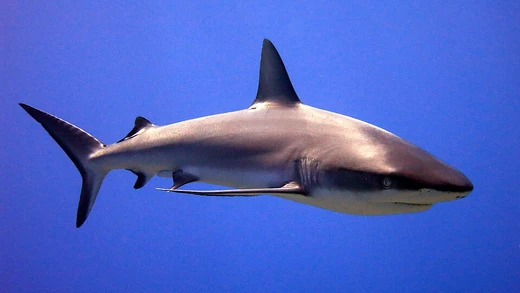
Broadfin shark
A tropical requiem shark with broad pectoral fins, now endangered.
Last updated

Müller & Henle · via Wikipedia: Broadfin shark · Public domain
This tropical shark gets its name from the unusually wide shape of its pectoral fins.[1] The IUCN lists this shark as endangered.[2][3]
Scientific classification
- KingdomAnimalia
- PhylumChordata
- ClassChondrichthyes
- SubclassElasmobranchii
- DivisionSelachii
- OrderCarcharhiniformes
- FamilyCarcharhinidae
- GenusLamiopsis
- SpeciesLamiopsis temminckii
Named by (J. P. Müller & Henle, 1839)
Close relatives
Other species of Lamiopsis with a Codexery entry.
- Borneo broadfin shark Lamiopsis tephrodes
Sources: Wikipedia taxobox: Broadfin shark (CC BY-SA 4.0) · order, family and genus agree with WoRMS AphiaID 281270 (CC BY 4.0)
Conservation status
Endangered (EN)
- LC
- NT
- VU
- EN▲ this species
- CR
- EW
- EX
Source: IUCN Red List assessment · GBIF copy of the Red List category
How big is it?
Largest length in the source, 1.75 m, next to a 1.8 m person.
Diagram: drawn by Codexery, schematic shapes to scale (not a likeness). Length: Wikipedia: Broadfin shark
Description
Females and males look different from one another.[4] Females reach a maximum size of about 175 cm, and the reported size of males has increased.[4] Males have calcified claspers—external appendages that help with reproduction—on the ends of their pelvic fins.[4] Throughout their range, you'll find female and male broadfin sharks spread out pretty evenly.[4]
Biology and ecology
Crustaceans, teleost fish, and cephalopods make up the bulk of the broadfin shark's diet.[5] This shark sits at the top of the food chain in its coastal home, but a tapeworm called Sanguilevator yearsleyi can parasitize it by stealing blood.[5] This shark gives birth to live pups that are born with an umbilical scar.[4] A female carries two to four embryos in each uterus, so a whole litter usually adds up to about eight pups.[4]
Late-stage embryos show up most often from April to August, and scientists think most births happen between March and September.[4] Newborn broadfin sharks measure anywhere from 41.8 to 65.0 centimeters long.[4] This shark has a low productivity rate, so its population can't bounce back quickly from declines.[4]
Human interactions
The broadfin shark is endangered globally, but this status may need reassessment.[1] The last assessment happened before scientists identified the Borneo broadfin shark as a separate species, so mixing up the two could have thrown off the population numbers.[1]
References
- Wikipedia, "Broadfin shark" (CC BY-SA 4.0), which cites: White, "Resurrection and redescription of the Borneo Broadfin Shark Lamiopsis tephrodes (Fowler, 1905) (Carcharhiniformes: Carcharhinidae)", CSIRO Marine and Atmospheric Research Paper, 2010, p. 45–59 (original not read by us) en.wikipedia.org
- Wikipedia, "Broadfin shark" (CC BY-SA 4.0), which cites: Pal, "An overview of the fishes of Indian Sundarbans and their conservation status", Journal of Environment and Sociobiology, 2014, p. 171–185 (original not read by us) en.wikipedia.org
- IUCN Red List assessment (category and year as redistributed in GBIF's IUCN Red List checklist). IUCN Red List terms: fact (category, year) cited, no text reused. iucnredlist.org
- Wikipedia, "Broadfin shark" (CC BY-SA 4.0), which cites: Akhilesh, "Biological observations on the broadfin shark Lamiopsis temminckii (Carcharhiniformes: Carcharhinidae)", Journal of Fish Biology, 2017-10-16, p. 1721–1729 (we also read that source) en.wikipedia.org
- Wikipedia, "Broadfin shark" (CC BY-SA 4.0), which cites: Akhilesh, "Biological observations on the broadfin shark Lamiopsis temminckii (Carcharhiniformes: Carcharhinidae)", Journal of Fish Biology, 2017-10-16, p. 1721–1729; Caira, "An unusual blood sequestering tapeworm (Sanguilevator yearsleyi n. gen., n. sp.) from Borneo with description of Cathetocephalus resendezi n. sp. from Mexico and molecular support for the recognition of the order (we also read that source) en.wikipedia.org
Each numbered sentence above was checked against the source it cites before publication. Sentences citing Wikipedia adapt text from the English Wikipedia article Broadfin shark (contributors), used under CC BY-SA 4.0; this entry is available under the same licence. Other sources were used for facts only; no text or images are copied from them.
More in Reef sharks
Elsewhere in Sharks
Test yourself
Three questions drawn from this entry’s sources. Pick an answer to check it.
Answers checked against the source article
Sources
Compiled from Wikipedia and the sources listed below. Text from Wikipedia is available under CC BY-SA 4.0; this entry is adapted from it.
- Wikipedia: Broadfin shark (CC BY-SA 4.0).
- Classification: the source article's taxobox; order, family and genus checked against WoRMS, the World Register of Marine Species (CC BY 4.0).
- Conservation status: IUCN Red List assessment.
- Word definitions: the Codexery glossary, each quoted from its Wikipedia article.
Spotted an error? Know more?
Reader corrections go straight into our review queue. Suggest an edit · How this site is sourced