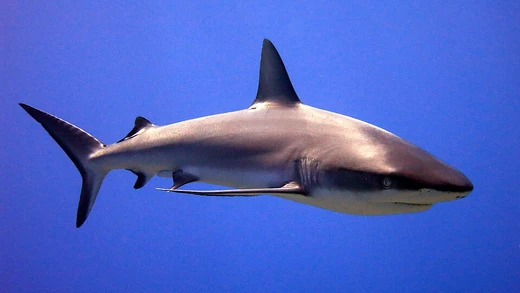
Oceanic whitetip
The oceanic whitetip shark is a slow-moving but aggressive pelagic predator, critically endangered due to fishing pressure.
Last updated

Johan Lantz, Malmö SWEDEN · via Wikipedia: Oceanic whitetip shark · CC BY-SA 3.0
This shark lives across the globe between 45°N and 43°S latitude, and people once described it as extraordinarily abundant—maybe the most abundant large animal over 100 pounds on the planet.[1][2]
Scientific classification
- KingdomAnimalia
- PhylumChordata
- ClassChondrichthyes
- SubclassElasmobranchii
- DivisionSelachii
- OrderCarcharhiniformes
- FamilyCarcharhinidae
- GenusCarcharhinus
- SpeciesCarcharhinus longimanus
Named by (Poey, 1861)
Close relatives
Other species of Carcharhinus with a Codexery entry.
- Blacktip reef shark Carcharhinus melanopterus
- Bull shark Carcharhinus leucas
- Pigeye shark (Carcharhinus amboinensis) Carcharhinus amboinensis
- Pondicherry shark (Carcharhinus hemiodon) Carcharhinus hemiodon
Sources: Wikipedia taxobox: Oceanic whitetip shark (CC BY-SA 4.0) · order, family and genus agree with WoRMS AphiaID 105794 (CC BY 4.0)
Conservation status
Critically Endangered (CR)
- LC
- NT
- VU
- EN
- CR▲ this species
- EW
- EX
Source: IUCN Red List assessment · GBIF copy of the Red List category
How big is it?
Largest length in the source, 4 m, next to a 1.8 m person.
Diagram: drawn by Codexery, schematic shapes to scale (not a likeness). Length: Wikipedia: Oceanic whitetip shark
Where the oceanic whitetip has been recorded
Each dot is a place where the species has been observed and reported (2,918 records, half-degree grid) — not a modelled range. 24 inland records left out (institution coordinates).
Map: drawn by Codexery. Data: GBIF occurrence search (records CC0 / CC BY) · Natural Earth basemap (public domain) · place coordinates: Wikipedia (CC BY-SA 4.0)
Description
This shark has a robust, heavy body.[3] Young sharks may have black marks on their fins, and a saddle-shaped patch sometimes appears between the two dorsal fins.[4] Teeth in the upper jaw are broad, triangular, and fully serrated, while those in the lower jaw are thinner with serrated tips only.[4] The upper jaw holds 14 or 15 teeth on each side, and the lower jaw holds 13 to 15.[4]
What really sets this shark apart are its long, wing-like pectoral fins and its very large first dorsal fin, both of which have conspicuously rounded white tips.[4][5][6] The shark's back is grey-bronze and its belly is white, a color pattern known as countershading.[5] It has a rounded snout and circular eyes that come with a nictitating membrane—a protective third eyelid.[4] The skin feels smooth to the touch because the dermal denticles lie almost flat, with little overlap between them.[4][6]
Biology and ecology
Its diet includes bony fish like tuna, mackerel, and mahi-mahi, as well as squid.[7] It sometimes feeds by swimming through schools of tuna with its mouth open.[8] Whitetips commonly compete with silky sharks for food.[8] Large sharks are potential predators, especially of juveniles.[6]
Oceanic whitetips usually hang out alone, but they'll gather in groups when there's a lot of food around.[5][9] They cruise slowly near the surface, swimming during both day and night.[5][10] They'll also eat stingrays, sea turtles, seabirds, crustaceans, and the carcasses of marine mammals.[8] The oldest known individual lived 22 years.[11]
Litter size ranges from two to fourteen pups. In the northwest Atlantic, pups are 65–75 cm long, while in the Pacific they average 45–55 cm.[12]
Distribution and habitat
It spends most of its time in the upper 150 m of the water column.[7] Longline data show that populations increase with distance from land, though the shark sometimes swims close to oceanic islands and narrow continental shelves, in waters as shallow as 37 meters.[13]
Human interactions
Between 1955 and 2020, this shark attacked people 21 times, and five of those attacks were fatal.[14] Fisheries mainly threaten this shark, catching it intentionally or as bycatch on longlines, gillnets, and trawls.[15] As of 2019, the IUCN Red List calls it critically endangered, with an estimated population decline of around 98 percent over three generations.[16] In 2018, the US Endangered Species Act listed it as threatened.[17]
People have kept this species in captivity, and one female at the Monterey Bay Aquarium lived more than three years.[18] During World War II, many deaths after the sinking of the RMS Nova Scotia were blamed on this species, and hundreds of sailors who survived the USS Indianapolis sinking reportedly died from shark attacks.[19][20]
Taxonomy and phylogeny
The species epithet longimanus means "long hands" in Latin, referring to the large pectoral fins.[5] Other common names include brown shark, shipwreck shark, and whitetip shark.[4] The rules of naming species say Lesson's name should have priority, but most people still use the name Carcharhinus longimanus.[5]
References
- Wikipedia, "Oceanic whitetip shark" (CC BY-SA 4.0), which cites: ; Compagno, Leonard J. V., "Sharks of the World: An annotated and illustrated catalogue of shark species known to date", Food and Agriculture Organization of the United Nations, 1984, p. 484–86, 555–61, 588; Bonfil, "The Biology and Ecology of the Oceanic Whitetip Shark, Carcharhinus Longimanus", Blackwell Publishing Ltd, 2008, p. 128–139; "Shifting baselines and the decline of pelagic sharks in the Gulf of Mexico", Ecology Letters, 2004, p. 135–45 (we also read that source) en.wikipedia.org
- Wikipedia, "Oceanic whitetip shark" (CC BY-SA 4.0), which cites: "The Natural History of Sharks", Lippincott, 1969; "Shifting baselines and the decline of pelagic sharks in the Gulf of Mexico", Ecology Letters, 2004, p. 135–45; Baum, J.K., "Robust estimates of decline for pelagic shark populations in the northwest Atlantic and Gulf of Mexico", Fisheries, 2005, p. 27–30; Briggs, "Extinction: 'Time is running out' to save sharks and rays", BBC News, 28 January 2021; Richardson, "Shark, ray populations have declined by 'alarming' 70 per cent since 1970s, study finds", ABC News, 27 January 2021 (w en.wikipedia.org
- Wikipedia, "Oceanic whitetip shark" (CC BY-SA 4.0), which cites: Andrzejaczek, "Temperature and the vertical movements of oceanic whitetip sharks, Carcharhinus longimanus", Scientific Reports, 29 May 2018, p. 8351; Carrier, "Sharks of the Shallows: Coastal Species in Florida and the Bahamas", JHU Press, 31 August 2017, p. 108; Bester, Cathleen, "Oceanic Whitetip Shark", Florida Museum of Natural history; Compagno, Leonard J. V., "Sharks of the World: An annotated and illustrated catalogue of shark species known to date", Food and Agriculture Organization of the United Nations, 1984, p. 484–86, en.wikipedia.org
- Wikipedia, "Oceanic whitetip shark" (CC BY-SA 4.0), which cites: Bester, Cathleen, "Oceanic Whitetip Shark", Florida Museum of Natural history (we also read that source) en.wikipedia.org
- Wikipedia, "Oceanic whitetip shark" (CC BY-SA 4.0), which cites: Compagno, Leonard J. V., "Sharks of the World: An annotated and illustrated catalogue of shark species known to date", Food and Agriculture Organization of the United Nations, 1984, p. 484–86, 555–61, 588 (we also read that source) en.wikipedia.org
- Bester, Cathleen, "Oceanic Whitetip Shark", Florida Museum of Natural history. facts only, no text reused. web.archive.org
- Wikipedia, "Oceanic whitetip shark" (CC BY-SA 4.0) en.wikipedia.org
- Wikipedia, "Oceanic whitetip shark" (CC BY-SA 4.0), which cites: Compagno, Leonard J. V., "Sharks of the World: An annotated and illustrated catalogue of shark species known to date", Food and Agriculture Organization of the United Nations, 1984, p. 484–86, 555–61, 588; Bester, Cathleen, "Oceanic Whitetip Shark", Florida Museum of Natural history; Madigan, "Diet shift and site-fidelity of oceanic whitetip sharks Carcharhinus longimanus along the Great Bahama Bank", Marine Ecology Progress Series, 2015, p. 185–197; "This shark fought off a deep-sea squid, first-ever picture reveals", Animals, 5 en.wikipedia.org
- Wikipedia, "Oceanic whitetip shark" (CC BY-SA 4.0), which cites: Compagno, Leonard J. V., "Sharks of the World: An annotated and illustrated catalogue of shark species known to date", Food and Agriculture Organization of the United Nations, 1984, p. 484–86, 555–61, 588; Madigan, "Diet shift and site-fidelity of oceanic whitetip sharks Carcharhinus longimanus along the Great Bahama Bank", Marine Ecology Progress Series, 2015, p. 185–197 (we also read that source) en.wikipedia.org
- Wikipedia, "Oceanic whitetip shark" (CC BY-SA 4.0), which cites: Bester, Cathleen, "Oceanic Whitetip Shark", Florida Museum of Natural history; Andrzejaczek, "Temperature and the vertical movements of oceanic whitetip sharks, Carcharhinus longimanus", Scientific Reports, 29 May 2018, p. 8351; Papastamatiou, "Optimal swimming strategies and behavioral plasticity of oceanic whitetip sharks", Scientific Reports, 2018, p. 551 (we also read that source) en.wikipedia.org
- Wikipedia, "Oceanic whitetip shark" (CC BY-SA 4.0), which cites: Lessa, "Age, growth and stock structure of the oceanic whitetip shark, Carcharhinus longimanus, from the southwestern equatorial Atlantic", Fisheries Research, 1999, p. 21–30; dos Santos Tambourgi, "Reproductive aspects of the oceanic whitetip shark, Carcharhinus longimanus (Elasmobranchii: Carcharhinidae), in the equatorial and southwestern Atlantic Ocean", Brazilian Journal of Oceanography, ; Seki, "Age, Growth and Reproduction of the Oceanic Whitetip Shark from the Pacific Ocean", Fisheries Science, 1998, p. 14–20; Bester, Cat en.wikipedia.org
- Wikipedia, "Oceanic whitetip shark" (CC BY-SA 4.0), which cites: Bonfil, "The Biology and Ecology of the Oceanic Whitetip Shark, Carcharhinus Longimanus", Blackwell Publishing Ltd, 2008, p. 128–139; Seki, "Age, Growth and Reproduction of the Oceanic Whitetip Shark from the Pacific Ocean", Fisheries Science, 1998, p. 14–20; Bonfil, "The Biology and Ecology of the Oceanic Whitetip Shark, Carcharhinus Longimanus", Blackwell Publishing Ltd, 2008, p. 128–139; Seki, "Age, Growth and Reproduction of the Oceanic Whitetip Shark from the Pacific Ocean", Fisheries Science, 1998, p. 14–20 (we also read th en.wikipedia.org
- Wikipedia, "Oceanic whitetip shark" (CC BY-SA 4.0), which cites: Bester, Cathleen, "Oceanic Whitetip Shark", Florida Museum of Natural history; Compagno, Leonard J. V., "Sharks of the World: An annotated and illustrated catalogue of shark species known to date", Food and Agriculture Organization of the United Nations, 1984, p. 484–86, 555–61, 588 (we also read that source) en.wikipedia.org
- Wikipedia, "Oceanic whitetip shark" (CC BY-SA 4.0), which cites: Clua, "Suspected predatory bites on a snorkeler by an oceanic whitetip shark Carcharhinus longimanus off Moorea island (French Polynesia)", Journal of Forensic Sciences, 2021, p. 2493–2498 (original not read by us) en.wikipedia.org
- Wikipedia, "Oceanic whitetip shark" (CC BY-SA 4.0), which cites: Rigby, C.L., "Carcharhinus longimanus", 2019; Compagno, Leonard J. V., "Sharks of the World: An annotated and illustrated catalogue of shark species known to date", Food and Agriculture Organization of the United Nations, 1984, p. 484–86, 555–61, 588; Compagno, Leonard J. V., "Sharks of the World: An annotated and illustrated catalogue of shark species known to date", Food and Agriculture Organization of the United Nations, 1984, p. 484–86, 555–61, 588; Tolotti, "Vulnerability of the oceanic whitetip shark to pelagic longline fis en.wikipedia.org
- Wikipedia, "Oceanic whitetip shark" (CC BY-SA 4.0), which cites: Rigby, C.L., "Carcharhinus longimanus", 2019 (we also read that source) en.wikipedia.org
- Wikipedia, "Oceanic whitetip shark" (CC BY-SA 4.0), which cites: MCGrath, Matt, "'Historic' day for shark protection", BBC News, 11 March 2013; "Home page of NOAA Fisheries Service – Pacific Islands Regional Office"; "Endangered whitetip sharks to be protected", New Zealand Government, 27 September 2012; "Wildlife (Oceanic Whitetip Shark) Order 2012", New Zealand government gazette, 6 December 2012; Duffy, "Conservation status of New Zealand chondrichthyans (chimaeras, sharks and rays), 2016", Department of Conservation, 2018, p. 9 (original not read by us) en.wikipedia.org
- Wikipedia, "Oceanic whitetip shark" (CC BY-SA 4.0), which cites: "Oceanic Whitetip Shark Carcharhinus longimanus (Poey, 1861) in Captivity", H. F. Mollet; "Monterey aquarium whitetip shark dies after three years", Napa Valley Register, 24 December 2003; "Oceanic Whitetip Shark Carcharhinus longimanus (Poey, 1861) in Captivity", H. F. Mollet (we also read that source) en.wikipedia.org
- Wikipedia, "Oceanic whitetip shark" (CC BY-SA 4.0), which cites: Bass, "Sharks of the east coast of southern Africa. 1. The genus Carcharhinus (Carcharhinidae)", Oceanographic Research Institute, 1973, p. 49–55 (original not read by us) en.wikipedia.org
- Wikipedia, "Oceanic whitetip shark" (CC BY-SA 4.0), which cites: Stanton, "In Harm's Way: The Sinking of the USS Indianapolis and the Extraordinary Story of Its Survivors", H. Holt, 2003; Hulver, "Dispelling the Myths of the Indianapolis", U.S. Naval Institute, 2017-11-01; "Surviving the Sinking of the USS Indianapolis", The National WWII Museum New Orleans, 2025-07-30 (original not read by us) en.wikipedia.org
Each numbered sentence above was checked against the source it cites before publication. Sentences citing Wikipedia adapt text from the English Wikipedia article Oceanic whitetip shark (contributors), used under CC BY-SA 4.0; this entry is available under the same licence. Other sources were used for facts only; no text or images are copied from them.
More in Reef sharks
Elsewhere in Sharks
Test yourself
Three questions drawn from this entry’s sources. Pick an answer to check it.
Answers checked against the source article
Sources
Compiled from Wikipedia and the sources listed below. Text from Wikipedia is available under CC BY-SA 4.0; this entry is adapted from it.
- Wikipedia: Oceanic whitetip shark (CC BY-SA 4.0).
- Classification: the source article's taxobox; order, family and genus checked against WoRMS, the World Register of Marine Species (CC BY 4.0).
- Conservation status: IUCN Red List assessment.
- Occurrence records: GBIF (CC0 / CC BY). Basemap: Natural Earth (public domain).
- Word definitions: the Codexery glossary, each quoted from its Wikipedia article.
Spotted an error? Know more?
Reader corrections go straight into our review queue. Suggest an edit · How this site is sourced