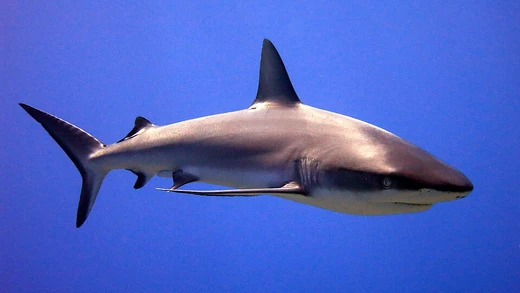
Sandbar shark
A large coastal shark with a high dorsal fin and interdorsal ridge.
Last updated

Brian Gratwicke · via Wikipedia: Sandbar shark · CC BY 2.0
The sandbar shark—often called the brown shark or thickskin shark—is a requiem shark that lives in the Atlantic Ocean and the Indo-Pacific.[1] Don't mix it up with the sand tiger shark, which has a similar name but is a different species.[1]
Scientific classification
- KingdomAnimalia
- PhylumChordata
- ClassChondrichthyes
- SubclassElasmobranchii
- DivisionSelachii
- OrderCarcharhiniformes
- FamilyCarcharhinidae
- GenusCarcharhinus
- SpeciesCarcharhinus plumbeus
Named by (Nardo, 1827)
Close relatives
Other species of Carcharhinus with a Codexery entry.
- Bignose shark Carcharhinus altimus
- Bull shark Carcharhinus leucas
- Dusky shark Carcharhinus obscurus
- Australian blackspot shark Carcharhinus coatesi
- Australian blacktip shark Carcharhinus tilstoni
- Blacknose shark Carcharhinus acronotus
- Blackspot shark Carcharhinus sealei
- Blacktip reef shark Carcharhinus melanopterus
Sources: Wikipedia taxobox: Sandbar shark (CC BY-SA 4.0) · order, family and genus agree with WoRMS AphiaID 105797 (CC BY 4.0)
Conservation status
Endangered (EN)
- LC
- NT
- VU
- EN▲ this species
- CR
- EW
- EX
Source: IUCN Red List assessment · GBIF copy of the Red List category
How big is it?
Largest length in the source, 2.5 m, next to a 1.8 m person.
Diagram: drawn by Codexery, schematic shapes to scale (not a likeness). Length: Wikipedia: Sandbar shark
Where the sandbar shark has been recorded
Each dot is a place where the species has been observed and reported (29,467 records, half-degree grid) — not a modelled range. 51 inland records left out (institution coordinates).
Map: drawn by Codexery. Data: GBIF occurrence search (records CC0 / CC BY) · Natural Earth basemap (public domain) · place coordinates: Wikipedia (CC BY-SA 4.0)
Description
The first dorsal fin is especially large compared to other sharks.[2] They have a moderately long rounded snout and high triangular saw-edged upper teeth.[2] You can spot a sandbar shark by its unusually tall first dorsal fin and the ridge that runs between its two dorsal fins.[1] As newborns, these sharks are about 56 to 75 cm total length.[2]
Female sandbar sharks can reach lengths of 2 to 2.5 meters, while males top out at about 1.8 meters.[3] The heaviest sandbar shark ever recorded weighed 240 kilograms.[3] On average, females measure 154.9 centimeters from nose to tail fork, and males average 151.6 centimeters.[3]
Biology and ecology
Sandbar sharks are more active at night.[2] They give birth to live young, meaning the pups develop inside the mother and are supported by a placental yolk sac.[4][2] Females reach sexual maturity around 13 years of age, while males tend to reach maturity around 12 years old.[4] Female sharks reach sexual maturity at 165 to 170 cm total length.[2]
Females reproduce every two or three years, and they return to the same place to give birth.[5] The gestation period ranges between 9 and 12 months, and litters can range from 1 to 14 pups.[2] Male and female sandbar sharks only interact during mating and otherwise swim in separate schools.[2] To initiate mating, males follow and bite the dorsal fins of females until they flip over.[2]
Sandbar sharks mate with multiple partners—females will reproduce with several males.[2] In places like the Mediterranean and the Gulf of Gabés, they mostly eat bony fish, octopuses, European squid, and cuttlefish.[6] They sit at the top of the food chain in their ecosystem.[6]
Distribution and habitat
They are commonly found over muddy or sandy bottoms in shallow coastal waters such as bays, estuaries, harbors, or river mouths.[7] They also swim in deeper waters of 200 m or more, as well as intertidal zones.[7] Sandbar sharks may live in depths ranging from 1 m to 280 m.[2] You'll find sandbar sharks in tropical and temperate waters all around the world.[7]
In the western Atlantic, their range stretches from Massachusetts all the way down to Brazil.[7]
Human interactions
Sandbar sharks are not considered dangerous to people despite their large size.[8] Sandbar sharks have been disproportionately targeted by U.S. commercial shark fisheries due to their high fin-to-body weight ratio.[9] The IUCN Red List category for the sandbar shark is Endangered.[10] Because they're so safe to swim with, they're a favorite for public aquariums.[8]
In 2008, the National Marine Fisheries Service stopped all commercial fishing for sandbar sharks, basing that decision on a stock assessment from 2006.[9] Today, only a few boats with special permits can catch sandbar sharks, and only for scientific research.[9]
Taxonomy and phylogeny
The sandbar shark was first described by Nardo in 1827.[11][12] Its scientific name is Carcharhinus plumbeus.[11] The oldest known sandbar shark teeth come from fossils found in Italy, dating back to the Early Miocene.[13] After that, their fossils started showing up in many more places around the world.[13]
References
- Wikipedia, "Sandbar shark" (CC BY-SA 4.0), which cites: Ferrari, A., "Sharks", Firefly Books, 2002 (we also read that source) en.wikipedia.org
- Lesinski, "Carcharhinus plumbeus (Brown shark)", Animal Diversity Web. facts only, no text reused. animaldiversity.org
- Wikipedia, "Sandbar shark" (CC BY-SA 4.0), which cites: "IGFA Member Services". igfa.org.; Baremore, Ivy E.; Loraine F. Hale (1 June 2012). "Reproduction of the Sandbar Shark in the Western North Atlantic Ocean and Gulf of Mexico". Marine and Coastal (original not read by us) en.wikipedia.org
- Wikipedia, "Sandbar shark" (CC BY-SA 4.0), which cites: Romine, "Compensatory Growth of the Sandbar Shark in the Western North Atlantic Including the Gulf of Mexico", Marine and Coastal Fisheries, 2013, p. 189–199 (we also read that source) en.wikipedia.org
- Wikipedia, "Sandbar shark" (CC BY-SA 4.0), which cites: Baremore, Ivy E.; Loraine F. Hale (1 June 2012). "Reproduction of the Sandbar Shark in the Western North Atlantic Ocean and Gulf of Mexico". Marine and Coastal ; Bray, Dianne J. (2011) Sandbar Shark, Carcharhinus plumbeus (Nardo 1827), in Fishes of Australia (original not read by us) en.wikipedia.org
- Wikipedia, "Sandbar shark" (CC BY-SA 4.0), which cites: Lesinski, "Carcharhinus plumbeus (Brown shark)", Animal Diversity Web; Saidi, Bechir, et al. "Feeding habits of the sandbar shark Carcharhinus plumbeus (Chondrichthyes: Carcharhinidae) from the Gulf of Gabès, Tunisia." Cahiers de b; Ellis, Julia K., and John A. Musick. "Ontogenetic changes in the diet of the sandbar shark, Carcharhinus plumbeus, in lower Chesapeake Bay and Virginia (USA) co (we also read that source) en.wikipedia.org
- Wikipedia, "Sandbar shark" (CC BY-SA 4.0), which cites: "Special Environmental Protection Area Gölbaşı", Özel Çevre Koruma Kurumu; Baremore, "Reproduction of the Sandbar Shark in the Western North Atlantic Ocean and Gulf of Mexico", Marine and Coastal Fisheries: Dynamics, Management, and Ecosystem Science, 1 June 2012, p. 560–572 (we also read that source) en.wikipedia.org
- Wikipedia, "Sandbar shark" (CC BY-SA 4.0), which cites: "Girl's injuries consistent with shark bite, a Maryland first", Yahoo! News, 6 August 2021 (we also read that source) en.wikipedia.org
- Wikipedia, "Sandbar shark" (CC BY-SA 4.0), which cites: Baremore, "Reproduction of the Sandbar Shark in the Western North Atlantic Ocean and Gulf of Mexico", Marine and Coastal Fisheries: Dynamics, Management, and Ecosystem Science, 1 June 2012, p. 560–572 (we also read that source) en.wikipedia.org
- IUCN Red List assessment (category and year as redistributed in GBIF's IUCN Red List checklist). IUCN Red List terms: fact (category, year) cited, no text reused. iucnredlist.org
- World Register of Marine Species, Carcharhinus plumbeus (AphiaID 105797). CC BY 4.0. marinespecies.org
- GBIF Backbone Taxonomy and occurrence index, Carcharhinus plumbeus (taxon key 2418009). CC BY 4.0 (backbone); counts are facts. gbif.org
- Wikipedia, "Sandbar shark" (CC BY-SA 4.0), which cites: Höltke, "A Review of the Paleobiology of Some Neogene Sharks and the Fossil Records of Extant Shark Species", Diversity, 2024-02-26, p. 147 (we also read that source) en.wikipedia.org
Each numbered sentence above was checked against the source it cites before publication. Sentences citing Wikipedia adapt text from the English Wikipedia article Sandbar shark (contributors), used under CC BY-SA 4.0; this entry is available under the same licence. Other sources were used for facts only; no text or images are copied from them.
More in Reef sharks
Elsewhere in Sharks
Sources
Compiled from Wikipedia and the sources listed below. Text from Wikipedia is available under CC BY-SA 4.0; this entry is adapted from it.
- Wikipedia: Sandbar shark (CC BY-SA 4.0).
- Classification: the source article's taxobox; order, family and genus checked against WoRMS, the World Register of Marine Species (CC BY 4.0).
- Conservation status: IUCN Red List assessment.
- Occurrence records: GBIF (CC0 / CC BY). Basemap: Natural Earth (public domain).
- Word definitions: the Codexery glossary, each quoted from its Wikipedia article.
Spotted an error? Know more?
Reader corrections go straight into our review queue. Suggest an edit · How this site is sourced