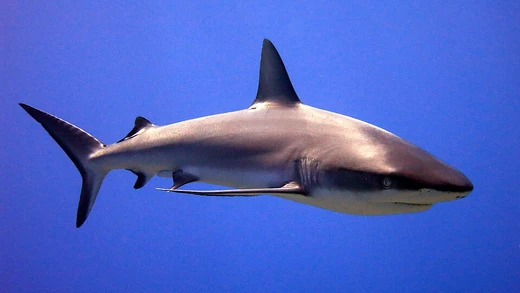
Copper shark
A slow-growing, temperate requiem shark with disjunct populations worldwide.
Last updated

Robert Nyman · via Wikipedia: Copper shark · CC BY 2.0
This shark is the only one in its genus that prefers temperate seas over tropical ones.[1] Commercial and recreational fisheries value this shark for its meat. But the shark grows slowly and reproduces at a low rate, so it's very vulnerable to overfishing. The IUCN lists it as vulnerable worldwide.[2][3]
Scientific classification
- KingdomAnimalia
- PhylumChordata
- ClassChondrichthyes
- SubclassElasmobranchii
- DivisionSelachii
- OrderCarcharhiniformes
- FamilyCarcharhinidae
- GenusCarcharhinus
- SpeciesCarcharhinus brachyurus
Named by (Günther, 1870)
Close relatives
Other species of Carcharhinus with a Codexery entry.
- Blacknose shark Carcharhinus acronotus
- Blacktip reef shark Carcharhinus melanopterus
- Bull shark Carcharhinus leucas
- Dusky shark Carcharhinus obscurus
- Nervous shark Carcharhinus cautus
- Night shark Carcharhinus signatus
- Silky shark Carcharhinus falciformis
- Spinner shark Carcharhinus brevipinna
Sources: Wikipedia taxobox: Copper shark (CC BY-SA 4.0) · order, family and genus agree with WoRMS AphiaID 217341 (CC BY 4.0)
Conservation status
Vulnerable (VU)
- LC
- NT
- VU▲ this species
- EN
- CR
- EW
- EX
Source: IUCN Red List assessment · GBIF copy of the Red List category
How big is it?
Largest length in the source, 3.3 m, next to a 1.8 m person.
Diagram: drawn by Codexery, schematic shapes to scale (not a likeness). Length: Wikipedia: Copper shark
Where the copper shark has been recorded
Each dot is a place where the species has been observed and reported (12,317 records, half-degree grid) — not a modelled range. 40 inland records left out (institution coordinates).
Map: drawn by Codexery. Data: GBIF occurrence search (records CC0 / CC BY) · Natural Earth basemap (public domain) · place coordinates: Wikipedia (CC BY-SA 4.0)
Description
The copper shark is bronze to olive-gray above with a metallic sheen, and white below with a prominent band extending onto the flanks.[4] It has a slender, streamlined body, a long pointed snout, and moderately large round eyes.[5][6] Inside the mouth you'll find 29 to 35 rows of teeth on the upper jaw and 29 to 33 rows on the lower jaw.[6] People often confuse the copper shark with other large requiem sharks, especially the dusky shark.[4]
Biology and ecology
Parasites of this shark include several species of tapeworms, a marine leech, and a fluke.[7] The copper shark feeds mostly near the bottom, consuming cephalopods, bony fishes, and cartilaginous fishes.[8] Young sharks also eat jellyfish and crustaceans.[8] Copper sharks mate from October to December in the Southern Hemisphere.[9]
Female copper sharks use shallow inshore habitats as nurseries, which provide abundant food and reduce predation risk.[10] The copper shark is among the slowest-growing requiem sharks, with males off South Africa reaching maturity at 13 to 19 years.[11] Larger sharks and killer whales may prey on this species.[7]
Distribution and habitat
Copper sharks live in many parts of the world, but they form separate regional populations that rarely mix.[1] In the Indo-Pacific, you'll find them from the East China Sea to Japan, off southern Australia, and around New Zealand.[12] Juveniles inhabit inshore waters less than 30 meters deep throughout the year.[2] Adults usually live further offshore and come close to the coast only in spring and summer.[2]
In the Atlantic, you'll find this shark from the Mediterranean Sea to Morocco and the Canary Islands, off Argentina, and off Namibia and South Africa.[13]
Human interactions
Fatal attacks blamed on this shark include the 2014 death of a swimmer in Australia and the 1976 death of a swimmer in New Zealand.[14] The copper shark isn't particularly aggressive toward humans unless food is around.[15] One problem with counting attacks is that the copper shark looks very similar to other requiem sharks, making identification difficult.[16] Like many large, active sharks, this species adapts poorly to captivity and often dies from infections caused by bumping into enclosure walls.[17]
Commercial fisheries target copper sharks off New Zealand, Australia, South Africa, Brazil, Uruguay, Argentina, Mexico, and China.[18] Fishermen also catch them as bycatch in other commercial fisheries across their range.[18] The copper shark is popular with recreational fishers in several countries.[18] In New Zealand, it sustains a small summer recreational fishery that mainly practices tag and release.[2]
In some regions, the IUCN lists the copper shark as Least Concern—off Australia, New Zealand, and South Africa, where fisheries are well-managed.[2] Additional threats include degradation of coastal nurseries from development and pollution, mortality from shark nets, and persecution by fish farmers.[2]
Taxonomy and phylogeny
British zoologist Albert Günther gave the copper shark its first valid scientific description in 1870, calling it Carcharias brachyurus.[19] Early attempts to figure out its evolutionary relationships by looking at its body shape didn't give clear answers.[20] A 1992 genetic study concluded that the closest relative of the copper shark is the spinner shark.[20]
References
- Wikipedia, "Copper shark" (CC BY-SA 4.0), which cites: Garrick, J.A.f. (1982). Sharks of the genus Carcharhinus. NOAA Technical Report, NMFS Circ. 445: 1–194. (original not read by us) en.wikipedia.org
- Wikipedia, "Copper shark" (CC BY-SA 4.0), which cites: "Carcharhinus brachyurus", 2020 (we also read that source) en.wikipedia.org
- IUCN Red List assessment (category and year as redistributed in GBIF's IUCN Red List checklist). IUCN Red List terms: fact (category, year) cited, no text reused. iucnredlist.org
- Wikipedia, "Copper shark" (CC BY-SA 4.0), which cites: Compagno, L.J.V., "Sharks of the World: An Annotated and Illustrated Catalogue of Shark Species Known to Date", Food and Agricultural Organization of the United Nations, 1984, p. 464–466; "Sharks", Firefly Books, 2002, p. 164–165; "Sharks and Rays of Australia", Harvard University Press, 2009, p. 254–255; Bray, Dianne J. (2011) Bronze Whaler, Carcharhinus brachyurus (Günther 1870). Fishes of Australia; Press, M. Biological Profiles: Narrowtooth Shark . Florida Museum of Natural History Ichthyology Department. Retrieved on April 18, 2010.; en.wikipedia.org
- Wikipedia, "Copper shark" (CC BY-SA 4.0), which cites: Compagno, L.J.V., "Sharks of the World: An Annotated and Illustrated Catalogue of Shark Species Known to Date", Food and Agricultural Organization of the United Nations, 1984, p. 464–466; Van der Elst, R., "A Guide to the Common Sea Fishes of Southern Africa", Struik, 1993, p. 35 (we also read that source) en.wikipedia.org
- Wikipedia, "Copper shark" (CC BY-SA 4.0), which cites: Compagno, L.J.V., "Sharks of the World: An Annotated and Illustrated Catalogue of Shark Species Known to Date", Food and Agricultural Organization of the United Nations, 1984, p. 464–466; "Sharks and Rays of Australia", Harvard University Press, 2009, p. 254–255; Ebert, D.A., "Sharks, Rays, and Chimaeras of California", University of California Press, 2003, p. 149–152; Compagno, L.J.V., "Sharks of the World: An Annotated and Illustrated Catalogue of Shark Species Known to Date", Food and Agricultural Organization of the United Nations, 198 en.wikipedia.org
- Wikipedia, "Copper shark" (CC BY-SA 4.0), which cites: "Carcharhinus brachyurus", 2020; Hennemann, R.M., "Sharks & Rays: Elasmobranch Guide of the World", IKAN-Unterwasserarchiv, 2001, p. 133; Press, M. Biological Profiles: Narrowtooth Shark . Florida Museum of Natural History Ichthyology Department. Retrieved on April 18, 2010.; "Cathetocephalus australis n. sp. (Cestoidea: Cathetocephalidae) from Australia, with a Proposal for Cathetocephalidea n. ord", The Journal of Parasitology, June 1990, p. 337–339; "A revision of Dasyrhynchus Pintner (Cestoda: Trypanorhyncha), parasitic in elasmobranch en.wikipedia.org
- Wikipedia, "Copper shark" (CC BY-SA 4.0), which cites: "Carcharhinus brachyurus", 2020; Van der Elst, R., "A Guide to the Common Sea Fishes of Southern Africa", Struik, 1993, p. 35; "Carcharhinus brachyurus (Bronze)", Animal Diversity Web; Smale M.J., "Occurrence and feeding of three shark species, Carcharhinus brachyurus, C. obscurus and Sphyrna zygaena, on the Eastern Cape coast of South Africa", South African Journal of Marine Science, 1991, p. 31–42; "Carcharhinus brachyurus", 2020; Heithaus, M.R., "Predator-prey and competitive interactions between sharks (order Selachii) and dolphins (su en.wikipedia.org
- Wikipedia, "Copper shark" (CC BY-SA 4.0), which cites: "Carcharhinus brachyurus", 2020; "Sharks caught in the protective gill nets off Natal, South Africa. 6. The copper shark Carcharhinus brachyurus (Günther)", South African Journal of Marine Science, 1992, p. 663–674; Lucifora, L.O., "Reproduction and seasonal occurrence of the copper shark, Carcharhinus brachyurus, from north Patagonia, Argentina", ICES Journal of Marine Science, 2005, p. 107–115 (we also read that source) en.wikipedia.org
- Wikipedia, "Copper shark" (CC BY-SA 4.0), which cites: "Carcharhinus brachyurus", 2020; Lucifora, L.O., "Reproduction and seasonal occurrence of the copper shark, Carcharhinus brachyurus, from north Patagonia, Argentina", ICES Journal of Marine Science, 2005, p. 107–115; Smale M.J., "Occurrence and feeding of three shark species, Carcharhinus brachyurus, C. obscurus and Sphyrna zygaena, on the Eastern Cape coast of South Africa", South African Journal of Marine Science, 1991, p. 31–42; "Carcharhinus brachyurus", 2020 (we also read that source) en.wikipedia.org
- Wikipedia, "Copper shark" (CC BY-SA 4.0), which cites: "Carcharhinus brachyurus", 2020; Ebert, D.A., "Sharks, Rays, and Chimaeras of California", University of California Press, 2003, p. 149–152; "Preliminary estimates of age of the bronze whaler Carcharhinus brachyurus (Chondrichthyes: Carcharhinidae) from southern Africa, with a review of some life history parameters", South African Journal of Marine Science, 1; "Carcharhinus brachyurus", 2020; Lucifora, L.O., "Reproduction and seasonal occurrence of the copper shark, Carcharhinus brachyurus, from north Patagonia, Argentina", ICES Journal of en.wikipedia.org
- Wikipedia, "Copper shark" (CC BY-SA 4.0), which cites: Roberts, "The fishes of New Zealand", Te Papa Press, 2015, p. 100 (original not read by us) en.wikipedia.org
- Wikipedia, "Copper shark" (CC BY-SA 4.0), which cites: "Preliminary estimates of age of the bronze whaler Carcharhinus brachyurus (Chondrichthyes: Carcharhinidae) from southern Africa, with a review of some life history parameters", South African Journal of Marine Science, 1 (we also read that source) en.wikipedia.org
- Wikipedia, "Copper shark" (CC BY-SA 4.0), which cites: Anna Leask, "Shark victim named", New Zealand Herald, Feb 27, 2013; "Shark Victim Named", The New Zealand Herald, February 27, 2013; "Shark Victim Named", The New Zealand Herald; Rickard, L., "Shark attack witness tells of mauling horror", The Sydney Morning Herald, September 5, 2011 (original not read by us) en.wikipedia.org
- Wikipedia, "Copper shark" (CC BY-SA 4.0), which cites: "ISAF Statistics on Attacking Species of Shark", Florida Museum of Natural History, University of Florida (original not read by us) en.wikipedia.org
- Wikipedia, "Copper shark" (CC BY-SA 4.0), which cites: Burgess, "ISAF Statistics on Attacking Species of Shark", International Shark Attack File Florida Museum of Natural History, University of Florida; "ISAF Statistics on Attacking Species of Shark", International Shark Attack File Florida Museum of Natural History, University of Florida (original not read by us) en.wikipedia.org
- Wikipedia, "Copper shark" (CC BY-SA 4.0), which cites: Hennemann, R.M., "Sharks & Rays: Elasmobranch Guide of the World", IKAN-Unterwasserarchiv, 2001, p. 133 (original not read by us) en.wikipedia.org
- Wikipedia, "Copper shark" (CC BY-SA 4.0), which cites: "Carcharhinus brachyurus", 2020; Ebert, D.A., "Sharks, Rays, and Chimaeras of California", University of California Press, 2003, p. 149–152 (we also read that source) en.wikipedia.org
- Wikipedia, "Copper shark" (CC BY-SA 4.0), which cites: Günther, A.C.L.G., "Catalogue of the Fishes in the British museum, Volume 8", The Trustees, 1870, p. 369 (original not read by us) en.wikipedia.org
- Wikipedia, "Copper shark" (CC BY-SA 4.0), which cites: Garrick, J.A.f. (1982). Sharks of the genus Carcharhinus. NOAA Technical Report, NMFS Circ. 445: 1–194.; Compagno, L.J.V., "Sharks of the Order Carcharhiniformes", Princeton University Press, 1988, p. 319–320; Naylor, G.J.P., "The phylogenetic relationships among requiem and hammerhead sharks: inferring phylogeny when thousands of equally most parsimonious trees result", Cladistics, 1992, p. 295–318; Bianucci, "Taphonomy and palaeoecology of the lower Miocene marine vertebrate assemblage of Ullujaya (Chilcatay Formation, East Pisco Basin, en.wikipedia.org
Each numbered sentence above was checked against the source it cites before publication. Sentences citing Wikipedia adapt text from the English Wikipedia article Copper shark (contributors), used under CC BY-SA 4.0; this entry is available under the same licence. Other sources were used for facts only; no text or images are copied from them.
More in Reef sharks
Elsewhere in Sharks
Test yourself
Three questions drawn from this entry’s sources. Pick an answer to check it.
Answers checked against the source article
Sources
Compiled from Wikipedia and the sources listed below. Text from Wikipedia is available under CC BY-SA 4.0; this entry is adapted from it.
- Wikipedia: Copper shark (CC BY-SA 4.0).
- Classification: the source article's taxobox; order, family and genus checked against WoRMS, the World Register of Marine Species (CC BY 4.0).
- Conservation status: IUCN Red List assessment.
- Occurrence records: GBIF (CC0 / CC BY). Basemap: Natural Earth (public domain).
- Word definitions: the Codexery glossary, each quoted from its Wikipedia article.
Spotted an error? Know more?
Reader corrections go straight into our review queue. Suggest an edit · How this site is sourced