Requiem shark
Migratory, live-bearing sharks of warm seas, often involved in attacks.
Last updated

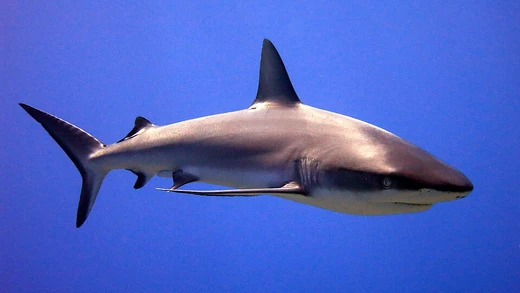
Brian Gratwicke · via Wikipedia: Requiem shark · CC BY 2.0
Requiem sharks make up the family Carcharhinidae, a group of about 57 species with a streamlined body plan.[1] They live in tropical and warm waters worldwide, from coastal reefs and estuaries to open ocean and even rivers far inland.[2][1] If you picture a shark without thinking about it, you are almost certainly picturing a requiem shark.[1]
Scientific classification
- KingdomAnimalia
- PhylumChordata
- ClassChondrichthyes
- SubclassElasmobranchii
- DivisionSelachii
- OrderCarcharhiniformes
- FamilyCarcharhinidae
Named by D. S. Jordan & Evermann, 1896
Sources: Wikipedia taxobox: Requiem shark (CC BY-SA 4.0)
Quick Facts
- Family
- Carcharhinidae
- Number of species
- 60
- Oldest fossil
- Archaeogaleus lengadocensis from the Early Cretaceous (Valanginian) of France
- Mating season
- spring to autumn
- Top attack group
- among the top five species involved in shark attacks on humans (ISAF)
Facts from the source article.
Description
Requiem sharks have the usual features of their order, including round eyes and a nictitating membrane—a third eyelid that sweeps across the eye to protect it during a strike.[2][1] Requiem sharks have long, streamlined bodies that look like torpedoes, which helps them swim fast and turn quickly.[3] Scientists think the size and shape of requiem sharks' pectoral fins are just right for cutting down the energy they use while swimming.[2]
Biology and ecology
Their food sources vary by location and species, including bony fish, squid, octopus, lobster, turtles, marine mammals, seabirds, other sharks and rays.[3] Smaller species tend to select a narrow range of prey, but some very large species are virtually omnivorous.[3] Requiem sharks are most active at night, when their excellent vision helps them creep up on prey that doesn't see them coming.[4] Some requiem shark species stay active all the time, while others can lie still on the ocean floor for long stretches.[3]
Most requiem sharks hunt by themselves, but a few species, like whitetip reef sharks and lemon sharks, work together and hunt in groups with carefully timed attacks.[5] When divers or other sharks get close, some requiem shark species put on special displays that might signal they feel threatened or are getting ready to attack.[4] Every requiem shark species gives birth to live young that are already fully developed when they're born.[2] Requiem sharks typically mate from around spring through autumn.[6]
Distribution and habitat
Most species are coastal, working reef edges, drop-offs, surf zones and estuaries.[1] A smaller number, including the blue shark, live out in open water and cross entire ocean basins.[1] Requiem sharks include the river sharks of the genus Glyphis, which live in muddy tropical rivers and estuaries.[1] The bull shark moves between salt and fresh water at will, and has been recorded far up the Mississippi, the Amazon and the Zambezi.[1]
Requiem sharks live in marine, brackish, and freshwater environments.[7]
Human interactions
According to the ISAF, requiem sharks are among the top five species involved in shark attacks on humans.[8] Even trained experts have trouble telling many requiem shark species apart.[9] Late maturity and a handful of pups per litter leave requiem sharks with no capacity to absorb fishing pressure.[1] They are heavily represented in the fin trade and in tuna and swordfish bycatch.[1]
Several species are assessed as Endangered or Critically Endangered, including the dusky, the daggernose and the river sharks.[1] White, tiger, and bull sharks are the "Big Three" for attacks—they're large, swim where people do, and have teeth that shear flesh.[9] Identifying which shark attacked is very hard because victims rarely get a good look during the encounter.[9]
Taxonomy and phylogeny
The tiger shark was treated as a requiem shark for most of the twentieth century, but genetic work has since separated it into its own family, Galeocerdonidae.[1][5] In 1896, two scientists named D.S. Jordan and B.W. Evermann first proposed the scientific name Carcharhinidae as a subfamily of Galeidae.[10][7] Only a few fossils of this group have been found from before the Cenozoic era began.[11]
References
- "Introducing Requiem Sharks", 22 August 2016. facts only, no text reused. sharksider.com
- Wikipedia, "Requiem shark" (CC BY-SA 4.0), which cites: Compagno, L.J.V. Family Carcharhinidae - Requiem sharks in Froese, R. and D. Pauly. Editors. 2010. FishBase. World Wide Web electronic publication, version (10/; Iosilevskii, "Relations between morphology, buoyancy and energetics of requiem sharks", Royal Society Open Science, 2016 (we also read that source) en.wikipedia.org
- Wikipedia, "Requiem shark" (CC BY-SA 4.0), which cites: Compagno 1984, p. 445; Compagno 1984, p. 445 (original not read by us) en.wikipedia.org
- Wikipedia, "Requiem shark" (CC BY-SA 4.0), which cites: Compagno 1984, p. 445 (original not read by us) en.wikipedia.org
- Wikipedia, "Requiem shark" (CC BY-SA 4.0), which cites: Pollerspöck, J.; Straube, N. Bibliography Database of Living/Fossil Sharks, Rays and Chimaeras (Chondrichtyes: Elasmobranchii, Holocephali)—List of Valid Extant (original not read by us) en.wikipedia.org
- Wikipedia, "Requiem shark" (CC BY-SA 4.0), which cites: "Introducing Requiem Sharks", 22 August 2016 (we also read that source) en.wikipedia.org
- World Register of Marine Species, Carcharhinidae (AphiaID 105689). CC BY 4.0. marinespecies.org
- Wikipedia, "Requiem shark" (CC BY-SA 4.0), which cites: "Species Implicated in Attacks", Florida Museum, 24 January 2018 (we also read that source) en.wikipedia.org
- "Species Implicated in Attacks", Florida Museum, 24 January 2018. facts only, no text reused. floridamuseum.ufl.edu
- Wikipedia, "Requiem shark" (CC BY-SA 4.0), which cites: Subfamily Carcharhininae Jordan & Evermann, 1896 (Family Galeidae), Bull.U.S.Nat.Mus., 48(1):28.; Compagno 1984, p. 445; Scharpf, "Order Carcharhiniformes (Ground Sharks): Families Pentanchidae, Scyliorhinidae, Proscylliidae, Pseudotriakidae, Leptochariidae, Triakidae, Hemigaleidae, Carcharhinidae and Sphyrnidae", The ETYFish Project, 18 J (we also read that source) en.wikipedia.org
- Wikipedia, "Requiem shark" (CC BY-SA 4.0), which cites: Guinot, "A rare elasmobranch assemblage from the Valanginian (Lower Cretaceous) of southern France", Cretaceous Research, March 2014, p. 54–84; Gates, "New sharks and other chondrichthyans from the latest Maastrichtian (Late Cretaceous) of North America", Journal of Paleontology, 2019-01-22, p. 512–530; Sorenson, "The effect of habitat on modern shark diversification", Journal of Evolutionary Biology, August 2014, p. 1536–1548 (we also read that source) en.wikipedia.org
Each numbered sentence above was checked against the source it cites before publication. Sentences citing Wikipedia adapt text from the English Wikipedia article Requiem shark (contributors), used under CC BY-SA 4.0; this entry is available under the same licence. Other sources were used for facts only; no text or images are copied from them.
More in Reef sharks
Elsewhere in Sharks
Sources
Compiled from Wikipedia and the sources listed below. Text from Wikipedia is available under CC BY-SA 4.0; this entry is adapted from it.
- Wikipedia: Requiem shark (CC BY-SA 4.0).
- Word definitions: the Codexery glossary, each quoted from its Wikipedia article.
Spotted an error? Know more?
Reader corrections go straight into our review queue. Suggest an edit · How this site is sourced