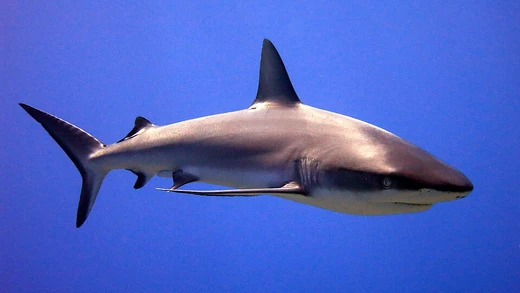
Bignose shark
A deepwater requiem shark with a circumglobal tropical distribution.
Last updated

Apex Predators Program, NOAA/NEFSC · via Wikipedia: Bignose shark · Public domain
The bignose shark is a large, deep-water requiem shark found in tropical and subtropical seas around the world.[1][2]
Scientific classification
- KingdomAnimalia
- PhylumChordata
- ClassChondrichthyes
- SubclassElasmobranchii
- DivisionSelachii
- OrderCarcharhiniformes
- FamilyCarcharhinidae
- GenusCarcharhinus
- SpeciesCarcharhinus altimus
Named by (S. Springer, 1950)
Close relatives
Other species of Carcharhinus with a Codexery entry.
- Dusky shark Carcharhinus obscurus
- Galapagos shark Carcharhinus galapagensis
- Sandbar shark Carcharhinus plumbeus
- Australian blackspot shark Carcharhinus coatesi
- Australian blacktip shark Carcharhinus tilstoni
- Blacknose shark Carcharhinus acronotus
- Blackspot shark Carcharhinus sealei
- Blacktip reef shark Carcharhinus melanopterus
Sources: Wikipedia taxobox: Bignose shark (CC BY-SA 4.0) · order, family and genus agree with WoRMS AphiaID 105787 (CC BY 4.0)
Conservation status
Near Threatened (NT)
- LC
- NT▲ this species
- VU
- EN
- CR
- EW
- EX
Source: IUCN Red List assessment · GBIF copy of the Red List category
How big is it?
Largest length in the source, 2.8 m, next to a 1.8 m person.
Diagram: drawn by Codexery, schematic shapes to scale (not a likeness). Length: Wikipedia: Bignose shark
Where the bignose shark has been recorded
Each dot is a place where the species has been observed and reported (1,132 records, half-degree grid) — not a modelled range. 74 inland records left out (institution coordinates).
Map: drawn by Codexery. Data: GBIF occurrence search (records CC0 / CC BY) · Natural Earth basemap (public domain)
Description
Sometimes there is a green sheen along the gills.[3] This shark is pretty stocky, with a long, wide, blunt snout and noticeable triangular skin flaps right in front of its nostrils.[4] Its eyes are moderately large and round, and they have nictitating membranes—basically a built-in third eyelid for protection.[4] On each side of the upper jaw, you'll find 14 to 16 rows of teeth; these teeth are tall, broad, and triangular with serrated edges.[4]
The lower jaw has 14 to 15 rows of teeth on each side, and these are narrow, stand upright, and have super fine serrations.[4]
Biology and ecology
Like other requiem sharks, this species is viviparous, meaning the developing embryos exhaust their yolk supply and then receive nourishment from the mother through a placental connection.[5] Females give birth to litters of 3 to 15 pups (usually 7), after being pregnant for about 10 months.[6] In the Mediterranean, pups are born in August and September; off Madagascar, it's September and October.[6] Males become sexually mature at around 2.2 meters long, and females at around 2.3 meters.[7]
The heaviest one ever recorded weighed 168 kilograms.[8]
Human interactions
We don't have solid numbers, but scientists suspect bignose sharks have declined in US waters. People often mistake them for sandbar sharks, and since longline fishing has cut sandbar numbers, bignose numbers may have dropped too.[9]
Taxonomy and phylogeny
Morphology-based studies by Jack Garrick in 1982 and Leonard Compagno in 1988 put the bignose shark in the obscurus group of Carcharhinus, which centers on the dusky shark and the Galapagos shark.[10]
References
- Wikipedia, "Bignose shark" (CC BY-SA 4.0), which cites: Rigby, C.L., "Carcharhinus altimus", 2020; Castro, J.I., "The Sharks of North America", Oxford University Press, 2011, p. 400–402; Atlas of Exotic Fishes in the Mediterranean Sea (Carcharhinus altimus). 2nd Edition. 2021. 366p. CIESM Publishers, Paris, Monaco.https://ciesm.org/atlas/fishes_ (we also read that source) en.wikipedia.org
- World Register of Marine Species, Carcharhinus altimus (AphiaID 105787). CC BY 4.0. marinespecies.org
- Wikipedia, "Bignose shark" (CC BY-SA 4.0), which cites: Compagno, L.J.V., "Sharks of the World: An Annotated and Illustrated Catalogue of Shark Species Known to Date", Food and Agricultural Organization of the United Nations, 1984, p. 457–458; Castro, J.I., "The Sharks of North America", Oxford University Press, 2011, p. 400–402; Bester, C. Biological Profiles: Bignose Shark . Florida Museum of Natural History Ichthyology Department. Retrieved on June 30, 2011. (we also read that source) en.wikipedia.org
- Wikipedia, "Bignose shark" (CC BY-SA 4.0), which cites: "Sharks of the World", Princeton University Press, 2005, p. 289–290; Compagno, L.J.V., "Sharks of the World: An Annotated and Illustrated Catalogue of Shark Species Known to Date", Food and Agricultural Organization of the United Nations, 1984, p. 457–458 (we also read that source) en.wikipedia.org
- Wikipedia, "Bignose shark" (CC BY-SA 4.0), which cites: Compagno, L.J.V., "Sharks of the World: An Annotated and Illustrated Catalogue of Shark Species Known to Date", Food and Agricultural Organization of the United Nations, 1984, p. 457–458; Hennemann, R.M., "Sharks & Rays: Elasmobranch Guide of the World", IKAN – Unterwasserarchiv, 2001, p. 132; Bester, C. Biological Profiles: Bignose Shark . Florida Museum of Natural History Ichthyology Department. Retrieved on June 30, 2011. (we also read that source) en.wikipedia.org
- Wikipedia, "Bignose shark" (CC BY-SA 4.0), which cites: Hennemann, R.M., "Sharks & Rays: Elasmobranch Guide of the World", IKAN – Unterwasserarchiv, 2001, p. 132; "Assessment of multiple paternity in single litters from three species of carcharhinid sharks in Hawaii", Environmental Biology of Fishes, 2006, p. 419–424 (we also read that source) en.wikipedia.org
- Wikipedia, "Bignose shark" (CC BY-SA 4.0), which cites: Compagno, L.J.V., "Sharks of the World: An Annotated and Illustrated Catalogue of Shark Species Known to Date", Food and Agricultural Organization of the United Nations, 1984, p. 457–458; Rigby, C.L., "Carcharhinus altimus", 2020 (we also read that source) en.wikipedia.org
- Wikipedia, "Bignose shark" (CC BY-SA 4.0), which cites: Castro, J.I., "The Sharks of North America", Oxford University Press, 2011, p. 400–402; Compagno, L.J.V., "Sharks of the World: An Annotated and Illustrated Catalogue of Shark Species Known to Date", Food and Agricultural Organization of the United Nations, 1984, p. 457–458; (we also read that source) en.wikipedia.org
- Wikipedia, "Bignose shark" (CC BY-SA 4.0), which cites: Rigby, C.L., "Carcharhinus altimus", 2020 (we also read that source) en.wikipedia.org
- Wikipedia, "Bignose shark" (CC BY-SA 4.0), which cites: Garrick, J.A.F. (1982). Sharks of the genus Carcharhinus. NOAA Technical Report, NMFS Circ. 445: 1–194.; Compagno, L.J.V., "Sharks of the Order Carcharhiniformes", Princeton University Press, 1988, p. 319–320 (original not read by us) en.wikipedia.org
Each numbered sentence above was checked against the source it cites before publication. Sentences citing Wikipedia adapt text from the English Wikipedia article Bignose shark (contributors), used under CC BY-SA 4.0; this entry is available under the same licence. Other sources were used for facts only; no text or images are copied from them.
More in Reef sharks
Elsewhere in Sharks
Test yourself
Three questions drawn from this entry’s sources. Pick an answer to check it.
Answers checked against the source article
Sources
Compiled from Wikipedia and the sources listed below. Text from Wikipedia is available under CC BY-SA 4.0; this entry is adapted from it.
- Wikipedia: Bignose shark (CC BY-SA 4.0).
- Classification: the source article's taxobox; order, family and genus checked against WoRMS, the World Register of Marine Species (CC BY 4.0).
- Conservation status: IUCN Red List assessment.
- Occurrence records: GBIF (CC0 / CC BY). Basemap: Natural Earth (public domain).
- Word definitions: the Codexery glossary, each quoted from its Wikipedia article.
Spotted an error? Know more?
Reader corrections go straight into our review queue. Suggest an edit · How this site is sourced