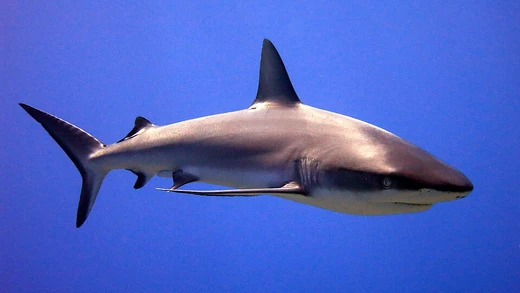
Caribbean reef shark
A large apex predator common on Caribbean coral reefs.
Last updated

Albert Kok3 · via Wikipedia: Caribbean reef shark · CC0
The Caribbean reef shark is a big requiem shark that hangs out in the tropical western Atlantic, from North Carolina down to Brazil.[1] You'll find plenty of Caribbean reef sharks on coral reefs, but scientists have studied them less than most other big requiem sharks.[2] But north of the Florida Keys, they're extremely rare.[1]
Scientific classification
- KingdomAnimalia
- PhylumChordata
- ClassChondrichthyes
- SubclassElasmobranchii
- DivisionSelachii
- OrderCarcharhiniformes
- FamilyCarcharhinidae
- GenusCarcharhinus
- SpeciesCarcharhinus perezi
Named by (Poey, 1876)
Close relatives
Other species of Carcharhinus with a Codexery entry.
- Bignose shark Carcharhinus altimus
- Bull shark Carcharhinus leucas
- Dusky shark Carcharhinus obscurus
- Galapagos shark Carcharhinus galapagensis
- Grey reef shark Carcharhinus amblyrhynchos
- Sandbar shark Carcharhinus plumbeus
- Silky shark Carcharhinus falciformis
- Australian blackspot shark Carcharhinus coatesi
Sources: Wikipedia taxobox: Caribbean reef shark (CC BY-SA 4.0) · order, family and genus agree with WoRMS AphiaID 298438 (CC BY 4.0)
Conservation status
Endangered (EN)
- LC
- NT
- VU
- EN▲ this species
- CR
- EW
- EX
Source: IUCN Red List assessment
How big is it?
Largest length in the source, 3 m, next to a 1.8 m person.
Diagram: drawn by Codexery, schematic shapes to scale (not a likeness). Length: Wikipedia: Caribbean reef shark
Where the caribbean reef shark has been recorded
Map: drawn by Codexery. Data: Natural Earth basemap (public domain) · place coordinates: Wikipedia (CC BY-SA 4.0)
Description
This shark has a heavy, streamlined body, so it's tough to tell apart from other large requiem sharks.[3] The first dorsal fin is high and sickle-shaped, with a ridge of skin running between it and the second dorsal fin.[4][5] Their backs are a dark gray or gray-brown, their bellies are white or white-yellow, and they have a faint white stripe running along their sides.[3] Each half of the upper and lower jaws has 11 to 13 rows of teeth.[4]
Biology and ecology
They feed on a wide variety of reef fish and cephalopods, as well as rays including eagle rays and yellow stingrays.[6] Females give birth to live young. The pups develop inside the mother and get nourishment through a placental connection after the yolk is used up.[7] Newborns measure no more than 74 centimeters long.[8] These sharks get more active once the sun goes down, and researchers haven't found any signs that they change their activity or migrate with the seasons.[2]
When threatened, this shark puts on a display—but it's not as dramatic as the one the grey reef shark does.[9] Young sharks stick around one local area all year long, but the adults roam over a much bigger territory.[2] In 1975, researcher Eugenie Clark studied the so-called "sleeping sharks" in caves at Isla Mujeres and found they weren't actually asleep—their eyes followed divers around.[10] These sharks can turn their stomachs inside out, likely to get rid of indigestible bits, parasites, and mucus.[6]
A typical litter has four to six pups, and the mom carries them for about a year.[7] Males reach sexual maturity when they're 1.5 to 1.7 meters long, while females mature at 2 to 3 meters.[8] Bigger sharks like tiger sharks and bull sharks will prey on the young ones.[11]
Human interactions
In Colombia, it's the most common shark caught, making up 39% of the longline catch. People use it for fins, oil, and jaws sold as ornaments.[12] In Belize, it is mainly caught as bycatch on hook-and-line gear, with fins sold to the Asian market and meat sold locally.[12] Normally these sharks are shy or just don't care about divers, but throw food into the mix and they can get aggressive—so they're considered potentially dangerous.[13] Commercial and artisanal fisheries catch these sharks throughout their range using longlines and gillnets.[12]
A big ecotourism business has grown up around organized shark feeds, where divers use bait to attract groups of reef sharks.[14] In the Bahamas, people spend about US$6,000,000 every year on shark viewing, and a single living Caribbean reef shark there can be worth between US$13,000 and US$40,000.[14] Overfishing has dropped their numbers off Belize and Cuba, and people keep fishing them in other areas.[12] Their coral reef homes are also getting degraded and destroyed, putting them at risk.[12]
But some of those reserves don't have enough enforcement to stop illegal fishing.[15]
Taxonomy and phylogeny
Felipe Poey first described the Caribbean reef shark in 1876, calling it Platypodon perezi.[16] In 1982, Jack Garrick grouped this species with the bignose shark and the sandbar shark based on their similar shapes.[17] In 1988, Leonard Compagno placed it as the sister species of the grey reef shark.[17] A 1992 genetic analysis showed it is the closest relative to a group that includes the Galapagos shark, dusky shark, oceanic whitetip shark, and blue shark.[17]
Most fossil teeth are found along the east coast of the Americas, matching the modern range, but some are also known from the Late Miocene of Portugal and the Pliocene of Italy.[18] Later researchers merged the genus Platypodon into Carcharhinus.[16] Scientists still need to do more work to figure out exactly how all the species in the genus Carcharhinus are related.[17]
References
- Wikipedia, "Caribbean reef shark" (CC BY-SA 4.0), which cites: Scharfer, A. Biological Profiles: Caribbean Reef Shark . Florida Museum of Natural History Ichthyology Department. Retrieved on February 14, 2009.; Carlson, J., "Carcharhinus perezi", 2021 (we also read that source) en.wikipedia.org
- Wikipedia, "Caribbean reef shark" (CC BY-SA 4.0), which cites: Garla, R.C., "Movement patterns of young Caribbean reef sharks, Carcharhinus perezi, at Fernando de Noronha Archipelago, Brazil: the potential of marine protected areas for conservation of a nursery ground", Marine Biolo (we also read that source) en.wikipedia.org
- Wikipedia, "Caribbean reef shark" (CC BY-SA 4.0), which cites: ; Ferrari, A., "Sharks", Firefly Books, 2002, p. 176–177 (we also read that source) en.wikipedia.org
- Wikipedia, "Caribbean reef shark" (CC BY-SA 4.0), which cites: Scharfer, A. Biological Profiles: Caribbean Reef Shark . Florida Museum of Natural History Ichthyology Department. Retrieved on February 14, 2009. (original not read by us) en.wikipedia.org
- Wikipedia, "Caribbean reef shark" (CC BY-SA 4.0), which cites: Compagno, Leonard J.V., "Sharks of the World: An Annotated and Illustrated Catalogue of Shark Species Known to Date", Food and Agriculture Organization, 1984, p. 492–493; Scharfer, A. Biological Profiles: Caribbean Reef Shark . Florida Museum of Natural History Ichthyology Department. Retrieved on February 14, 2009. (we also read that source) en.wikipedia.org
- Wikipedia, "Caribbean reef shark" (CC BY-SA 4.0), which cites: Carlson, J., "Carcharhinus perezi", 2021; Scharfer, A. Biological Profiles: Caribbean Reef Shark . Florida Museum of Natural History Ichthyology Department. Retrieved on February 14, 2009.; Martin, R.A. Caribbean Reef Shark. ReefQuest Centre for Shark Research. Retrieved on February 14, 2009.; Martin, R.A. Caribbean Reef Shark. ReefQuest Centre for Shark Research. Retrieved on February 14, 2009.; "Rapid voluntary stomach eversion in a free-living shark", Journal of the Marine Biological Association of the United Kingdom, 2005, p. 1 en.wikipedia.org
- Wikipedia, "Caribbean reef shark" (CC BY-SA 4.0), which cites: Scharfer, A. Biological Profiles: Caribbean Reef Shark . Florida Museum of Natural History Ichthyology Department. Retrieved on February 14, 2009.; Scharfer, A. Biological Profiles: Caribbean Reef Shark . Florida Museum of Natural History Ichthyology Department. Retrieved on February 14, 2009.; "Habitat of juvenile Caribbean reef sharks, Carcharhinus perezi, at two oceanic insular marine protected areas in the southwestern Atlantic Ocean: Fernando de Noronha Archipelago and Atol das Rocas, Brazil", Fisheries Re (original not read b en.wikipedia.org
- Wikipedia, "Caribbean reef shark" (CC BY-SA 4.0), which cites: Martin, R.A. Caribbean Reef Shark. ReefQuest Centre for Shark Research. Retrieved on February 14, 2009.; Scharfer, A. Biological Profiles: Caribbean Reef Shark . Florida Museum of Natural History Ichthyology Department. Retrieved on February 14, 2009. (original not read by us) en.wikipedia.org
- Wikipedia, "Caribbean reef shark" (CC BY-SA 4.0), which cites: Martin, R.A. Caribbean Reef Shark. ReefQuest Centre for Shark Research. Retrieved on February 14, 2009.; Martin, R.A., "A review of shark agonistic displays: comparison of display features and implications for shark-human interactions", Marine and Freshwater Behaviour and Physiology, March 2007, p. 3–34 (original not read by us) en.wikipedia.org
- Wikipedia, "Caribbean reef shark" (CC BY-SA 4.0), which cites: Martin, R.A. Caribbean Reef Shark. ReefQuest Centre for Shark Research. Retrieved on February 14, 2009. (original not read by us) en.wikipedia.org
- Wikipedia, "Caribbean reef shark" (CC BY-SA 4.0), which cites: Scharfer, A. Biological Profiles: Caribbean Reef Shark . Florida Museum of Natural History Ichthyology Department. Retrieved on February 14, 2009.; Sazima, I., "Shark (Carcharhinus perezi), Cleaned by the Goby (Elacatinus randalli), at Fernando de Noronha Archipelago, Western South Atlantic", Copeia, 2000, p. 297–299; "Rapid voluntary stomach eversion in a free-living shark", Journal of the Marine Biological Association of the United Kingdom, 2005, p. 1141–1144 (we also read that source) en.wikipedia.org
- Wikipedia, "Caribbean reef shark" (CC BY-SA 4.0), which cites: Carlson, J., "Carcharhinus perezi", 2021; Scharfer, A. Biological Profiles: Caribbean Reef Shark . Florida Museum of Natural History Ichthyology Department. Retrieved on February 14, 2009. (we also read that source) en.wikipedia.org
- Wikipedia, "Caribbean reef shark" (CC BY-SA 4.0), which cites: Ferrari, A., "Sharks", Firefly Books, 2002, p. 176–177; ISAF Statistics on Attacking Species of Shark. International Shark Attack File, Florida Museum of Natural History, University of Florida. Retrieved on April 22, (we also read that source) en.wikipedia.org
- Wikipedia, "Caribbean reef shark" (CC BY-SA 4.0), which cites: Fowler, S.L., "Elasmobranch Biodiversity, Conservation and Management: Proceedings of the International Seminar and Workshop, Sabah, Malaysia", International Union for Conservation of Nature and Natural Resources Species (we also read that source) en.wikipedia.org
- Wikipedia, "Caribbean reef shark" (CC BY-SA 4.0), which cites: Carlson, J., "Carcharhinus perezi", 2021 (we also read that source) en.wikipedia.org
- Wikipedia, "Caribbean reef shark" (CC BY-SA 4.0), which cites: Compagno, Leonard J.V., "Sharks of the World: An Annotated and Illustrated Catalogue of Shark Species Known to Date", Food and Agriculture Organization, 1984, p. 492–493 (we also read that source) en.wikipedia.org
- Wikipedia, "Caribbean reef shark" (CC BY-SA 4.0), which cites: Naylor, G.J.P., "The phylogenetic relationships among requiem and hammerhead sharks: inferring phylogeny when thousands of equally most parsimonious trees result", Cladistics, 1992, p. 295–318 (we also read that source) en.wikipedia.org
- Wikipedia, "Caribbean reef shark" (CC BY-SA 4.0), which cites: Höltke, "A Review of the Paleobiology of Some Neogene Sharks and the Fossil Records of Extant Shark Species", Diversity, 2024-02-26, p. 147 (we also read that source) en.wikipedia.org
Each numbered sentence above was checked against the source it cites before publication. Sentences citing Wikipedia adapt text from the English Wikipedia article Caribbean reef shark (contributors), used under CC BY-SA 4.0; this entry is available under the same licence. Other sources were used for facts only; no text or images are copied from them.
More in Reef sharks
Elsewhere in Sharks
Test yourself
Three questions drawn from this entry’s sources. Pick an answer to check it.
Answers checked against the source article
Sources
Compiled from Wikipedia and the sources listed below. Text from Wikipedia is available under CC BY-SA 4.0; this entry is adapted from it.
- Wikipedia: Caribbean reef shark (CC BY-SA 4.0).
- Classification: the source article's taxobox; order, family and genus checked against WoRMS, the World Register of Marine Species (CC BY 4.0).
- Conservation status: IUCN Red List assessment.
- Word definitions: the Codexery glossary, each quoted from its Wikipedia article.
Spotted an error? Know more?
Reader corrections go straight into our review queue. Suggest an edit · How this site is sourced