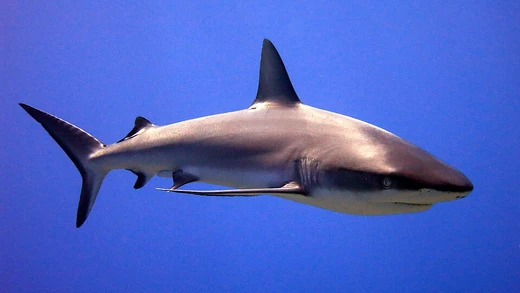
Frilled shark
Living fossil with eel-like body and frilled gill slits.
Last updated

NOAA · via Wikipedia: Frilled shark · Public domain
This shark has an eel-like body and a mouth full of needle-sharp teeth.[1][2] You can find it in the Atlantic and Pacific Oceans, usually near the ocean floor on the outer continental shelf and upper continental slope.[1] Its family line stretches back to the Carboniferous period, which is why people call it a "living fossil."[3]
Scientific classification
- KingdomAnimalia
- PhylumChordata
- ClassChondrichthyes
- SubclassElasmobranchii
- DivisionSelachii
- OrderHexanchiformes
- FamilyChlamydoselachidae
- GenusChlamydoselachus
- SpeciesChlamydoselachus anguineus
Named by Samuel Garman, 1884
Sources: Wikipedia taxobox: Frilled shark (CC BY-SA 4.0) · order, family and genus agree with WoRMS AphiaID 105831 (CC BY 4.0)
Conservation status
Least Concern (LC)
- LC▲ this species
- NT
- VU
- EN
- CR
- EW
- EX
Source: IUCN Red List assessment · GBIF copy of the Red List category
How big is it?
Largest length in the source, 2 m, next to a 1.8 m person.
Diagram: drawn by Codexery, schematic shapes to scale (not a likeness). Length: Wikipedia: Frilled shark
Where the frilled shark has been recorded
Each dot is a place where the species has been observed and reported (178 records, half-degree grid) — not a modelled range. 13 inland records left out (institution coordinates).
Map: drawn by Codexery. Data: GBIF occurrence search (records CC0 / CC BY) · Natural Earth basemap (public domain) · place coordinates: Wikipedia (CC BY-SA 4.0)
Description
The jaws hold 300 trident-shaped teeth, each with a central cusp and two smaller cusplets.[4] Six pairs of long gill slits sit at the throat, with the first pair forming a collar and the gill filaments making a fleshy frill.[4] Its tail fin is very long and triangular, with no lower lobe or notch in the upper lobe.[5] The biggest male ever found was 1.7 meters long, and the biggest female was 2.0 meters.[2]
Its nostrils look like vertical slits, and a flap of skin separates them.[4] The teeth sit in widely spaced rows, 19 to 28 in the upper jaw and 21 to 29 in the lower jaw.[4] Large, broad, and rounded pelvic and anal fins sit near the tail.[5] A pair of long, thick skin folds runs along the belly, and scientists are not sure what they do.[5]
Biology and ecology
A special sensory system along its sides helps it detect movement, vibration, and pressure changes in the water.[6] The frilled shark eats cephalopods, smaller sharks, and bony fish, with squid making up about 60 percent of its diet.[1][7] It migrates up and down in the water each day, feeding at night near the ocean surface.[1] The 300 recurved teeth snag soft-bodied prey like squid, especially when the tooth rows rotate outward as the jaws open.[8]
Its bite is fairly weak because its long jaws attach directly to the skull, which limits leverage and force.[8] Its jaws open wide enough to swallow prey more than half its own size.[8] Females give birth to live young, but the babies develop inside the mother without a placenta.[9] The embryos grow inside egg capsules within the mother, and after hatching they feed on yolk until birth.[9][10]
They do not have a specific breeding season.[9][11] Males become sexually mature at 1.0 to 1.2 meters long, and females at 1.3 to 1.5 meters.[11] An embryo grows about 1.4 centimeters per month until birth, when pups are 40 to 60 centimeters long.[12] Pregnancy can last up to 3.5 years, and a litter has 2 to 15 pups.[9][12]
Parasites include a tapeworm, a flatworm, and a roundworm.[6] Other sharks eat them, and you can tell because some frilled sharks have tail tips bitten off.[6] Frilled sharks are usually solitary, but in the late 2000s, fishermen caught over 30 of them over a seamount on the Mid-Atlantic Ridge.[13]
Distribution and habitat
In the eastern Atlantic, people have caught it off northern Norway, northern Scotland, western Ireland, from France to Morocco, Madeira, and Mauritania.[14] In Suruga Bay, Japan, you usually find them at 50 to 200 meters deep, except from August to November when the water at 100 meters gets warmer than 15 °C and they move deeper.[15] In the central Atlantic, people have caught it along the Mid-Atlantic Ridge from north of the Azores to the Rio Grande Rise off southern Brazil and the Vavilov Ridge off West Africa.[14]
Human interactions
People use them for meat and fishmeal.[9][16] In 2004, marine biologists first saw a frilled shark in its deep-water home, at 873.55 meters deep on the Blake Plateau off the southeastern US.[17] In 2007, a Japanese fisherman caught a 1.6 meter female at the surface and took it to the Awashima Marine Park, where it died after a few hours in captivity.[17] In 2014, a trawler caught a 1.5 meter frilled shark in 1.0 kilometer deep water off Lakes Entrance, Victoria, Australia, and the CSIRO confirmed what it was.[17]
Commercial fishing often catches them by accident, in trawl nets, gillnets, and longlines.[18][9]
Taxonomy and phylogeny
In 1884, zoologist Samuel Garman first formally described the species in the Bulletin of the Essex Institute, using a 1.5 meter female from Sagami Bay, Japan.[19] Garman named it Chlamydoselachus anguineus, from Greek words meaning frill and shark, and a Latin word meaning eel-like.[19] People also call it the lizard shark and the scaffold shark.[19] Garman put it in its own genus and family.[19]
Garman thought it was related to ancient sharks called cladodonts, based on primitive features like long jaws with trident-shaped teeth and a partly cartilaginous backbone.[3] Cope placed the species in the fossil genus Xenacanthus, which lived from the late Devonian to the end of the Triassic.[20] Based on its body structure, scientists place it in the group of modern sharks and rays, and it is related to the cow shark.[21] The oldest fossil teeth of this species come from the early Pleistocene epoch.[22]
In 2009, marine biologists identified and classified Chlamydoselachus africana, the southern African frilled shark, as a separate species.[22]
References
- Wikipedia, "Frilled shark" (CC BY-SA 4.0), which cites: Ebert, D.A., "Sharks, Rays, and Chimaeras of California", University of California Press, 2003, p. 50–52 (original not read by us) en.wikipedia.org
- Wikipedia, "Frilled shark" (CC BY-SA 4.0), which cites: "Chlamydoselachus africana, a new species of frilled shark from southern Africa (Chondrichthyes, Hexanchiformes, Chlamydoselachidae)", Zootaxa, 2009, p. 1–18; Ebert, D.A., "Sharks, Rays, and Chimaeras of California", University of California Press, 2003, p. 50–52; Ebert, "Chlamydoselachus Africana, A New Species Of Frilled Shark From Southern Africa (Chondrichthyes, Hexanchiformes, Chlamydoselachidae)", Zootaxa, 2009, p. 1–18; Ebert, D.A., "Sharks, Rays, and Chimaeras of California", University of California Press, 2003, p. 50–52 (we also en.wikipedia.org
- Wikipedia, "Frilled shark" (CC BY-SA 4.0), which cites: "The Frilled Shark—The Oldest Living Type of Vertebrates", Scientific American, 1887-02-26, p. 130; Compagno, L.J.V., "Phyletic Relationships of Living Sharks and Rays", American Zoologist, 1977, p. 303–322 (original not read by us) en.wikipedia.org
- Wikipedia, "Frilled shark" (CC BY-SA 4.0), which cites: Ebert, D.A., "Sharks, Rays, and Chimaeras of California", University of California Press, 2003, p. 50–52; Martin, R.A. Deep Sea: Frilled Shark. ReefQuest Centre for Shark Research. Retrieved on April 25, 2010.; Garman, S., "An Extraordinary Shark", Bulletin of the Essex Institute, January 17, 1884, p. 47–55; "Chlamydoselachus africana, a new species of frilled shark from southern Africa (Chondrichthyes, Hexanchiformes, Chlamydoselachidae)", Zootaxa, 2009, p. 1–18; Ebert, "Chlamydoselachus Africana, A New Species Of Frilled Shark From Sout en.wikipedia.org
- Wikipedia, "Frilled shark" (CC BY-SA 4.0), which cites: Garman, S., "An Extraordinary Shark", Bulletin of the Essex Institute, January 17, 1884, p. 47–55; Garman, S., "An Extraordinary Shark", Bulletin of the Essex Institute, January 17, 1884, p. 47–55; Martin, R.A. Deep Sea: Frilled Shark. ReefQuest Centre for Shark Research. Retrieved on April 25, 2010.; "Sharks and Rays of Australia", Harvard University Press, 2009, p. 34–35 (original not read by us) en.wikipedia.org
- Wikipedia, "Frilled shark" (CC BY-SA 4.0), which cites: Martin, R.A. Deep Sea: Frilled Shark. ReefQuest Centre for Shark Research. Retrieved on April 25, 2010.; Martin, R.A. Deep Sea: Frilled Shark. ReefQuest Centre for Shark Research. Retrieved on April 25, 2010.; Martin, R.A. Hearing and Vibration Detection. ReefQuest Centre for Shark Research. Retrieved on April 25, 2010.; Collett, R., "On Chlamydoselacnus anguineus Garman. A remarkable shark found in Norway 1896", Christiania, 1897, p. 1–17; Machida, M., "A new nematode (Spirurida, Physalopteridae) from frill shark of Japan", Bulletin of t en.wikipedia.org
- Wikipedia, "Frilled shark" (CC BY-SA 4.0), which cites: Ebert, D.A., "Sharks, Rays, and Chimaeras of California", University of California Press, 2003, p. 50–52; Kubota, T., "Food habits of the frilled shark Chlamydoselachus anguineus collected from Suruga bay, central Japan", Nippon Suisan Gakkaishi, January 1991, p. 15–20; Martin, R.A. Deep Sea: Frilled Shark. ReefQuest Centre for Shark Research. Retrieved on April 25, 2010.; Kubota, T., "Food habits of the frilled shark Chlamydoselachus anguineus collected from Suruga bay, central Japan", Nippon Suisan Gakkaishi, January 1991, p. 15–20; Las en.wikipedia.org
- Wikipedia, "Frilled shark" (CC BY-SA 4.0), which cites: Kubota, T., "Food habits of the frilled shark Chlamydoselachus anguineus collected from Suruga bay, central Japan", Nippon Suisan Gakkaishi, January 1991, p. 15–20; Martin, R.A. Deep Sea: Frilled Shark. ReefQuest Centre for Shark Research. Retrieved on April 25, 2010.; Ebert, D.A., "Sharks, Rays, and Chimaeras of California", University of California Press, 2003, p. 50–52; Garman, S., "An Extraordinary Shark", Bulletin of the Essex Institute, January 17, 1884, p. 47–55; Moss, S., "Feeding Mechanisms in Sharks", American Zoologist, 1977, p en.wikipedia.org
- Wikipedia, "Frilled shark" (CC BY-SA 4.0), which cites: Bray, "Frill Shark, Chlamydoselachus anguineus", FishesofAustralia.net.au, 2011 (we also read that source) en.wikipedia.org
- Wikipedia, "Frilled shark" (CC BY-SA 4.0), which cites: López‐Romero, "Growth trajectories of prenatal embryos of the deep‐sea shark Chlamydoselachus anguineus (Chondrichthyes)", Journal of Fish Biology, 2020, p. 212–224; Tanaka, S., "The reproductive biology of the frilled shark, Chlamydoselachus anguineus, from Suruga Bay, Japan", Japanese Journal of Ichthyology, 1990, p. 273–291; Nishikawa, T., "Notes on some embryos of Chlamydoselachus anguineus, Garm.", Annotationes Zoologicae Japonenses, 1898, p. 95–102 (we also read that source) en.wikipedia.org
- Wikipedia, "Frilled shark" (CC BY-SA 4.0), which cites: Tanaka, S., "The reproductive biology of the frilled shark, Chlamydoselachus anguineus, from Suruga Bay, Japan", Japanese Journal of Ichthyology, 1990, p. 273–291; Smart, J.J., "Chlamydoselachus anguineus", 2016; Tanaka, S., "The reproductive biology of the frilled shark, Chlamydoselachus anguineus, from Suruga Bay, Japan", Japanese Journal of Ichthyology, 1990, p. 273–291; Ebert, D.A., "Sharks, Rays, and Chimaeras of California", University of California Press, 2003, p. 50–52 (we also read that source) en.wikipedia.org
- Wikipedia, "Frilled shark" (CC BY-SA 4.0), which cites: Tanaka, S., "The reproductive biology of the frilled shark, Chlamydoselachus anguineus, from Suruga Bay, Japan", Japanese Journal of Ichthyology, 1990, p. 273–291; Martin, R.A. Deep Sea: Frilled Shark. ReefQuest Centre for Shark Research. Retrieved on April 25, 2010.; Ebert, D.A., "Sharks, Rays, and Chimaeras of California", University of California Press, 2003, p. 50–52 (original not read by us) en.wikipedia.org
- Wikipedia, "Frilled shark" (CC BY-SA 4.0), which cites: "The First Case of Mass Catch of a Rare Frill Shark Chlamydoselachus anguineus over a Seamount of the Mid-Atlantic Ridge", Journal of Ichthyology, 2008, p. 676–678; Jenner, J. (2004). Estuary to the Abyss: Excitement, Realities, and "Bubba". NOAA Ocean Explorer. Retrieved on April 25, 2010.; "The First Case of Mass Catch of a Rare Frill Shark Chlamydoselachus anguineus over a Seamount of the Mid-Atlantic Ridge", Journal of Ichthyology, 2008, p. 676–678; "Chlamydoselachus africana, a new species of frilled shark from southern Africa (Chond en.wikipedia.org
- Wikipedia, "Frilled shark" (CC BY-SA 4.0), which cites: Compagno, L.J.V., "Sharks of the World: An Annotated and Illustrated Catalogue of Shark Species Known to Date", Food and Agricultural Organization of the United Nations, 1984, p. 14–15 (original not read by us) en.wikipedia.org
- Wikipedia, "Frilled shark" (CC BY-SA 4.0), which cites: Ebert, D.A., "Sharks, Rays, and Chimaeras of California", University of California Press, 2003, p. 50–52; Smart, J.J., "Chlamydoselachus anguineus", 2016; Martin, R.A. Deep Sea: Frilled Shark. ReefQuest Centre for Shark Research. Retrieved on April 25, 2010.; Ebert, D.A., "Sharks, Rays, and Chimaeras of California", University of California Press, 2003, p. 50–52; Tanaka, S., "The reproductive biology of the frilled shark, Chlamydoselachus anguineus, from Suruga Bay, Japan", Japanese Journal of Ichthyology, 1990, p. 273–291; Kubota, T., "F en.wikipedia.org
- Wikipedia, "Frilled shark" (CC BY-SA 4.0), which cites: Tanaka, S., "The reproductive biology of the frilled shark, Chlamydoselachus anguineus, from Suruga Bay, Japan", Japanese Journal of Ichthyology, 1990, p. 273–291 (original not read by us) en.wikipedia.org
- Wikipedia, "Frilled shark" (CC BY-SA 4.0), which cites: Jenner, J. (2004). Estuary to the Abyss: Excitement, Realities, and "Bubba". NOAA Ocean Explorer. Retrieved on April 25, 2010.; Japanese Marine Park Captures Rare 'Living Fossil' Frilled Shark; Pictures of a Live Specimen 'Extremely Rare'. Underwatertimes.com. January 24, 2007. Retrieved; "'Horrific' Rarely-sighted Frilled Shark Caught off south-east Victoria", The Age, 21 January 2015 (we also read that source) en.wikipedia.org
- Wikipedia, "Frilled shark" (CC BY-SA 4.0), which cites: Smart, J.J., "Chlamydoselachus anguineus", 2016 (we also read that source) en.wikipedia.org
- Wikipedia, "Frilled shark" (CC BY-SA 4.0), which cites: Garman, S., "An Extraordinary Shark", Bulletin of the Essex Institute, January 17, 1884, p. 47–55; Bright, M., "The Private Life of Sharks: The Truth Behind the Myth", Stackpole Books, 2000, p. 210–213; Ebert, D.A., "Sharks, Rays, and Chimaeras of California", University of California Press, 2003, p. 50–52; Smart, J.J., "Chlamydoselachus anguineus", 2016; (we also read that source) en.wikipedia.org
- Wikipedia, "Frilled shark" (CC BY-SA 4.0), which cites: "'The Oldest Living Type of Vertebrata,' Chlamydoselachus", Science, March 21, 1884, p. 345–346; Martin, R.A. Chlamydoselachiformes: Frilled Sharks. ReefQuest Centre for Shark Research. Retrieved on April 25, 2010. (original not read by us) en.wikipedia.org
- Wikipedia, "Frilled shark" (CC BY-SA 4.0), which cites: Bustamante, "Genetype and phylogenomic position of the frilled shark Chlamydoselachus anguineus inferred from the mitochondrial genome", Mitochondrial DNA Part B, 2016-01-01, p. 18–20; Compagno, L.J.V., "Phyletic Relationships of Living Sharks and Rays", American Zoologist, 1977, p. 303–322; Martin, R.A. Chlamydoselachiformes: Frilled Sharks. ReefQuest Centre for Shark Research. Retrieved on April 25, 2010. (original not read by us) en.wikipedia.org
- Wikipedia, "Frilled shark" (CC BY-SA 4.0), which cites: Martin, R.A. The Rise of Modern Sharks. ReefQuest Centre for Shark Research. Retrieved on April 25, 2010.; Bright, M., "The Private Life of Sharks: The Truth Behind the Myth", Stackpole Books, 2000, p. 210–213; Marsili, S. (2007). Analisi systematic, paleoecological e paleobiogeographical Della selaciofauna polio-Pleistocene del Mediterraneo.; "Chlamydoselachus africana, a new species of frilled shark from southern Africa (Chondrichthyes, Hexanchiformes, Chlamydoselachidae)", Zootaxa, 2009, p. 1–18 (we also read that source) en.wikipedia.org
Each numbered sentence above was checked against the source it cites before publication. Sentences citing Wikipedia adapt text from the English Wikipedia article Frilled shark (contributors), used under CC BY-SA 4.0; this entry is available under the same licence. Other sources were used for facts only; no text or images are copied from them.
More in Dogfish sharks and relatives
Elsewhere in Sharks
Test yourself
Three questions drawn from this entry’s sources. Pick an answer to check it.
Answers checked against the source article
Sources
Compiled from Wikipedia and the sources listed below. Text from Wikipedia is available under CC BY-SA 4.0; this entry is adapted from it.
- Wikipedia: Frilled shark (CC BY-SA 4.0).
- Classification: the source article's taxobox; order, family and genus checked against WoRMS, the World Register of Marine Species (CC BY 4.0).
- Conservation status: IUCN Red List assessment.
- Occurrence records: GBIF (CC0 / CC BY). Basemap: Natural Earth (public domain).
- Word definitions: the Codexery glossary, each quoted from its Wikipedia article.
Spotted an error? Know more?
Reader corrections go straight into our review queue. Suggest an edit · How this site is sourced