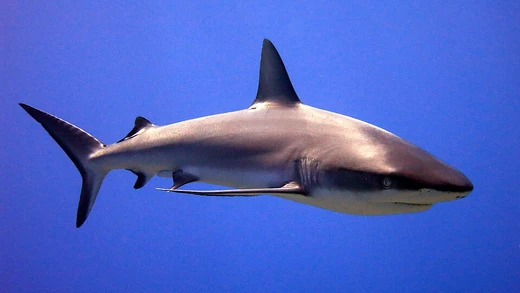
Hardnose shark
A small, gregarious requiem shark with a calcified snout.
Last updated

Müller & Henle · via Wikipedia: Hardnose shark · Public domain
The hardnose shark is a slim, bronze-coloured requiem shark that lives in the warm coastal waters of the tropical western Indo-Pacific.[1][2] Its most distinctive feature is its unusually stiff, calcified snout, which gives the species its common name.[2]
Scientific classification
- KingdomAnimalia
- PhylumChordata
- ClassChondrichthyes
- SubclassElasmobranchii
- DivisionSelachii
- OrderCarcharhiniformes
- FamilyCarcharhinidae
- GenusCarcharhinus
- SpeciesCarcharhinus macloti
Named by (J. P. Müller & Henle, 1839)
Close relatives
Other species of Carcharhinus with a Codexery entry.
- Australian blacktip shark Carcharhinus tilstoni
- Blackspot shark Carcharhinus sealei
- Borneo shark Carcharhinus borneensis
- Creek whaler Carcharhinus fitzroyensis
- Smalltail shark Carcharhinus porosus
- Whitecheek shark Carcharhinus dussumieri
- Pondicherry shark (Carcharhinus hemiodon) Carcharhinus hemiodon
- Australian blackspot shark Carcharhinus coatesi
Sources: Wikipedia taxobox: Hardnose shark (CC BY-SA 4.0) · order, family and genus agree with WoRMS AphiaID 217335 (CC BY 4.0)
Conservation status
Near Threatened (NT)
- LC
- NT▲ this species
- VU
- EN
- CR
- EW
- EX
Source: IUCN Red List assessment · GBIF copy of the Red List category
How big is it?
Largest length in the source, 1.1 m, next to a 1.8 m person.
Diagram: drawn by Codexery, schematic shapes to scale (not a likeness). Length: Wikipedia: Hardnose shark
Where the hardnose shark has been recorded
Each dot is a place where the species has been observed and reported (3,036 records, half-degree grid) — not a modelled range. 13 inland records left out (institution coordinates). 1 isolated far-off record not drawn.
Map: drawn by Codexery. Data: GBIF occurrence search (records CC0 / CC BY) · Natural Earth basemap (public domain)
Description
The hardnose shark has a long, narrow, and pointed snout, and the cartilage inside it is heavily hardened with calcium, so the snout feels stiff.[2] The arched mouth has faint furrows at the corners, and the tiny pores above the mouth (called hyomandibular pores) may or may not be enlarged.[2] Those big, round eyes come with a built-in third eyelid called a nictitating membrane that protects them.[2] Up top, you'll find 29 to 32 rows of teeth, each with a narrow, smooth central point and really rough serrations down near the base.[2]
Down below, there are 26 to 29 rows of teeth, and they're narrow and smooth all the way.[2] This shark breathes through five pairs of gill slits, and they're all pretty short.[2] A medium-sized, triangular first dorsal fin starts up roughly where the free rear tips of the pectoral fins end.[2] Right where the upper tail fin begins, you'll see a clear notch on the tail stalk (the caudal peduncle).[2]
This shark shows off a bronze back and a white belly, with a very faint pale stripe along its sides.[2] A full-grown hardnose shark tops out at about 1.1 meters long.[2]
Biology and ecology
It is viviparous—the young develop inside the mother. Once the embryos use up their yolk supply, the empty yolk sac becomes a placental connection that provides nutrition.[3] Males and females tend to keep to their own separate gangs.[3] Every other year, a female gives birth to just one or two pups after carrying them for twelve months.[4] Newborn pups measure between 45 and 55 centimeters, and they become sexually mature when they reach 70 to 75 centimeters.[4]
Distribution and habitat
Tagging studies reveal that these sharks aren't big travelers—30 percent of recaptured individuals had moved less than 50 kilometers from where scientists first tagged them.[5] The longest journey scientists have recorded for one of these sharks is 711 kilometers.[5]
Human interactions
Don't worry—this shark poses no danger to people.[6] Fisheries across much of its range catch this shark with gillnets and line gear, both for small-scale and commercial operations.[6] People sell its meat fresh or dried and salted, but because the shark is small, it doesn't bring in much money.[6] Because it reproduces slowly, it could be vulnerable to overfishing, and with current fishing pressure, the IUCN lists it as Near Threatened globally.[6][7]
Taxonomy and phylogeny
Back in 1839, German biologists Johannes Müller and Jakob Henle first described this shark.[8] Scientists still haven't completely figured out how the hardnose shark is related to other sharks.[9] A 1988 study based on shape tentatively grouped it with several other requiem sharks, but later molecular studies have given inconsistent results.[9]
References
- Wikipedia, "Hardnose shark" (CC BY-SA 4.0), which cites: Rigby, C.L., "Carcharhinus macloti", 2021; "Field Guide for Sharks of the Genus Carcharhinus", Verlag Dr. Friedrich Pfeil, 2011, p. 80–81 (we also read that source) en.wikipedia.org
- Wikipedia, "Hardnose shark" (CC BY-SA 4.0), which cites: "Sharks and Rays of Australia", Harvard University Press, 2009, p. 266–267; "Field Guide for Sharks of the Genus Carcharhinus", Verlag Dr. Friedrich Pfeil, 2011, p. 80–81; Compagno, L.J.V., "Sharks of the World: An Annotated and Illustrated Catalogue of Shark Species Known to Date", Food and Agricultural Organization of the United Nations, 1984, p. 486–487 (we also read that source) en.wikipedia.org
- Wikipedia, "Hardnose shark" (CC BY-SA 4.0), which cites: "Field Guide for Sharks of the Genus Carcharhinus", Verlag Dr. Friedrich Pfeil, 2011, p. 80–81; "Acanthocheilus rotundatus (Nematoda: Acanthocheilidae) from the intestine of shark (Carcharhinus macloti) in Persian Gulf, Iran", Iranian Journal of Veterinary Research, 2008, p. 178–180; "Redescriptions and new records of species of Otobothrium Linton, 1890 (Cestoda: Trypanorhyncha)", Systematic Parasitology, 2013, p. 17–55 (we also read that source) en.wikipedia.org
- Wikipedia, "Hardnose shark" (CC BY-SA 4.0), which cites: Rigby, C.L., "Carcharhinus macloti", 2021 (we also read that source) en.wikipedia.org
- Wikipedia, "Hardnose shark" (CC BY-SA 4.0), which cites: "Sharks and Rays of Australia", Harvard University Press, 2009, p. 266–267 (we also read that source) en.wikipedia.org
- Wikipedia, "Hardnose shark" (CC BY-SA 4.0), which cites: Compagno, L.J.V., "Sharks of the World: An Annotated and Illustrated Catalogue of Shark Species Known to Date", Food and Agricultural Organization of the United Nations, 1984, p. 486–487 (we also read that source) en.wikipedia.org
- IUCN Red List assessment (category and year as redistributed in GBIF's IUCN Red List checklist). IUCN Red List terms: fact (category, year) cited, no text reused. iucnredlist.org
- Wikipedia, "Hardnose shark" (CC BY-SA 4.0), which cites: "Systematische Beschreibung der Plagiostomen (volume 2)", Veit und Comp., 1839, p. 34 (original not read by us) en.wikipedia.org
- Wikipedia, "Hardnose shark" (CC BY-SA 4.0), which cites: Compagno, L.J.V., "Sharks of the Order Carcharhiniformes", Princeton University Press, 1988, p. 319–320; Naylor, G.J.P., "The phylogenetic relationships among requiem and hammerhead sharks: inferring phylogeny when thousands of equally most parsimonious trees result", Cladistics, 1992, p. 295–318; "Shark tales: A molecular species-level phylogeny of sharks (Selachimorpha, Chondrichthyes)", Molecular Phylogenetics and Evolution, February 2011, p. 207–217; "The Biology of Sharks and Their Relatives", CRC Press, 2012, p. 31–57 (we also read en.wikipedia.org
Each numbered sentence above was checked against the source it cites before publication. Sentences citing Wikipedia adapt text from the English Wikipedia article Hardnose shark (contributors), used under CC BY-SA 4.0; this entry is available under the same licence. Other sources were used for facts only; no text or images are copied from them.
More in Reef sharks
Elsewhere in Sharks
Test yourself
Three questions drawn from this entry’s sources. Pick an answer to check it.
Answers checked against the source article
Sources
Compiled from Wikipedia and the sources listed below. Text from Wikipedia is available under CC BY-SA 4.0; this entry is adapted from it.
- Wikipedia: Hardnose shark (CC BY-SA 4.0).
- Classification: the source article's taxobox; order, family and genus checked against WoRMS, the World Register of Marine Species (CC BY 4.0).
- Conservation status: IUCN Red List assessment.
- Occurrence records: GBIF (CC0 / CC BY). Basemap: Natural Earth (public domain).
- Word definitions: the Codexery glossary, each quoted from its Wikipedia article.
Spotted an error? Know more?
Reader corrections go straight into our review queue. Suggest an edit · How this site is sourced