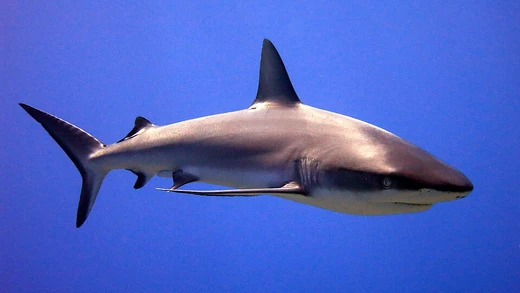
Australian blackspot shark
A cryptic requiem shark of northern Australian inshore waters.
Last updated

CSIRO National Fish Collection · via Wikipedia: Australian blackspot shark · CC BY 4.0
Australian blackspot sharks are small requiem sharks that live in the shallow coastal waters off northern Australia and possibly New Guinea.[1] They're part of a group of closely related blackspot sharks that scientists only sorted out as separate species in 2012.[1]
Scientific classification
- KingdomAnimalia
- PhylumChordata
- ClassChondrichthyes
- SubclassElasmobranchii
- DivisionSelachii
- OrderCarcharhiniformes
- FamilyCarcharhinidae
- GenusCarcharhinus
- SpeciesCarcharhinus coatesi
Named by (Whitley, 1939)
Close relatives
Other species of Carcharhinus with a Codexery entry.
- Australian blacktip shark Carcharhinus tilstoni
- Bignose shark Carcharhinus altimus
- Blacknose shark Carcharhinus acronotus
- Blackspot shark Carcharhinus sealei
- Blacktip reef shark Carcharhinus melanopterus
- Blacktip shark Carcharhinus limbatus
- Borneo shark Carcharhinus borneensis
- Bull shark Carcharhinus leucas
Sources: Wikipedia taxobox: Australian blackspot shark (CC BY-SA 4.0) · order, family and genus agree with WoRMS AphiaID 1014961 (CC BY 4.0)
Conservation status
Least Concern (LC)
- LC▲ this species
- NT
- VU
- EN
- CR
- EW
- EX
Source: IUCN Red List assessment · GBIF copy of the Red List category
How big is it?
Largest length in the source, 0.88 m, next to a 1.8 m person.
Diagram: drawn by Codexery, schematic shapes to scale (not a likeness). Length: Wikipedia: Australian blackspot shark
Where the australian blackspot shark has been recorded
Each dot is a place where the species has been observed and reported (2,213 records, half-degree grid) — not a modelled range. 5 inland records left out (institution coordinates).
Map: drawn by Codexery. Data: GBIF occurrence search (records CC0 / CC BY) · Natural Earth basemap (public domain) · place coordinates: Wikipedia (CC BY-SA 4.0)
Description
These small inshore sharks reach a maximum length of 88 cm.[2] At birth, pups measure between 38 and 40 cm.[2] Both sexes mature at about 70 cm.[2] The body is pale brown, fading to gray after death, with an almost white belly—a classic countershading pattern that helps camouflage them from above and below.[3]
Biology and ecology
They are thought to reproduce every year, though the gestation period is unknown because breeding does not seem tied to a particular season.[4]
Taxonomy and phylogeny
Its scientific name is Carcharhinus coatesi, and Whitley first described it in 1939.[5][6] It's a member of the family Carcharhinidae—the requiem sharks.[5] Researchers resurrected it as a valid species in 2012, separating it from the whitecheek shark and the blackspot shark.[1]
References
- Wikipedia, "Australian blackspot shark" (CC BY-SA 4.0), which cites: White, "A redescription of Carcharhinus dussumieri and C. sealei, with resurrection of C. coatesi and C. tjutjot as valid species (Chondrichthyes: Carcharhinidae)", Zootaxa, 2012-03-21, p. 1–34; Stevens, "Distribution, size and sex composition, reproductive biology and diet of sharks from Northern Australia", Marine and Freshwater Research, 1991, p. 151–199 (we also read that source) en.wikipedia.org
- Wikipedia, "Australian blackspot shark" (CC BY-SA 4.0), which cites: Stevens, "Distribution, size and sex composition, reproductive biology and diet of sharks from Northern Australia", Marine and Freshwater Research, 1991, p. 151–199 (we also read that source) en.wikipedia.org
- Wikipedia, "Australian blackspot shark" (CC BY-SA 4.0), which cites: White, "Sharks and Rays of Papua New Guinea", Australian Centre for International Agricultural Research, 2018 (original not read by us) en.wikipedia.org
- Wikipedia, "Australian blackspot shark" (CC BY-SA 4.0), which cites: White, "Sharks and Rays of Papua New Guinea", Australian Centre for International Agricultural Research, 2018; Stevens, "Distribution, size and sex composition, reproductive biology and diet of sharks from Northern Australia", Marine and Freshwater Research, 1991, p. 151–199; White, "Sharks and Rays of Papua New Guinea", Australian Centre for International Agricultural Research, 2018 (we also read that source) en.wikipedia.org
- World Register of Marine Species, Carcharhinus coatesi (AphiaID 1014961). CC BY 4.0. marinespecies.org
- GBIF Backbone Taxonomy and occurrence index, Carcharhinus coatesi (taxon key 7466803). CC BY 4.0 (backbone); counts are facts. gbif.org
Each numbered sentence above was checked against the source it cites before publication. Sentences citing Wikipedia adapt text from the English Wikipedia article Australian blackspot shark (contributors), used under CC BY-SA 4.0; this entry is available under the same licence. Other sources were used for facts only; no text or images are copied from them.
More in Reef sharks
Elsewhere in Sharks
Test yourself
Three questions drawn from this entry’s sources. Pick an answer to check it.
Answers checked against the source article
Sources
Compiled from Wikipedia and the sources listed below. Text from Wikipedia is available under CC BY-SA 4.0; this entry is adapted from it.
- Wikipedia: Australian blackspot shark (CC BY-SA 4.0).
- Classification: the source article's taxobox; order, family and genus checked against WoRMS, the World Register of Marine Species (CC BY 4.0).
- Conservation status: IUCN Red List assessment.
- Occurrence records: GBIF (CC0 / CC BY). Basemap: Natural Earth (public domain).
- Word definitions: the Codexery glossary, each quoted from its Wikipedia article.
Spotted an error? Know more?
Reader corrections go straight into our review queue. Suggest an edit · How this site is sourced