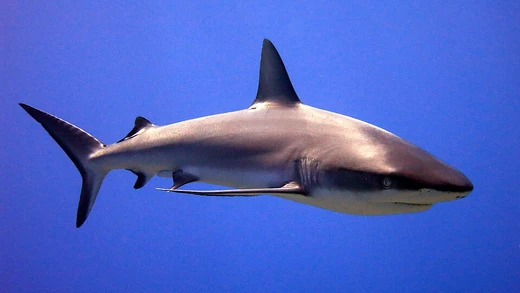
Basking shark
The second-largest fish, a gentle filter feeder that basks at the surface.
Last updated

Ian Andrews · CC BY-SA 2.0
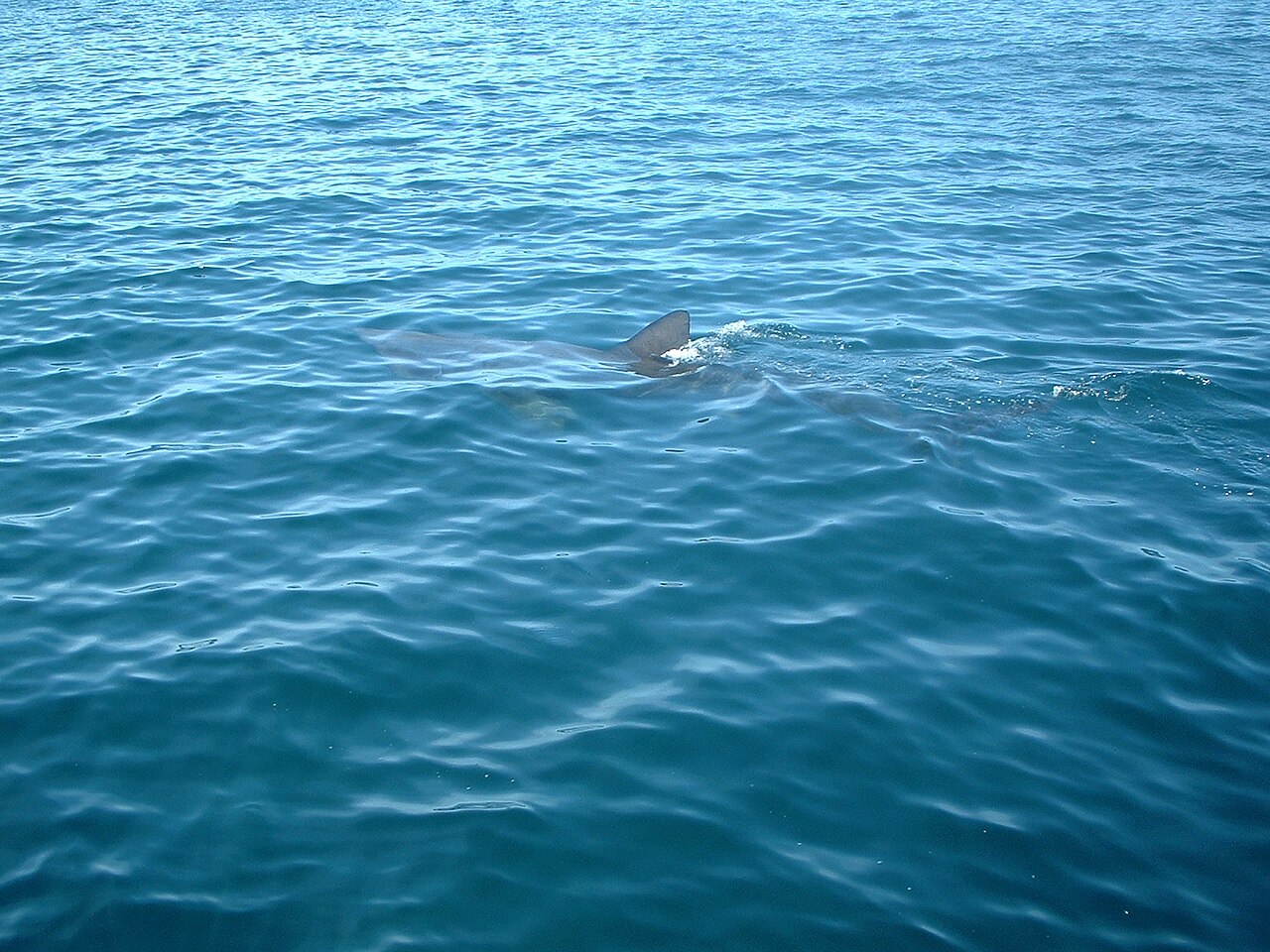
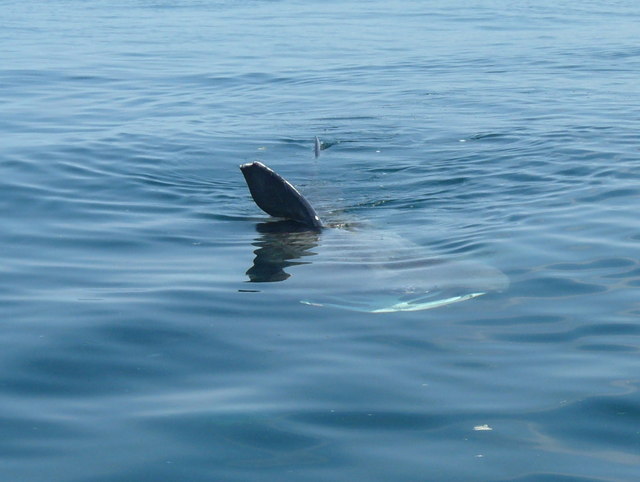
Three shark species consume plankton: the whale shark, the megamouth shark, and the basking shark.[1] The name "basking shark" comes from this animal's tendency to feed while floating at the surface, which makes it look like it is sunbathing.[2]
Scientific classification
- KingdomAnimalia
- PhylumChordata
- ClassChondrichthyes
- SubclassElasmobranchii
- DivisionSelachii
- OrderLamniformes
- FamilyCetorhinidae
- GenusCetorhinus
- SpeciesCetorhinus maximus
Named by (Gunnerus, 1765)
Sources: Wikipedia taxobox: Basking shark (CC BY-SA 4.0) · order, family and genus agree with WoRMS AphiaID 105837 (CC BY 4.0)
Conservation status
Endangered (EN)
- LC
- NT
- VU
- EN▲ this species
- CR
- EW
- EX
Source: IUCN Red List assessment · GBIF copy of the Red List category
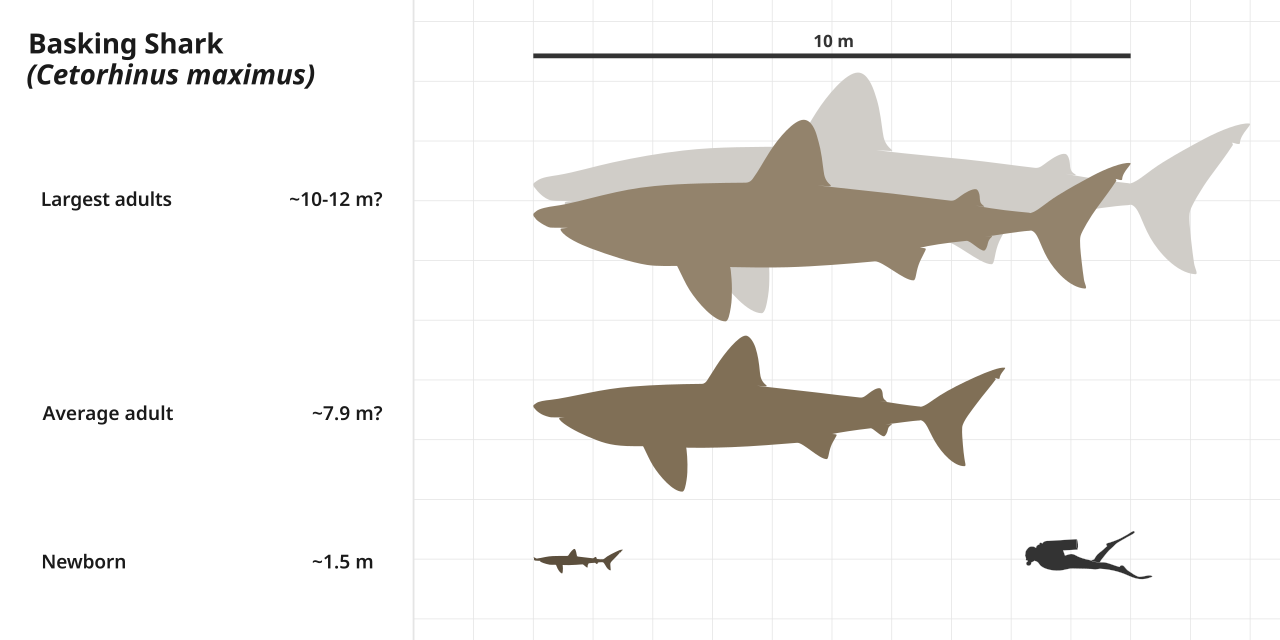
How big is it?
Largest length in the source, 10 m, next to a 1.8 m person.
Diagram: drawn by Codexery, schematic shapes to scale (not a likeness). Length: Wikipedia: Basking shark
Where the basking shark has been recorded
Each dot is a place where the species has been observed and reported (38,977 records, half-degree grid) — not a modelled range. 17 inland records left out (institution coordinates). 2 isolated far-off records not drawn.
Map: drawn by Codexery. Data: GBIF occurrence search (records CC0 / CC BY) · Natural Earth basemap (public domain) · place coordinates: Wikipedia (CC BY-SA 4.0)
Biology and range
Temperate oceans worldwide host the migratory basking shark, a species found across the globe.[2] Filter-feeding in this shark is made possible by a very large mouth and well-developed gill rakers.[2] Each row of teeth in this species can contain about 100 very small teeth, each with a single conical cusp.[2] Relative to its body weight, the basking shark possesses the smallest brain of any shark, which matches its generally inactive way of life.[2]
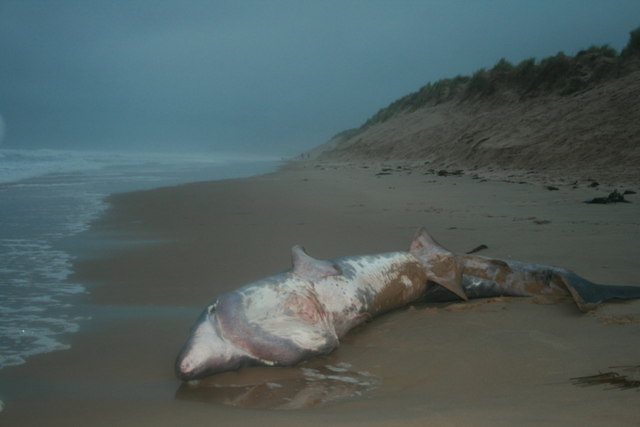
Satellite tagging has demonstrated that basking sharks spend the winter in waters over the continental shelf as well as in deeper areas.[3] These sharks can be solitary or form small groups.[3] The tagged sharks stayed at depths of 200 to 1000 meters for several weeks and swam across the equator to reach Brazil.[4][5]
What the specialist sources record
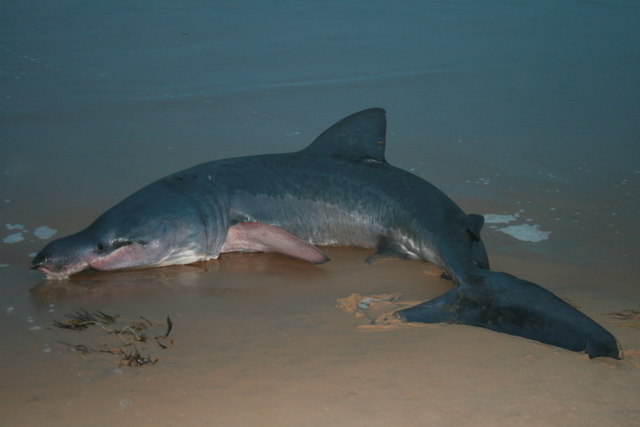
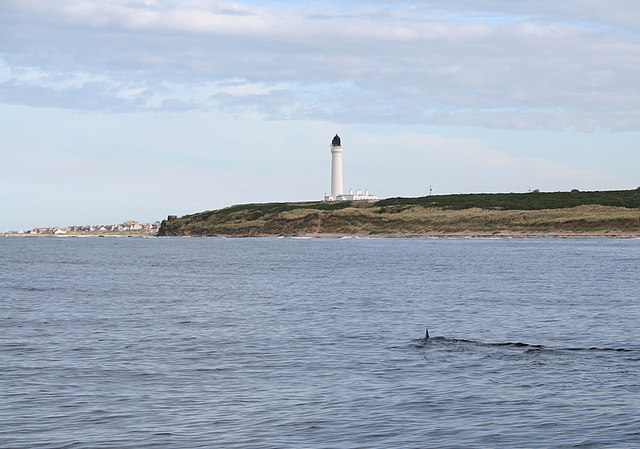
The Oceana account notes that basking sharks are the second largest fish in the world, following the whale shark.[6] Fishbase distinguishes them from all other sharks by the enormous gill slits practically encircling the head.[7] The same source reports that parasitic lampreys have been found attached to the back of basking sharks in the Bay of Fundy, Canada.[7] A 2003 study by Sims et al. confirmed that basking sharks do not hibernate and are active year-round.[8][9]
The Oceana account states that basking sharks are thought to live up to 50 years, but grow and reproduce slowly.[6]
References
- Wikipedia, "Basking shark" (CC BY-SA 4.0), which cites: "Basking Shark", Oceana (we also read that source) en.wikipedia.org
- Wikipedia, "Basking shark" (CC BY-SA 4.0), which cites: Kruska, "Brain of the basking shark (Cetorhinus maximus)", Brain Behav. Evol., 1988, p. 353–63 (we also read that source) en.wikipedia.org
- Wikipedia, "Basking shark" (CC BY-SA 4.0), which cites: Sims, "Seasonal movements and behaviour of basking sharks from archival tagging: no evidence of winter hibernation", Marine Ecology Progress Series, 2003, p. 187–196 (we also read that source) en.wikipedia.org
- Wikipedia, "Basking shark" (CC BY-SA 4.0), which cites: "Transequatorial Migrations by Basking Sharks in the Western Atlantic Ocean", Current Biology, 2009, p. 1019–1022; "Giant Shark Mystery Solved: Unexpected Hideout Found", News.nationalgeographic.com, 28 October 2010 (we also read that source) en.wikipedia.org
- Gregory B. Skomal, "Transequatorial Migrations by Basking Sharks in the Western Atlantic Ocean", Current Biology (2009), doi:10.1016/j.cub.2009.04.019. OpenAlex metadata CC0; paper not read. doi.org
- "Basking Shark", Oceana. facts only, no text reused. oceana.org
- "Cetorhinus maximus", fishbase, 12 May 2025. facts only, no text reused. fishbase.se
- DW Sims, "Seasonal movements and behaviour of basking sharks from archival tagging: no evidence of winter hibernation", Marine Ecology Progress Series (2003), doi:10.3354/meps248187. OpenAlex metadata CC0; paper not read. doi.org
- Wikipedia, "Basking shark" (CC BY-SA 4.0), which cites: Sims, "Seasonal movements and behaviour of basking sharks from archival tagging: no evidence of winter hibernation", Marine Ecology Progress Series, 2003, p. 187–196; Shepard, "Diel and tidal rhythms in diving behaviour of pelagic sharks identified by signal processing of archival tagging data", Marine Ecology Progress Series, 2006, p. 205–213 (we also read that source) en.wikipedia.org
Each numbered sentence above was checked against the source it cites before publication. Sentences citing Wikipedia adapt text from the English Wikipedia article Basking shark (contributors), used under CC BY-SA 4.0; this entry is available under the same licence. Other sources were used for facts only; no text or images are copied from them.
More in Mackerel sharks
Elsewhere in Sharks
Test yourself
Three questions drawn from this entry’s sources. Pick an answer to check it.
Answers checked against the source article
Sources
Compiled from Wikipedia and the sources listed below. Text from Wikipedia is available under CC BY-SA 4.0; this entry is adapted from it.
- Wikipedia: Basking shark (CC BY-SA 4.0).
- Classification: the source article's taxobox; order, family and genus checked against WoRMS, the World Register of Marine Species (CC BY 4.0).
- Conservation status: IUCN Red List assessment.
- Occurrence records: GBIF (CC0 / CC BY). Basemap: Natural Earth (public domain).
- Word definitions: the Codexery glossary, each quoted from its Wikipedia article.
Spotted an error? Know more?
Reader corrections go straight into our review queue. Suggest an edit · How this site is sourced