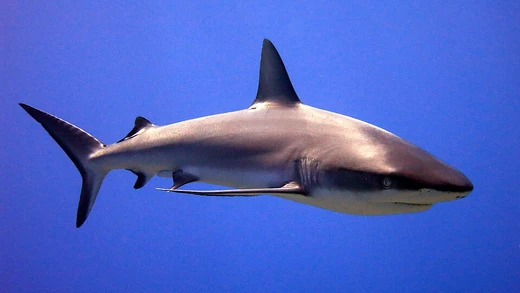
Greenland shark
The Greenland shark is a deep-dwelling Arctic giant with the longest lifespan of any vertebrate, a genome of 6.45 billion base pairs, and a slow, stealthy hunting style.
Last updated

NOAA Okeanos Explorer Program · via Wikipedia: Greenland shark · Public domain
The Greenland shark—also called the grey shark or gurry shark—is a big, slow-moving sleeper shark that lives in the cold North Atlantic and Arctic Oceans.[1] They are poorly studied because their natural habitat is deep and remote.[1]
Scientific classification
- KingdomAnimalia
- PhylumChordata
- ClassChondrichthyes
- SubclassElasmobranchii
- DivisionSelachii
- OrderSqualiformes
- FamilySomniosidae
- GenusSomniosus
- SpeciesSomniosus microcephalus
Named by (Bloch & J. G. Schneider, 1801)
Sources: Wikipedia taxobox: Greenland shark (CC BY-SA 4.0) · order, family and genus agree with WoRMS AphiaID 105919 (CC BY 4.0)
Conservation status
Vulnerable (VU)
- LC
- NT
- VU▲ this species
- EN
- CR
- EW
- EX
Source: IUCN Red List assessment · GBIF copy of the Red List category
How big is it?
Largest length in the source, 6.4 m, next to a 1.8 m person.
Diagram: drawn by Codexery, schematic shapes to scale (not a likeness). Length: Wikipedia: Greenland shark
Where the greenland shark has been recorded
Each dot is a place where the species has been observed and reported (845 records, half-degree grid) — not a modelled range. 55 inland records left out (institution coordinates). 6 isolated far-off records not drawn.
Map: drawn by Codexery. Data: GBIF occurrence search (records CC0 / CC BY) · Natural Earth basemap (public domain) · place coordinates: Wikipedia (CC BY-SA 4.0)
Description
Adults typically grow to around 4 to 5 meters, with the largest confirmed specimen reaching 6.4 meters and weighing about 1023 kilograms.[2] Coloration ranges from pale creamy-gray to blackish-brown, and the body is usually uniform in color, though whitish spots or faint dark streaks sometimes appear on the back.[3] Females are typically larger than males.[4] For such a huge shark, its five gill slits are tiny.[5]
Because this shark is cold-blooded and lives in water that's almost freezing, it's really sluggish and slow, with the lowest swimming speed and tail-beat rate for its size of any fish.[6]
Biology and ecology
Because seals swim much faster, biologists are uncertain how the sharks are able to prey on the seals, though the sharks are thought to ambush while seals are asleep.[6] A tiny parasite called Ommatokoita elongata can damage the eyes, sometimes causing near blindness, but the sharks rely mostly on smell and hearing instead.[7] Their main diet includes fish like herring, cod, halibut, and redfish, plus seals.[8] Scientists have found remains of moose, horse, and reindeer in their stomachs, and polar bear remains too, though experts think those bears died from other causes.[9]
The pups are born live after a pregnancy that scientists think lasts between 8 and 18 years.[10] Greenland sharks become able to reproduce at around 150 years old, based on radiocarbon dating of their eye lenses.[10] This species holds the record for the longest life of any vertebrate, with the oldest known individual estimated to be 392 years old, give or take 120 years.[11]
Distribution and habitat
A submersible checking out the wreck of the SS Central America spotted one of these sharks at a depth of 2200 meters.[12] Back in August 2013, researchers caught a Greenland shark in the Gulf of Mexico at 1749 meters deep, where the water was 4.1 °C.[13] They're usually found from the surface down to 1500 meters, hanging out in shallower water up north and deeper water down south.[13]
Human interactions
Greenland sharks are not considered a threat to humans because they live deep in remote parts of the northern oceans.[14] There's a report of a possible attack on two British fishermen in August 1936, but nobody ever confirmed what kind of shark it was.[15] People used to hunt this shark for its liver oil until synthetic oils came along and exports from Greenland stopped in the 1960s.[16] Nowadays, industrial fisheries mostly catch Greenland sharks by accident, as bycatch.[16]
Every year, about 3,500 of them get caught as bycatch in the Arctic and Atlantic Oceans.[17] The IUCN Red List says the Greenland shark is Vulnerable.[18]
Taxonomy and phylogeny
Bloch and Schneider first described the Greenland shark in 1801, giving it the scientific name Somniosus microcephalus.[19][20] Genetic studies show that Greenland sharks split off from their sleeper shark ancestors in the Canadian Arctic about 1 to 2.34 million years ago, during the Pleistocene epoch.[21] Scientists published the Greenland shark's genome in 2024, and it's a whopping 6.45 billion base pairs long.[22]
References
- Wikipedia, "Greenland shark" (CC BY-SA 4.0), which cites: Yano, "A review of the systematics of the sleeper shark genus Somniosus with redescriptions of Somniosus (Somniosus) antarcticus and Somniosus (Rhinoscymnus) longus (Squaliformes: Somniosidae)", Ichthyological Research, ; "This shark lives for centuries. Scientists discover how it resists aging.", Yahoo Life, 2024-07-27 (original not read by us) en.wikipedia.org
- Wikipedia, "Greenland shark" (CC BY-SA 4.0), which cites: Nielsen, "Eye lens radiocarbon reveals centuries of longevity in the Greenland shark (Somniosus microcephalus)", Science, 2016-08-12, p. 702–704; MacNeil, "Biology of the Greenland shark Somniosus microcephalus", Journal of Fish Biology, 2012, p. 991–1018; McClain, "Sizing ocean giants: patterns of intraspecific size variation in marine megafauna", PeerJ, 13 January 2015; Eagle, "Greenland shark", Florida Museum of Natural History; "IGFA Member Services", igfa.org (we also read that source) en.wikipedia.org
- Wikipedia, "Greenland shark" (CC BY-SA 4.0), which cites: Eagle, "Greenland shark", Florida Museum of Natural History (we also read that source) en.wikipedia.org
- Wikipedia, "Greenland shark" (CC BY-SA 4.0), which cites: Nielsen, "Assessing the reproductive biology of the Greenland shark (Somniosus microcephalus)", PLOS ONE, 2020-10-07 (we also read that source) en.wikipedia.org
- Wikipedia, "Greenland shark" (CC BY-SA 4.0), which cites: MacNeil, "Biology of the Greenland shark Somniosus microcephalus", Journal of Fish Biology, 2012, p. 991–1018 (we also read that source) en.wikipedia.org
- Wikipedia, "Greenland shark" (CC BY-SA 4.0), which cites: Augustine, "Comment on the ecophysiology of the Greenland shark, Somniosus microcephalus", Polar Biology, 2017-12-01, p. 2429–2433; Watanabe, "The slowest fish: Swim speed and tail-beat frequency of Greenland sharks", Journal of Experimental Marine Biology and Ecology, 2012, p. 5–11; Lydersen, "A review of Greenland shark (Somniosus microcephalus) studies in the Kongsfjorden area, Svalbard Norway", Polar Biology, 2016-11-01, p. 2169–2178; Lydersen, "A review of Greenland shark (Somniosus microcephalus) studies in the Kongsfjorden area, en.wikipedia.org
- Wikipedia, "Greenland shark" (CC BY-SA 4.0), which cites: Borucinska, "Ocular lesions associated with attachment of the parasitic copepod Ommatokoita elongata (Grant) to corneas of Greenland sharks, Somniosus microcephalus", Journal of Fish Diseases, 1998, p. 415–422; Berland, "Copepod Ommatokoita elongata in the eyes of the Greenland shark – a possible cause of mutual dependence", Nature, 1961, p. 829–830; MacNeil, "Biology of the Greenland shark Somniosus microcephalus", Journal of Fish Biology, 2012, p. 991–1018; Borucinska, "Ocular lesions associated with attachment of the parasitic copepo en.wikipedia.org
- Wikipedia, "Greenland shark" (CC BY-SA 4.0), which cites: Nielsen, "Distribution and feeding ecology of the Greenland shark (Somniosus microcephalus) in Greenland waters", Polar Biology, 2014-01-01, p. 37–46; Lydersen, "A review of Greenland shark (Somniosus microcephalus) studies in the Kongsfjorden area, Svalbard Norway", Polar Biology, 2016-11-01, p. 2169–2178; Nielsen, "Distribution and feeding ecology of the Greenland shark (Somniosus microcephalus) in Greenland waters", Polar Biology, 2014-01-01, p. 37–46; Lydersen, "A review of Greenland shark (Somniosus microcephalus) studies in the Ko en.wikipedia.org
- Wikipedia, "Greenland shark" (CC BY-SA 4.0), which cites: Eagle, "Greenland shark", Florida Museum of Natural History; Howden, "Clash of the fiercest predators as shark eats polar bear", The Independent, 12 August 2008; Somniosus microcephalus (Greenland shark). (n.d.). Animal Diversity Web. https://animaldiversity.org/accounts/Somniosus_microcephalus/ (we also read that source) en.wikipedia.org
- Wikipedia, "Greenland shark" (CC BY-SA 4.0), which cites: Augustine, "Comment on the ecophysiology of the Greenland shark, Somniosus microcephalus", Polar Biology, 2017-12-01, p. 2429–2433; Nielsen, "Distribution and feeding ecology of the Greenland shark (Somniosus microcephalus) in Greenland waters", Polar Biology, 2014-01-01, p. 37–46 (original not read by us) en.wikipedia.org
- Wikipedia, "Greenland shark" (CC BY-SA 4.0), which cites: Nielsen, "Greenland sharks are longest-lived vertebrates on Earth, marine biologists say", Science, 12 August 2016, p. 702–704 (original not read by us) en.wikipedia.org
- Wikipedia, "Greenland shark" (CC BY-SA 4.0), which cites: "America's lost treasure", sscentralamerica.com; Owen, "Shark: In peril in the sea", Allen & Unwin, 2009 (original not read by us) en.wikipedia.org
- Wikipedia, "Greenland shark" (CC BY-SA 4.0), which cites: Grubs, Dean (15 August 2013). " Deep-C Scientists Capture First Greenland Shark in the Gulf of Mexico". deep-c.org; Benfield, "The second report of a sleeper shark (Somniosus (Somniosus) sp.) from the bathypelagic waters of the northern Gulf of Mexico", Bulletin of Marine Science, 2008, p. 195–198; "Distribution, reproduction and feeding of the Greenland shark Somniosus (Somniosus) microcephalus, with notes on two other sleeper sharks, Somniosus (Somniosus) pacificus and Somniosus (Somniosus) antarcticus", Journal ; "A checklist of the en.wikipedia.org
- Wikipedia, "Greenland shark" (CC BY-SA 4.0), which cites: Anthoni, "Poisonings from flesh of the Greenland shark Somniosus microcephalus may be due to trimethylamine", Toxicon, 1991, p. 1205–1212; Durst, "They Eat That? A cultural encyclopedia of weird and exotic food from around the world", Bloomsbury Publishing USA, 2012, p. 91–92 (we also read that source) en.wikipedia.org
- Wikipedia, "Greenland shark" (CC BY-SA 4.0), which cites: Bhanot, "The mariner's 'mare - remembering a Grimsby hero who fought off a shark", Grimsby Live, 4 October 2022 (original not read by us) en.wikipedia.org
- Wikipedia, "Greenland shark" (CC BY-SA 4.0), which cites: Hedeholm, R., Nygaard, R. and Nogueira, A. 2018. Greenland shark in Greenland waters in NAFO Subarea 1 and ICES XIV. North Atlantic Fisheries Organization Scien; Castro, "A preliminary evaluation of the status of shark species", FAO, 1999 (we also read that source) en.wikipedia.org
- Wikipedia, "Greenland shark" (CC BY-SA 4.0), which cites: "Greenland Shark", IUCN Red List, 20 June 2019 (original not read by us) en.wikipedia.org
- IUCN Red List assessment (category and year as redistributed in GBIF's IUCN Red List checklist). IUCN Red List terms: fact (category, year) cited, no text reused. iucnredlist.org
- Eagle, "Greenland shark", Florida Museum of Natural History. facts only, no text reused. web.archive.org
- World Register of Marine Species, Somniosus microcephalus (AphiaID 105919). CC BY 4.0. marinespecies.org
- Wikipedia, "Greenland shark" (CC BY-SA 4.0), which cites: Walter, "Origins of the Greenland shark (Somniosus microcephalus ): Impacts of ice-olation and introgression", Ecology and Evolution, October 2017, p. 8113–8125 (we also read that source) en.wikipedia.org
- Wikipedia, "Greenland shark" (CC BY-SA 4.0), which cites: "Greenland shark genome", glshark.leibniz-fli.de (original not read by us) en.wikipedia.org
Each numbered sentence above was checked against the source it cites before publication. Sentences citing Wikipedia adapt text from the English Wikipedia article Greenland shark (contributors), used under CC BY-SA 4.0; this entry is available under the same licence. Other sources were used for facts only; no text or images are copied from them.
More in Dogfish sharks and relatives
Elsewhere in Sharks
Sources
Compiled from Wikipedia and the sources listed below. Text from Wikipedia is available under CC BY-SA 4.0; this entry is adapted from it.
- Wikipedia: Greenland shark (CC BY-SA 4.0).
- Classification: the source article's taxobox; order, family and genus checked against WoRMS, the World Register of Marine Species (CC BY 4.0).
- Conservation status: IUCN Red List assessment.
- Occurrence records: GBIF (CC0 / CC BY). Basemap: Natural Earth (public domain).
- Word definitions: the Codexery glossary, each quoted from its Wikipedia article.
Spotted an error? Know more?
Reader corrections go straight into our review queue. Suggest an edit · How this site is sourced