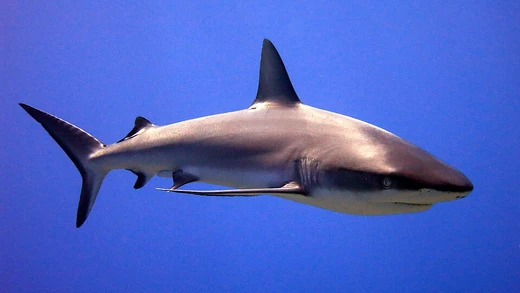
Daggernose shark
A critically endangered shark with a distinctive elongated snout.
Last updated

Naturalis Biodiversity Center · via Wikipedia: Daggernose shark · CC0
As of 2023, experts think there are probably no more than 250 of these sharks left in the wild.[1]
Scientific classification
- KingdomAnimalia
- PhylumChordata
- ClassChondrichthyes
- SubclassElasmobranchii
- DivisionSelachii
- OrderCarcharhiniformes
- FamilyCarcharhinidae
- GenusCarcharhinus
- SpeciesCarcharhinus oxyrhynchus
Named by (J. P. Müller & Henle, 1839)
Close relatives
Other species of Carcharhinus with a Codexery entry.
- Smalltail shark Carcharhinus porosus
- Australian blackspot shark Carcharhinus coatesi
- Australian blacktip shark Carcharhinus tilstoni
- Bignose shark Carcharhinus altimus
- Blacknose shark Carcharhinus acronotus
- Blackspot shark Carcharhinus sealei
- Blacktip reef shark Carcharhinus melanopterus
- Blacktip shark Carcharhinus limbatus
Sources: Wikipedia taxobox: Daggernose shark (CC BY-SA 4.0) · order, family and genus agree with WoRMS AphiaID 298437 (CC BY 4.0)
Conservation status
Critically Endangered (CR)
- LC
- NT
- VU
- EN
- CR▲ this species
- EW
- EX
Source: IUCN Red List assessment
How big is it?
Largest length in the source, 1.6 m, next to a 1.8 m person.
Diagram: drawn by Codexery, schematic shapes to scale (not a likeness). Length: Wikipedia: Daggernose shark
Where the daggernose shark has been recorded
Map: drawn by Codexery. Data: Natural Earth basemap (public domain) · place coordinates: Wikipedia (CC BY-SA 4.0)
Description
This shark gets its name from its most obvious feature: a really long, flat snout that comes to a sharp point and looks like a triangle when you view it from above.[2] The nostrils are pretty small, and there aren't any big flaps of skin sticking out around them.[2] At the corners of its mouth, on both the upper and lower jaws, you'll find short but deep grooves.[2] In the upper jaw, the tooth rows range from 49 to 60, while the lower jaw has between 49 and 56 rows.[2]
This shark has a sturdy, muscular body, and its pectoral fins are large, broad, and shaped like paddles, starting right under the fifth gill slit.[3] Males can grow to about 1.4 meters long, and females reach about 1.6 meters; there are some unconfirmed reports of individuals reaching 2.0 to 2.4 meters.[3]
Biology and ecology
Daggernose sharks are viviparous, which means the babies develop inside the mother; once they use up their yolk supply, the yolk sac turns into a placenta that lets the mom keep feeding them.[4] There's no link between how big a female is and how many pups she has.[4] Males become mature when they reach 103 centimeters, which happens when they're about 5 to 6 years old; females mature at 115 centimeters, at around 6 to 7 years old.[4] Scientists have measured males living up to 7 years and females up to 12 years, and by looking at growth rates, they think the biggest known males and females might be 12 and 20 years old, respectively.[5]
Distribution and habitat
There are reports of it as far south as Valença in the central Brazilian state of Bahia, but fishery surveys haven't found it there, and local fishermen don't seem to know about it.[6] It sticks to coastal waters between 4 and 40 meters deep, loves really murky water, and gets less common as the water gets clearer.[4]
Human interactions
Because of its small size and small teeth, the daggernose shark doesn't pose much danger to humans.[7] You'll often see this shark in fish markets, but people don't really consider it a great food fish.[8] The IUCN has given this species a Critically Endangered status because it only lives in a small area and is very vulnerable to overfishing due to its low reproductive rate.[8] Off Brazil, the daggernose shark's numbers have fallen by more than 90% over the last ten years, and similar drops have probably happened elsewhere in its range as fishing pressure keeps increasing.[8]
It also makes up about one-tenth of the catch in a northern Brazil floating gillnet fishery that targets two fish called Serra Spanish mackerel and Acoupa weakfish, and that fishery operates in estuaries during the dry season.[7]
Taxonomy and phylogeny
German biologists Johannes Peter Müller and Friedrich Gustav Jakob Henle first described this shark in 1839, giving it the scientific name Carcharias oxyrhynchus.[2] A 2023 study of the shark's family tree found that the daggernose shark actually belongs deep inside the genus Carcharhinus, and its closest relative is the smalltail shark, another member of that same group from the western Atlantic.[9] That weirdly long snout, which no other Carcharhinus species has, turned out to be a specialized feature that evolved for living in the muddy, cloudy waters created by the Amazon River's outflow.[9] Scientists have identified an extinct relative called †Carcharhinus acuarius from the Middle Eocene of Germany based on similar-looking teeth, but this doesn't match genetic studies that suggest the daggernose and smalltail sharks only split apart in the Middle Miocene.[10]
References
- Wikipedia, "Daggernose shark" (CC BY-SA 4.0), which cites: Lessa, Rosangela, et al. "Close to Extinction? The Collapse of the Endemic Daggernose Shark (Isogomphodon Oxyrhynchus) off Brazil." Global Ecology and Conservat; "The Daggernose Shark is Near Extinction" (we also read that source) en.wikipedia.org
- Wikipedia, "Daggernose shark" (CC BY-SA 4.0), which cites: Compagno, L.J.V., "Sharks of the World: An Annotated and Illustrated Catalogue of Shark Species Known to Date", Food and Agricultural Organization, 1984, p. 510–511 (we also read that source) en.wikipedia.org
- Wikipedia, "Daggernose shark" (CC BY-SA 4.0), which cites: Compagno, L.J.V., "Sharks of the World: An Annotated and Illustrated Catalogue of Shark Species Known to Date", Food and Agricultural Organization, 1984, p. 510–511; Pollom, R., "Isogomphodon oxyrhynchus", 2020; Compagno, L.J.V., "Sharks of the World: An Annotated and Illustrated Catalogue of Shark Species Known to Date", Food and Agricultural Organization, 1984, p. 510–511; Fowler, S.L., "Sharks, Rays and Chimaeras: The Status of the Chondrichthyan Fishes", International Union for Conservation of Nature and Natural Resources, 2005, p. en.wikipedia.org
- Wikipedia, "Daggernose shark" (CC BY-SA 4.0), which cites: Fowler, S.L., "Sharks, Rays and Chimaeras: The Status of the Chondrichthyan Fishes", International Union for Conservation of Nature and Natural Resources, 2005, p. 306–308 (we also read that source) en.wikipedia.org
- Wikipedia, "Daggernose shark" (CC BY-SA 4.0), which cites: Lessa, R., "Age and growth of the daggernose shark, Isogomphodon oxyrhynchus, from northern Brazil", Marine and Freshwater Research, 2000, p. 339–347 (we also read that source) en.wikipedia.org
- Wikipedia, "Daggernose shark" (CC BY-SA 4.0), which cites: Compagno, L.J.V., "Sharks of the World: An Annotated and Illustrated Catalogue of Shark Species Known to Date", Food and Agricultural Organization, 1984, p. 510–511; Pollom, R., "Isogomphodon oxyrhynchus", 2020 (we also read that source) en.wikipedia.org
- Wikipedia, "Daggernose shark" (CC BY-SA 4.0), which cites: Compagno, L.J.V., "Sharks of the World: An Annotated and Illustrated Catalogue of Shark Species Known to Date", Food and Agricultural Organization, 1984, p. 510–511; Fowler, S.L., "Sharks, Rays and Chimaeras: The Status of the Chondrichthyan Fishes", International Union for Conservation of Nature and Natural Resources, 2005, p. 306–308 (we also read that source) en.wikipedia.org
- Wikipedia, "Daggernose shark" (CC BY-SA 4.0), which cites: Pollom, R., "Isogomphodon oxyrhynchus", 2020; "The Daggernose Shark is Near Extinction" (we also read that source) en.wikipedia.org
- Wikipedia, "Daggernose shark" (CC BY-SA 4.0), which cites: ; da Silva Rodrigues-Filho, "Evolutionary History and Taxonomic Reclassification of the Critically Endangered Daggernose Shark, a Species Endemic to the Western Atlantic", Journal of Zoological Systematics and Evolutionary (we also read that source) en.wikipedia.org
- Wikipedia, "Daggernose shark" (CC BY-SA 4.0), which cites: "Carcharhinus acuarius Shark-References", shark-references.com; Carrier, J.C., "Biology of Sharks and Their Relatives", CRC Press, 2004, p. 51–52; da Silva Rodrigues-Filho, "Evolutionary History and Taxonomic Reclassification of the Critically Endangered Daggernose Shark, a Species Endemic to the Western Atlantic", Journal of Zoological Systematics and Evolutionary (we also read that source) en.wikipedia.org
Each numbered sentence above was checked against the source it cites before publication. Sentences citing Wikipedia adapt text from the English Wikipedia article Daggernose shark (contributors), used under CC BY-SA 4.0; this entry is available under the same licence. Other sources were used for facts only; no text or images are copied from them.
More in Reef sharks
Elsewhere in Sharks
Test yourself
Three questions drawn from this entry’s sources. Pick an answer to check it.
Answers checked against the source article
Sources
Compiled from Wikipedia and the sources listed below. Text from Wikipedia is available under CC BY-SA 4.0; this entry is adapted from it.
- Wikipedia: Daggernose shark (CC BY-SA 4.0).
- Classification: the source article's taxobox; order, family and genus checked against WoRMS, the World Register of Marine Species (CC BY 4.0).
- Conservation status: IUCN Red List assessment.
- Occurrence records: GBIF (CC0 / CC BY). Basemap: Natural Earth (public domain).
- Word definitions: the Codexery glossary, each quoted from its Wikipedia article.
Spotted an error? Know more?
Reader corrections go straight into our review queue. Suggest an edit · How this site is sourced