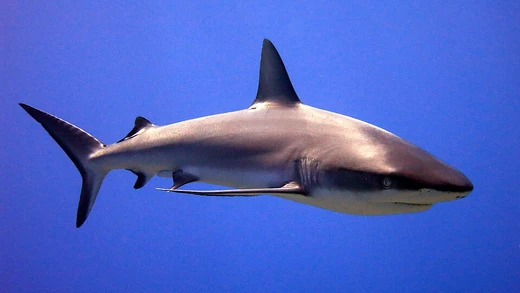
Creek whaler
A small, stocky requiem shark endemic to northern Australia.
Last updated

CSIRO National Fish Collection · via Wikipedia: Creek whaler · CC BY 3.0
The creek whaler (Carcharhinus fitzroyensis) is a requiem shark found only in northern Australia. It lives in shallow coastal waters and estuaries. This small, sturdy shark typically reaches 1.0–1.3 meters (3.3–4.3 ft) in length, has a brownish color without noticeable fin markings, and can be recognized by its long snout, large triangular pectoral fins, and a large first dorsal fin positioned toward the front of its body.
Its diet consists mainly of small bony fish and crustaceans. The species is viviparous, with embryos nourished through a placental connection.
Mating occurs from May to July, and after a gestation period of seven to nine months, females give birth to one to seven pups each year. A small number of creek whalers are caught accidentally in inshore gillnets and used for food, but fishing appears to have little impact on their population. Consequently, the IUCN lists this species as Least Concern.
Scientific classification
- KingdomAnimalia
- PhylumChordata
- ClassChondrichthyes
- SubclassElasmobranchii
- DivisionSelachii
- OrderCarcharhiniformes
- FamilyCarcharhinidae
- GenusCarcharhinus
- SpeciesCarcharhinus fitzroyensis
Named by (Whitley, 1943)
Close relatives
Other species of Carcharhinus with a Codexery entry.
- Australian blacktip shark Carcharhinus tilstoni
- Blackspot shark Carcharhinus sealei
- Blacktip reef shark Carcharhinus melanopterus
- Blacktip shark Carcharhinus limbatus
- Nervous shark Carcharhinus cautus
- Whitecheek shark Carcharhinus dussumieri
- Australian blackspot shark Carcharhinus coatesi
- Bignose shark Carcharhinus altimus
Sources: Wikipedia taxobox: Creek whaler (CC BY-SA 4.0) · order, family and genus agree with WoRMS AphiaID 271321 (CC BY 4.0)
Conservation status
Least Concern (LC)
- LC▲ this species
- NT
- VU
- EN
- CR
- EW
- EX
Source: IUCN Red List assessment · GBIF copy of the Red List category
How big is it?
Largest length in the source, 1.5 m, next to a 1.8 m person.
Diagram: drawn by Codexery, schematic shapes to scale (not a likeness). Length: Wikipedia: Creek whaler
Where the creek whaler has been recorded
Each dot is a place where the species has been observed and reported (7,836 records, half-degree grid) — not a modelled range. 2 inland records left out (institution coordinates).
Map: drawn by Codexery. Data: GBIF occurrence search (records CC0 / CC BY) · Natural Earth basemap (public domain) · place coordinates: Wikipedia (CC BY-SA 4.0)
Lore & Background
The creek whaler was described by Australian ichthyologist Gilbert Percy Whitley in a 1943 volume of Proceedings of the Linnean Society of New South Wales. He assigned the new species to the subgenus Uranganops of the genus Galeolamna, and gave it the specific epithet fitzroyensis because the type specimen, a 1.2-m-long female, was collected from Connor's Creek in the Fitzroy River estuary. Subsequent authors have synonymized Galeolamna with Carcharhinus. The evolutionary relationships of the creek whaler have yet to be fully resolved; various studies have placed it near the whitecheek shark and blackspot shark, or close to the nervous shark and blacktip reef shark, or as the basal member of a clade containing the graceful shark, blacktip shark, and Australian blacktip shark.
Did You Know?
- The creek whaler is endemic to northern Australia, between Gladstone in central Queensland and Cape Cuvier in Western Australia.
- Females give birth to one to seven pups annually after a gestation period of seven to 9 months.
More in Reef sharks
Elsewhere in Sharks
Test yourself
Three questions drawn from this entry’s sources. Pick an answer to check it.
Answers checked against the source article
Sources
Compiled from Wikipedia and the sources listed below. Text from Wikipedia is available under CC BY-SA 4.0; this entry is adapted from it.
- Wikipedia: Creek whaler (CC BY-SA 4.0).
- Classification: the source article's taxobox; order, family and genus checked against WoRMS, the World Register of Marine Species (CC BY 4.0).
- Conservation status: IUCN Red List assessment.
- Occurrence records: GBIF (CC0 / CC BY). Basemap: Natural Earth (public domain).
- Word definitions: the Codexery glossary, each quoted from its Wikipedia article.
Spotted an error? Know more?
Reader corrections go straight into our review queue. Suggest an edit · How this site is sourced