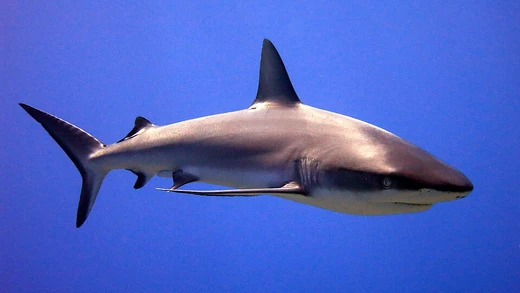
Borneo shark
Rare requiem shark with unique mouth pores, found only off northwestern Borneo.
Last updated

Naturalis Biodiversity Center · via Wikipedia: Borneo shark · CC0
This shark is one of the rarest in the world—every recent specimen came from just one fishing port in Sarawak.[1] Conservation groups list the Borneo shark as Critically Endangered, which means it faces an extremely high risk of extinction in the wild.[2][3] The Borneo shark is small and slim-bodied, a type of requiem shark that may now live only in shallow coastal waters off northwestern Borneo, though it used to be found in more places.[1]
Scientific classification
- KingdomAnimalia
- PhylumChordata
- ClassChondrichthyes
- SubclassElasmobranchii
- DivisionSelachii
- OrderCarcharhiniformes
- FamilyCarcharhinidae
- GenusCarcharhinus
- SpeciesCarcharhinus borneensis
Named by (Bleeker, 1858)
Close relatives
Other species of Carcharhinus with a Codexery entry.
- Blackspot shark Carcharhinus sealei
- Blacktip shark Carcharhinus limbatus
- Creek whaler Carcharhinus fitzroyensis
- Hardnose shark Carcharhinus macloti
- Smalltail shark Carcharhinus porosus
- Whitecheek shark Carcharhinus dussumieri
- Pondicherry shark (Carcharhinus hemiodon) Carcharhinus hemiodon
- Australian blackspot shark Carcharhinus coatesi
Sources: Wikipedia taxobox: Borneo shark (CC BY-SA 4.0) · order, family and genus agree with WoRMS AphiaID 271319 (CC BY 4.0)
Conservation status
Critically Endangered (CR)
- LC
- NT
- VU
- EN
- CR▲ this species
- EW
- EX
Source: IUCN Red List assessment · GBIF copy of the Red List category
How big is it?
Largest length in the source, 0.65 m, next to a 1.8 m person.
Diagram: drawn by Codexery, schematic shapes to scale (not a likeness). Length: Wikipedia: Borneo shark
Where the borneo shark has been recorded
Map: drawn by Codexery. Data: Natural Earth basemap (public domain) · place coordinates: Wikipedia (CC BY-SA 4.0)
Description
The skin is covered with small, overlapping dermal denticles—tiny tooth-like scales—each with three horizontal ridges.[4] The body is slate-gray above, darkening toward the tips of the dorsal fins and upper tail fin lobe.[4] This shark has a long, pointed snout. Its nostrils are slanted and slit-like, with narrow, nipple-shaped flaps of skin right in front of them.[4] Its eyes are pretty big and round, and each one comes with a nictitating membrane – that's a protective third eyelid.[4]
The upper jaw holds 25 to 26 rows of teeth, and the lower jaw holds 23 to 25 rows.[4] The first dorsal fin is large and triangular, with a blunt tip and a trailing edge that curves in a wavy line.[4]
Distribution and habitat
Every recent Borneo shark specimen came only from fishery landing sites at Mukah in Sarawak, even though people have surveyed the rest of Borneo thoroughly.[1] Several fishery surveys in areas where the shark used to live couldn't find any.[2]
Human interactions
The shark's conservation status remains risky because it lives in such a tiny area, and those waters are heavily fished by both small-scale and commercial operations.[2]
Taxonomy and phylogeny
In 1988, Leonard Compagno tentatively grouped the Borneo shark with several other small requiem sharks, though it resembles sharpnose sharks in traits like enlarged pores near the mouth.[5] Nobody is really sure how the Borneo shark is related to other sharks.[5] Still, other body features clearly place it in the genus Carcharhinus.[6]
References
- Wikipedia, "Borneo shark" (CC BY-SA 4.0), which cites: "Descriptions of New Sharks and Rays from Borneo", CSIRO Marine and Atmospheric Research, 2010, p. 17–28; Last, P.R., "Sharks and Rays of Borneo", CSIRO Publishing, 2010, p. 92–93 (we also read that source) en.wikipedia.org
- Wikipedia, "Borneo shark" (CC BY-SA 4.0), which cites: "Carcharhinus borneensis", 2021; Dulvy, N.K., Bin Ali, A., Derrick, D., Dharmadi & Fahmi., "Carcharhinus borneensis", IUCN Red List of Threatened Species, 2021, p. e.T39367A124407121; "Descriptions of New Sharks and Rays from Borneo", CSIRO Marine and Atmospheric Research, 2010, p. 17–28; Last, P.R., "Sharks and Rays of Borneo", CSIRO Publishing, 2010, p. 92–93 (we also read that source) en.wikipedia.org
- IUCN Red List assessment (category and year as redistributed in GBIF's IUCN Red List checklist). IUCN Red List terms: fact (category, year) cited, no text reused. iucnredlist.org
- Wikipedia, "Borneo shark" (CC BY-SA 4.0), which cites: "Descriptions of New Sharks and Rays from Borneo", CSIRO Marine and Atmospheric Research, 2010, p. 17–28; Compagno, L.J.V., "Sharks of the World: An Annotated and Illustrated Catalogue of Shark Species Known to Date", Food and Agricultural Organization, 1984, p. 458–459 (we also read that source) en.wikipedia.org
- Wikipedia, "Borneo shark" (CC BY-SA 4.0), which cites: Garrick, J.A.F. (1982). Sharks of the genus Carcharhinus. NOAA Technical Report, NMFS CIRC 445.; Compagno, L.J.V., "Sharks of the Order Carcharhiniformes", Princeton University Press, 1988, p. 319–320 (original not read by us) en.wikipedia.org
- Wikipedia, "Borneo shark" (CC BY-SA 4.0), which cites: "Descriptions of New Sharks and Rays from Borneo", CSIRO Marine and Atmospheric Research, 2010, p. 17–28 (original not read by us) en.wikipedia.org
Each numbered sentence above was checked against the source it cites before publication. Sentences citing Wikipedia adapt text from the English Wikipedia article Borneo shark (contributors), used under CC BY-SA 4.0; this entry is available under the same licence. Other sources were used for facts only; no text or images are copied from them.
More in Reef sharks
Elsewhere in Sharks
Test yourself
Three questions drawn from this entry’s sources. Pick an answer to check it.
Answers checked against the source article
Sources
Compiled from Wikipedia and the sources listed below. Text from Wikipedia is available under CC BY-SA 4.0; this entry is adapted from it.
- Wikipedia: Borneo shark (CC BY-SA 4.0).
- Classification: the source article's taxobox; order, family and genus checked against WoRMS, the World Register of Marine Species (CC BY 4.0).
- Conservation status: IUCN Red List assessment.
- Occurrence records: GBIF (CC0 / CC BY). Basemap: Natural Earth (public domain).
- Word definitions: the Codexery glossary, each quoted from its Wikipedia article.
Spotted an error? Know more?
Reader corrections go straight into our review queue. Suggest an edit · How this site is sourced