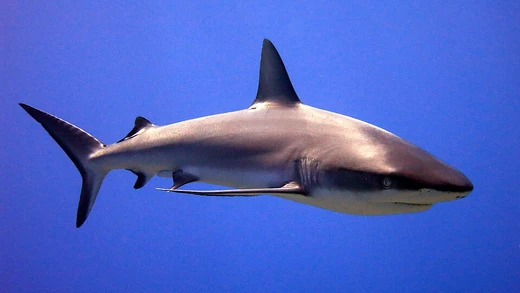
Australian blacktip shark
A requiem shark endemic to northern and eastern Australia.
Last updated

CSIRO National Fish Collection · via Wikipedia: Australian blacktip shark · CC BY 3.0
People long confused this shark with the common blacktip shark, but genetic studies confirmed they are separate.[1] In the 1980s, new data on body shape and life history pointed to it being a separate species, and allozyme studies later confirmed that.[1]
Scientific classification
- KingdomAnimalia
- PhylumChordata
- ClassChondrichthyes
- SubclassElasmobranchii
- DivisionSelachii
- OrderCarcharhiniformes
- FamilyCarcharhinidae
- GenusCarcharhinus
- SpeciesCarcharhinus tilstoni
Named by (Whitley, 1950)
Close relatives
Other species of Carcharhinus with a Codexery entry.
- Smoothtooth blacktip shark Carcharhinus leiodon
- Australian blackspot shark Carcharhinus coatesi
- Bignose shark Carcharhinus altimus
- Blacknose shark Carcharhinus acronotus
- Blackspot shark Carcharhinus sealei
- Blacktip reef shark Carcharhinus melanopterus
- Blacktip shark Carcharhinus limbatus
- Borneo shark Carcharhinus borneensis
Sources: Wikipedia taxobox: Australian blacktip shark (CC BY-SA 4.0) · order, family and genus agree with WoRMS AphiaID 271325 (CC BY 4.0)
Conservation status
Least Concern (LC)
- LC▲ this species
- NT
- VU
- EN
- CR
- EW
- EX
Source: IUCN Red List assessment · GBIF copy of the Red List category
How big is it?
Largest length in the source, 2 m, next to a 1.8 m person.
Diagram: drawn by Codexery, schematic shapes to scale (not a likeness). Length: Wikipedia: Australian blacktip shark
Where the australian blacktip shark has been recorded
Each dot is a place where the species has been observed and reported (11,667 records, half-degree grid) — not a modelled range. 14 inland records left out (institution coordinates).
Map: drawn by Codexery. Data: GBIF occurrence search (records CC0 / CC BY) · Natural Earth basemap (public domain)
Description
It reaches a typical length of 1.5 to 1.8 meters, with a maximum recorded length of 2.0 meters and weight of 52 kilograms.[2] The only sure way to tell it from the common blacktip shark is to count its vertebrae—174 to 182 total, with 84 to 91 before the tail.[3] Upper teeth are slender with fine serrations that get coarser near the base, and lower teeth are narrower and more finely serrated.[3] This shark is bronze on top, whitish underneath, with a pale stripe along its sides, and some individuals have black tips on all fins.[2]
Biology and ecology
Like other requiem sharks, it gives live birth—the embryos develop inside the mother and get nourishment through a placental connection.[4] Pups grow fast in their first year, gaining about 17 centimeters in length, then slow to 8 to 10 centimeters per year by age five.[5] After a 10-month pregnancy, pups are born around January, each about 60 centimeters long.[4]
Human interactions
The International Union for Conservation of Nature lists the Australian blacktip shark as Least Concern.[6][7]
Taxonomy and phylogeny
Molecular studies show the Australian and common blacktip sharks are closely related to the graceful shark and the smoothtooth blacktip shark.[1]
References
- Wikipedia, "Australian blacktip shark" (CC BY-SA 4.0), which cites: "Genetic evidence for separation of two sharks, Carcharhinus limbatus and C. tilstoni, from Northern Australia", Marine Biology, 1991, p. 1–4; Lavery, S., "Electrophoretic analysis of phylogenetic relationships among Australian carcharhinid sharks", Australian Journal of Marine and Freshwater Research, 1992, p. 97–108; "Rediscovery and redescription of the smoothtooth blacktip shark, Carcharhinus leiodon (Carcharhinidae), from Kuwait, with notes on its possible conservation status", Marine and Freshwater Research, 2011, p. 528 en.wikipedia.org
- Wikipedia, "Australian blacktip shark" (CC BY-SA 4.0), which cites: "Field Guide for Sharks of the Genus Carcharhinus", Verlag Dr. Friedrich Pfeil, 2011, p. 99–101; "Sharks and Rays of Australia", Harvard University Press, 2009, p. 271–272; "FAO Identification Guide for Fishery Purposes: The Living Marine Resources of the Western Central Pacific", Food and Agricultural Organization of the United Nations, 1998, p. 1312–1360 (we also read that source) en.wikipedia.org
- Wikipedia, "Australian blacktip shark" (CC BY-SA 4.0), which cites: "Field Guide for Sharks of the Genus Carcharhinus", Verlag Dr. Friedrich Pfeil, 2011, p. 99–101; "Sharks and Rays of Australia", Harvard University Press, 2009, p. 271–272 (we also read that source) en.wikipedia.org
- Wikipedia, "Australian blacktip shark" (CC BY-SA 4.0), which cites: "Biology of two commercially important carcharhinid sharks from northern Australia", Australian Journal of Marine and Freshwater Research, 1986, p. 671–688; "Utilisation of a tropical bay as a nursery area by sharks of the families Carcharhinidae and Sphyrnidae", Environmental Biology of Fishes, August 1, 1993, p. 337–345; Stevens, J.D., "Case studies of the management of elasmobranch fisheries 1", Food and Agricultural Organization of the United Nations, 1999 (we also read that source) en.wikipedia.org
- Wikipedia, "Australian blacktip shark" (CC BY-SA 4.0), which cites: "Biology of two commercially important carcharhinid sharks from northern Australia", Australian Journal of Marine and Freshwater Research, 1986, p. 671–688; "Age and growth of two commercially imported sharks (Carcharhinus tilstoni and C. sorrah) from Northern Australia", Australian Journal of Marine and Freshwater Research, 1988, p. 417–433 (we also read that source) en.wikipedia.org
- IUCN Red List assessment (category and year as redistributed in GBIF's IUCN Red List checklist). IUCN Red List terms: fact (category, year) cited, no text reused. iucnredlist.org
- Wikipedia, "Australian blacktip shark" (CC BY-SA 4.0), which cites: "Sharks and Rays of Australia", Harvard University Press, 2009, p. 271–272; Stevens, J.D., "Case studies of the management of elasmobranch fisheries 1", Food and Agricultural Organization of the United Nations, 1999; Johnson, G.J., "Carcharhinus tilstoni", 2019; "Sharks and Rays of Australia", Harvard University Press, 2009, p. 271–272; Stevens, J.D., "Case studies of the management of elasmobranch fisheries 1", Food and Agricultural Organization of the United Nations, 1999 (we also read that source) en.wikipedia.org
Each numbered sentence above was checked against the source it cites before publication. Sentences citing Wikipedia adapt text from the English Wikipedia article Australian blacktip shark (contributors), used under CC BY-SA 4.0; this entry is available under the same licence. Other sources were used for facts only; no text or images are copied from them.
More in Reef sharks
Elsewhere in Sharks
Test yourself
Three questions drawn from this entry’s sources. Pick an answer to check it.
Answers checked against the source article
Sources
Compiled from Wikipedia and the sources listed below. Text from Wikipedia is available under CC BY-SA 4.0; this entry is adapted from it.
- Wikipedia: Australian blacktip shark (CC BY-SA 4.0).
- Classification: the source article's taxobox; order, family and genus checked against WoRMS, the World Register of Marine Species (CC BY 4.0).
- Conservation status: IUCN Red List assessment.
- Occurrence records: GBIF (CC0 / CC BY). Basemap: Natural Earth (public domain).
- Word definitions: the Codexery glossary, each quoted from its Wikipedia article.
Spotted an error? Know more?
Reader corrections go straight into our review queue. Suggest an edit · How this site is sourced