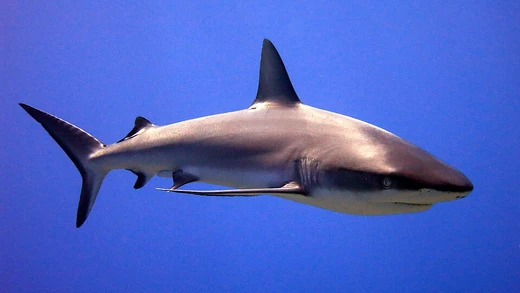
Nurse shark
A robust, bottom-dwelling shark vital to research.
Last updated

Bernard DUPONT from FRANCE · CC BY-SA 2.0
The nurse shark is an elasmobranch fish, meaning it belongs to the group of sharks and rays with skeletons made of cartilage.[1] You can find nurse sharks in tropical and subtropical coastal waters across the Eastern Atlantic, Western Atlantic, and Eastern Pacific.[2] In 2021, the IUCN Red List classified the nurse shark as Vulnerable worldwide.[3][1]
Scientific classification
- KingdomAnimalia
- PhylumChordata
- ClassChondrichthyes
- SubclassElasmobranchii
- DivisionSelachii
- OrderOrectolobiformes
- FamilyGinglymostomatidae
- GenusGinglymostoma
- SpeciesGinglymostoma cirratum
Named by (Bonnaterre, 1788)
Sources: Wikipedia taxobox: Nurse shark (CC BY-SA 4.0) · order, family and genus agree with WoRMS AphiaID 105846 (CC BY 4.0)
Conservation status
Vulnerable (VU)
- LC
- NT
- VU▲ this species
- EN
- CR
- EW
- EX
Source: IUCN Red List assessment · GBIF copy of the Red List category
How big is it?
Largest length in the source, 3.08 m, next to a 1.8 m person.
Diagram: drawn by Codexery, schematic shapes to scale (not a likeness). Length: Wikipedia: Nurse shark
Where the nurse shark has been recorded
Each dot is a place where the species has been observed and reported (32,857 records, half-degree grid) — not a modelled range. 30 inland records left out (institution coordinates). 2 isolated far-off records not drawn.
Map: drawn by Codexery. Data: GBIF occurrence search (records CC0 / CC BY) · Natural Earth basemap (public domain)
Description
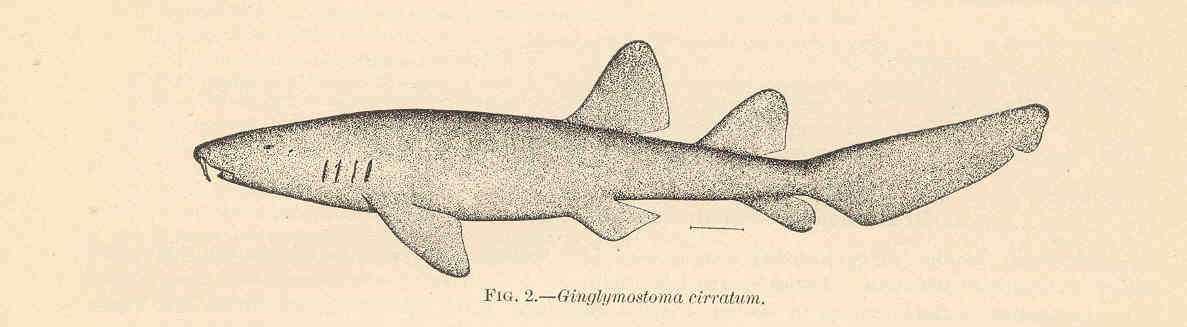
They have two rounded dorsal fins, rounded pectoral fins, an elongated tail fin, and a broad head.[4] The largest nurse shark ever recorded was 3.08 meters long.[4] Adults average about 193 centimeters long. Newborn pups are around 30 centimeters.[5][6] Nurse sharks have a spiracle between their eyes and gills. This leftover gill slit pulls in oxygen when the shark rests on the seafloor.[5]
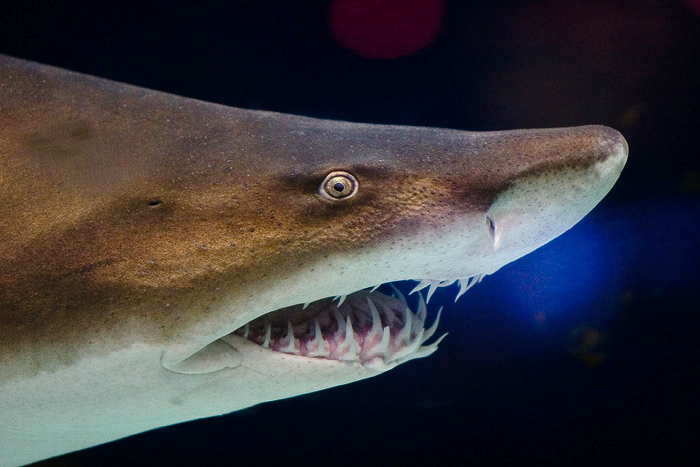
Nurse sharks have nasoral grooves and long barbels around the mouth. Their teeth come in single rows: 30 to 42 on top and 28 to 34 on the bottom.[5] They have five gills located between the head and first dorsal fin.[5] Adult nurse sharks are brownish. Young ones have small, dark, ocellar spots scattered across their body.[4][5] A genetic condition called piebaldism can give some nurse sharks a speckled look, where parts of their body lack normal pigmentation.[7]
Biology and ecology
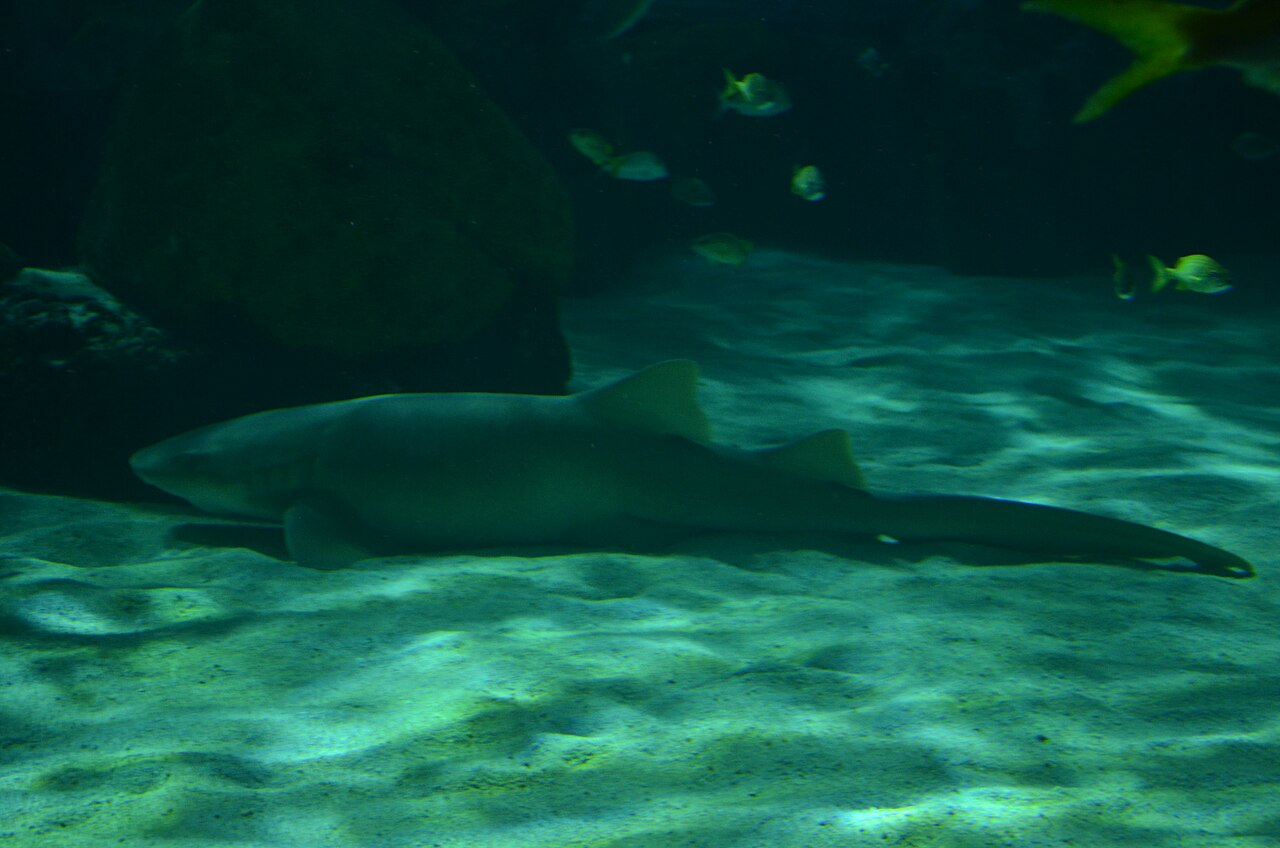
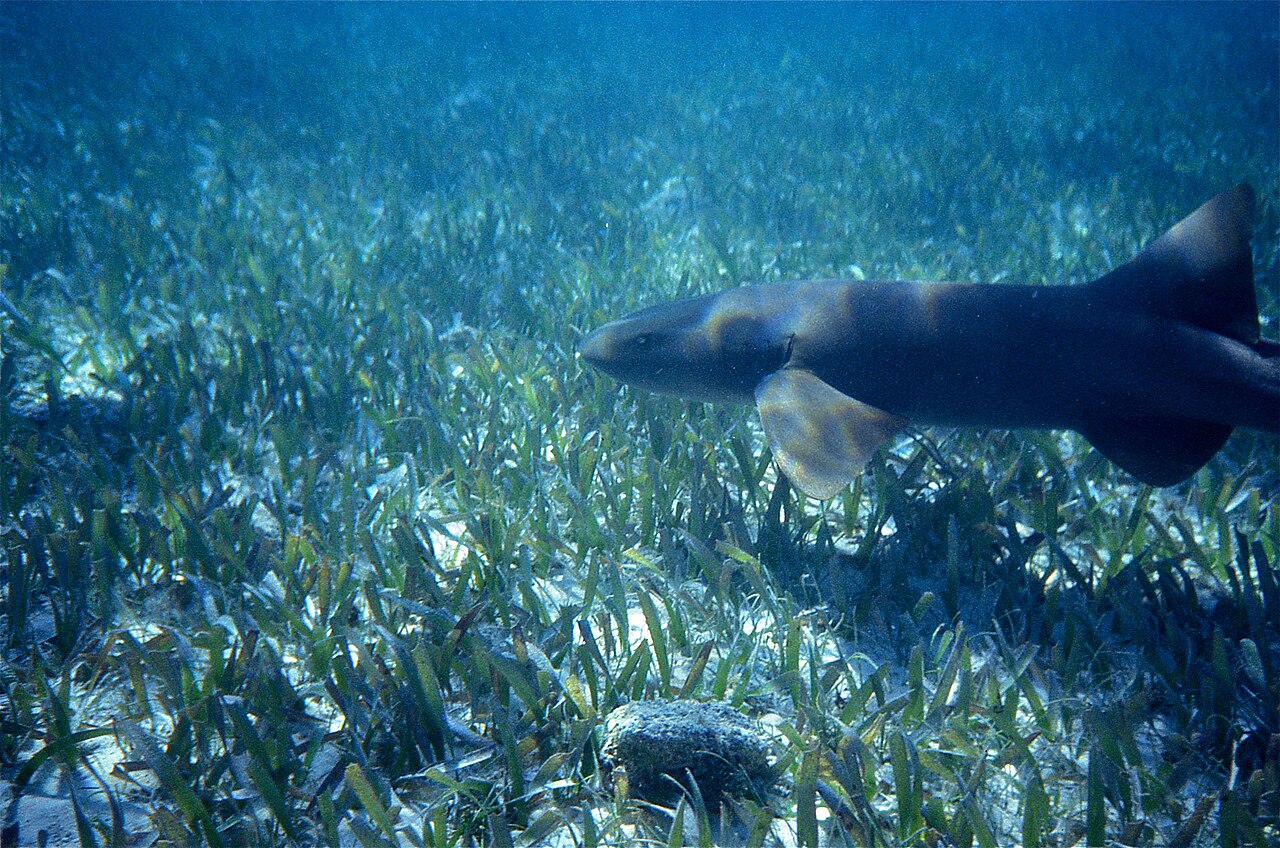
They eat small fish like stingrays and teleosts, plus invertebrates such as crustaceans, molluscs, sea urchins, tunicates, and anthozoans. They also eat algae.[8] Nurse sharks don't move around much and return to the same breeding spots year after year.[9] Nurse sharks practice multiple paternity, meaning a single litter can have more than one father. This boosts genetic diversity.[10] Growth rates in the wild average about 13.1 centimeters per year, but a captive nurse shark grew slightly faster at 19.1 centimeters per year.[5]
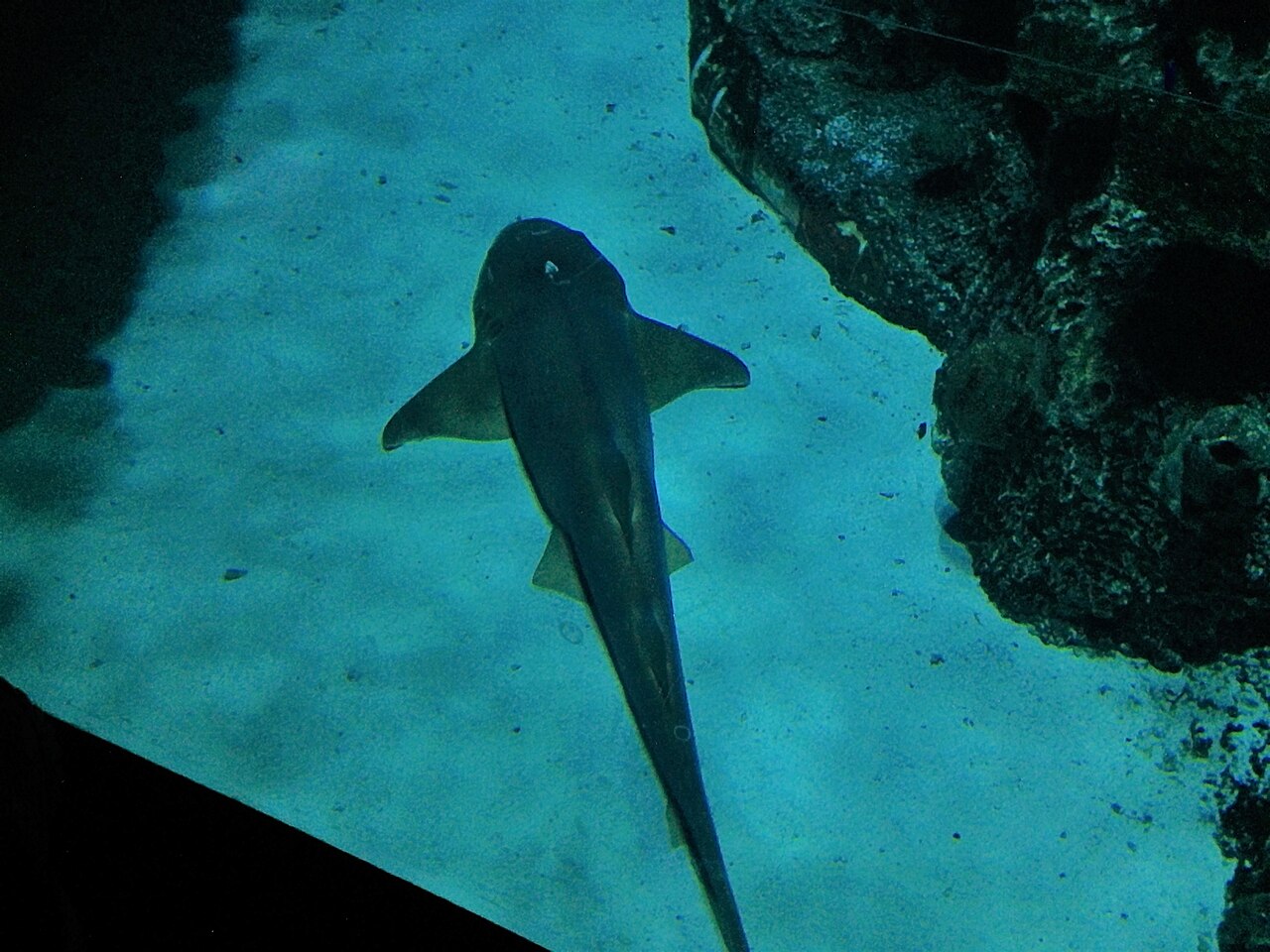
At night, nurse sharks usually hunt alone, sifting through the seafloor for food, but during the day they often gather in big, quiet groups.[8] Nurse sharks are suction feeders—they suck prey into their mouths. They can produce some of the strongest suction forces ever measured in any water-dwelling vertebrate.[11] Their small mouths might limit what they can eat, but nurse sharks break up food by shaking their heads hard or by sucking and spitting.[11] Females have a two-year mating cycle, and it can take them up to 18 months to develop a new set of eggs.[6]
Newborn pups come out fully formed and measure about 30 centimeters long.[6] In some coastal areas, American alligators and American crocodiles will occasionally eat nurse sharks.[12]
Distribution and habitat
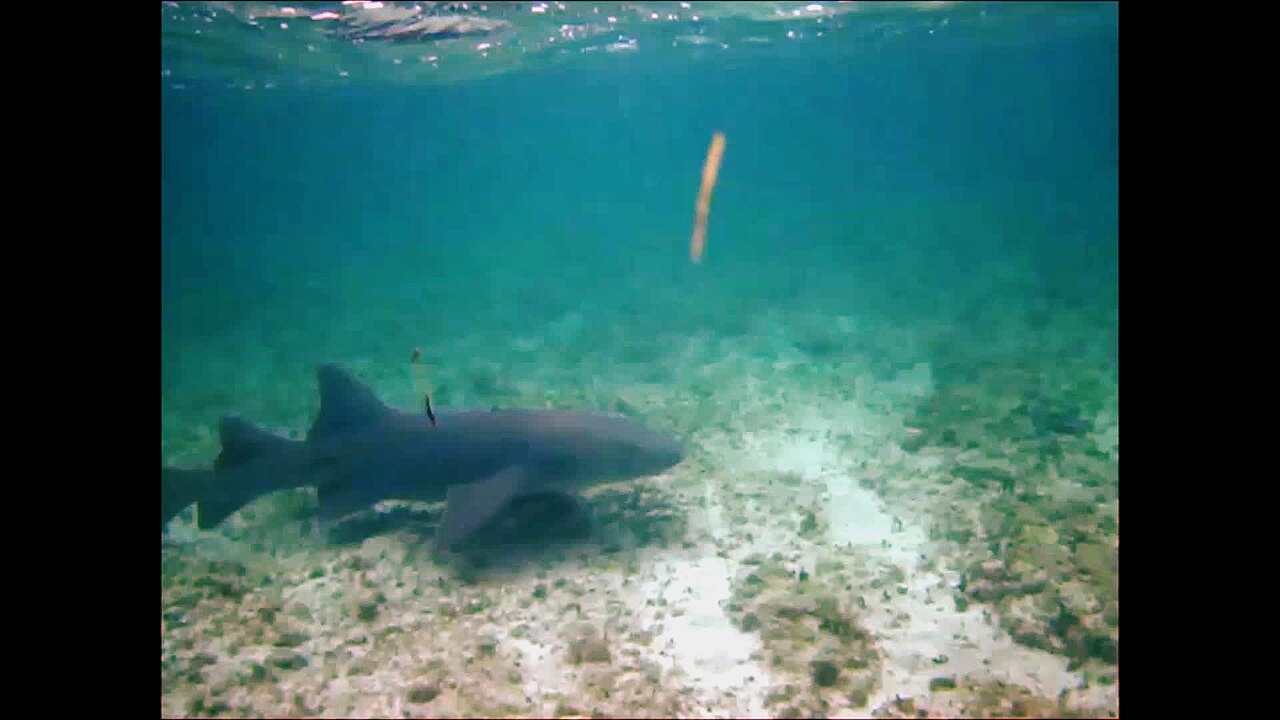
In the Eastern Pacific, nurse sharks range from Baja California to Peru.[2] Juveniles stay near the bottom of shallow coral reefs, seagrass flats, and areas around mangrove islands.[13] Older nurse sharks live around deeper reefs and rocky areas. During the day, they hide in crevices and under ledges.[13] Juvenile nurse sharks hang out at depths of 1 to 4 meters. Older juveniles and adults range from 1 to 75 meters during the day.[5]
In the Eastern Atlantic, you'll find nurse sharks from Cape Verde down to Gabon, and they've even been spotted as far north as France by accident.[2] Nurse sharks usually live in shallow waters and spend most of their time near the bottom.[13]
Human interactions
In the United States and The Bahamas, nurse sharks are considered least concern.[1] In the western Atlantic Ocean, nurse sharks are near threatened. They're vulnerable in South America and face dangers across much of Central America and the Caribbean.[1] Some fisheries target nurse sharks directly. In others, they end up as accidental by-catch.[1] Nurse sharks are valuable for research because they're tough and handle being caught, handled, and tagged well.[14]
Taxonomy and phylogeny
The name "nurse shark" might come from an old story: someone saw a shark giving birth and thought it was nursing its young.[15] Bonnaterre first described the species in 1788.[16][17]
References
- Wikipedia, "Nurse shark" (CC BY-SA 4.0), which cites: Carlson, "Ginglymostoma cirratum", 2021; Carlson, "Ginglymostoma cirratum", 2021 (we also read that source) en.wikipedia.org
- Wikipedia, "Nurse shark" (CC BY-SA 4.0), which cites: Compagno, L.J.V., "Bullhead, mackerel and carpet sharks (Heterodontiformes, Lamniformes and Orectolobiformes). Family Ginglymostomatidae. In: Sharks of the World: An Annotated and Illustrated Catalogue of Shark Species K; Carlson, "Ginglymostoma cirratum", 2021; Compagno, L.J.V., "Sharks of the World: An Annotated and Illustrated Catalogue of Shark Species Known to Date", Food and Agriculture Organization of the United Nations, 1984, p. 205–207, 555–561, 588; Carlson, "Ginglymostoma cirratum", 2021 (we also read that source) en.wikipedia.org
- IUCN Red List assessment (category and year as redistributed in GBIF's IUCN Red List checklist). IUCN Red List terms: fact (category, year) cited, no text reused. iucnredlist.org
- Wikipedia, "Nurse shark" (CC BY-SA 4.0), which cites: McEachran, "Fishes of the Gulf of Mexico, Vol. 1: Myxiniformes to Gasterosteiformes", University of Texas Press, 1998, p. 45; Carlson, "Ginglymostoma cirratum", 2021 (we also read that source) en.wikipedia.org
- "ADW: Ginglymostoma cirratum: INFORMATION", Animal Diversity Web. facts only, no text reused. animaldiversity.org
- Wikipedia, "Nurse shark" (CC BY-SA 4.0), which cites: Compagno, L.J.V., "Sharks of the World: An Annotated and Illustrated Catalogue of Shark Species Known to Date", Food and Agriculture Organization of the United Nations, 1984, p. 205–207, 555–561, 588 (we also read that source) en.wikipedia.org
- Wikipedia, "Nurse shark" (CC BY-SA 4.0), which cites: "Piebald nurse shark with incredible speckled skin may be first on record Sharks Earth Touch News", Earth Touch News Network (original not read by us) en.wikipedia.org
- Wikipedia, "Nurse shark" (CC BY-SA 4.0), which cites: Castro, J. I., "The biology of the nurse shark, Ginglymostoma cirratum, off the Florida east coast and the Bahama Islands)", Environmental Biology of Fishes, 2000, p. 1–22; "ADW: Ginglymostoma cirratum: INFORMATION", Animal Diversity Web (we also read that source) en.wikipedia.org
- Wikipedia, "Nurse shark" (CC BY-SA 4.0), which cites: Heithaus, M.R., Burkholder, D., Hueter, R. E., Heithaus, L. I., Prat Jr. H. L., Carrier, J. C., "Reproductive biology of elasmobranchs. In: Biology of sharks and their relatives.", CRC Press, Taylor & Francis Group, 2004; Carrier, J. C., Pratt, H. L., Castro, J. I., "Spatial and temporal variation in shark communities of the lower Florida Keys and evidence for historical population declines", Canadian Journal of Fisheries and Aquatic Scie (original not read by us) en.wikipedia.org
- Wikipedia, "Nurse shark" (CC BY-SA 4.0), which cites: Saville, "Multiple Paternity in the Nurse Shark, Ginglymostoma Cirratum", Environmental Biology of Fishes, 2002-03-01, p. 347–351 (we also read that source) en.wikipedia.org
- Wikipedia, "Nurse shark" (CC BY-SA 4.0), which cites: Tanaka, S. K., "Suction feeding by the nurse shark", Copeia, 1973, p. 606–608; Motta, P. J., Hueter, R. E., Tricas, T. C., Summers, A. P., Huber, D. R., Lowry, D., Mara, K. R., Matott, M. P., Whitenack, L. B., Wintzer, A.P., "Functional morphology of the feeding apparatus, feeding constraints, and ; Motta, P. J., "Prey capture behavior and feeding mechanics of elasmobranchs. In Biology of sharks and their relatives.", CRC Press, Taylor & Francis Group, 2004, p. 165–202 (original not read by us) en.wikipedia.org
- Wikipedia, "Nurse shark" (CC BY-SA 4.0), which cites: Jason Bittel, "Alligators Attack and Eat Sharks, Study Confirms", National Geographic, 20 September 2017; Nifong, "Reciprocal Intraguild Predation between Alligator mississippiensis (American Alligator) and Elasmobranchii in the Southeastern United States", Southeastern Naturalist, 2017, p. 383–396 (we also read that source) en.wikipedia.org
- Wikipedia, "Nurse shark" (CC BY-SA 4.0), which cites: Castro, J. I., "The biology of the nurse shark, Ginglymostoma cirratum, off the Florida east coast and the Bahama Islands)", Environmental Biology of Fishes, 2000, p. 1–22 (we also read that source) en.wikipedia.org
- Wikipedia, "Nurse shark" (CC BY-SA 4.0), which cites: Osgood, G. J and J. K. Baum., "Reef sharks: recent advances in ecological understanding to inform conservation", Journal of Fisheries Biology, 2015, p. 1489–1523; Aucoin, "A new underwater shark capture method used by divers to catch and release nurse sharks (Ginglymostoma cirratum)", Fishery Bulletin, 2017, p. 484–495 (we also read that source) en.wikipedia.org
- Wikipedia, "Nurse shark" (CC BY-SA 4.0), which cites: "Where did "Nurse" shark come from?" (original not read by us) en.wikipedia.org
- World Register of Marine Species, Ginglymostoma cirratum (AphiaID 105846). CC BY 4.0. marinespecies.org
- GBIF Backbone Taxonomy and occurrence index, Ginglymostoma cirratum (taxon key 2417495). CC BY 4.0 (backbone); counts are facts. gbif.org
Each numbered sentence above was checked against the source it cites before publication. Sentences citing Wikipedia adapt text from the English Wikipedia article Nurse shark (contributors), used under CC BY-SA 4.0; this entry is available under the same licence. Other sources were used for facts only; no text or images are copied from them.
More in Carpet sharks
Elsewhere in Sharks
Sources
Compiled from Wikipedia and the sources listed below. Text from Wikipedia is available under CC BY-SA 4.0; this entry is adapted from it.
- Wikipedia: Nurse shark (CC BY-SA 4.0).
- Classification: the source article's taxobox; order, family and genus checked against WoRMS, the World Register of Marine Species (CC BY 4.0).
- Conservation status: IUCN Red List assessment.
- Occurrence records: GBIF (CC0 / CC BY). Basemap: Natural Earth (public domain).
- Word definitions: the Codexery glossary, each quoted from its Wikipedia article.
Spotted an error? Know more?
Reader corrections go straight into our review queue. Suggest an edit · How this site is sourced