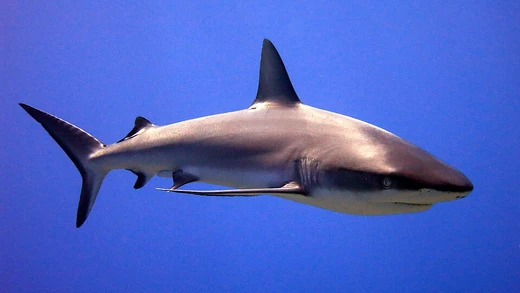
Blacknose shark
A small requiem shark with a distinctive dark snout tip.
Last updated

SEFSC Pascagoula Laboratory; Collection of Brandi Noble, NOAA/NMFS/SEFSC · via Wikipedia: Blacknose shark · Public domain
These sharks stick close to the coast. They hang out in areas with seagrass, sand, or rubble. The grown-ups tend to head for deeper water than the youngsters do.[1]
Scientific classification
- KingdomAnimalia
- PhylumChordata
- ClassChondrichthyes
- SubclassElasmobranchii
- DivisionSelachii
- OrderCarcharhiniformes
- FamilyCarcharhinidae
- GenusCarcharhinus
- SpeciesCarcharhinus acronotus
Named by (Poey, 1860)
Close relatives
Other species of Carcharhinus with a Codexery entry.
- Blackspot shark Carcharhinus sealei
- Blacktip reef shark Carcharhinus melanopterus
- Blacktip shark Carcharhinus limbatus
- Caribbean reef shark Carcharhinus perezi
- Silky shark Carcharhinus falciformis
- Smalltail shark Carcharhinus porosus
- Whitecheek shark Carcharhinus dussumieri
- Australian blackspot shark Carcharhinus coatesi
Sources: Wikipedia taxobox: Blacknose shark (CC BY-SA 4.0) · order, family and genus agree with WoRMS AphiaID 158508 (CC BY 4.0)
Conservation status
Endangered (EN)
- LC
- NT
- VU
- EN▲ this species
- CR
- EW
- EX
Source: IUCN Red List assessment · GBIF copy of the Red List category
How big is it?
Largest length in the source, 2 m, next to a 1.8 m person.
Diagram: drawn by Codexery, schematic shapes to scale (not a likeness). Length: Wikipedia: Blacknose shark
Where the blacknose shark has been recorded
Each dot is a place where the species has been observed and reported (625 records, half-degree grid) — not a modelled range. 50 inland records left out (institution coordinates).
Map: drawn by Codexery. Data: GBIF occurrence search (records CC0 / CC BY) · Natural Earth basemap (public domain) · place coordinates: Wikipedia (CC BY-SA 4.0)
Description
The biggest blacknose shark ever measured was 2.0 meters long and weighed 18.9 kilograms.[2] Right in front of each nostril there's a well-developed skin flap that separates the water flowing in from the water flowing out.[3] On each side of the upper jaw you'll find 12 to 13 rows of teeth, and on each side of the lower jaw there are 11 to 12 rows, plus one or two teeth right at the middle.[3]
Biology and ecology
Larger sharks prey on blacknose sharks.[4] Captive blacknose sharks have been seen performing a threat display toward divers or new sharks in the tank.[4] If it starts performing a threat display, you should be cautious.[5] Like other requiem sharks, the blacknose shark is viviparous, meaning the young develop inside the mother and receive nourishment through a placental connection.[6]
Distribution and habitat
The blacknose shark lives on the continental and insular shelves off the eastern coast of the Americas. Its range goes from North Carolina south to southern Uruguay, including the Bahamas, the Gulf of Mexico, and the Caribbean Sea.[7] Blacknose sharks split up by size and sex, with different groups sticking to different areas.[7] Blacknose sharks in the South Atlantic Bight head north in summer. In winter they head south or possibly offshore.[8]
Human interactions
The meat is sold dried and salted.[5] Anglers consider this species a game fish that puts up a good fight on light tackle.[5] It's also commercially important regionally. People catch it on purpose and as bycatch with gillnets and surface longlines, especially off southwestern Florida, Venezuela, and Brazil.[5] Shrimp trawlers also catch large numbers by accident. That may be a bigger threat because many of the sharks taken are immature.[9]
Recent stock assessments have found the populations are overfished in both the Atlantic and the Gulf of Mexico.[10]
Taxonomy and phylogeny
Looking at the sharks' body shapes, Jack Garrick suggested in 1982 that the blacknose shark is closely related to a group that includes the whitecheek shark and the blackspot shark.[11] Leonard Compagno proposed in 1988 that it belongs in a group with five other species, like the silky shark and the blacktip reef shark.[11] Molecular analyses have been similarly unclear about its relationships.[11] Gavin Naylor's 1992 analysis of proteins called allozymes found it to be the earliest branching member of the genus Carcharhinus.[11]
References
- Wikipedia, "Blacknose shark" (CC BY-SA 4.0), which cites: "Species Carcharhinus acronotus Poey 1860", FishWisePro, 1860 (original not read by us) en.wikipedia.org
- Wikipedia, "Blacknose shark" (CC BY-SA 4.0), which cites: Compagno, L.J.V., "Sharks of the World: An Annotated and Illustrated Catalogue of Shark Species Known to Date", Food and Agricultural Organization, 1984, p. 454–455; "Fishes of the Gulf of Mexico: Myxiniformes to Gasterosteiformes", University of Texas Press, 1998, p. 74; (we also read that source) en.wikipedia.org
- Wikipedia, "Blacknose shark" (CC BY-SA 4.0), which cites: Bester, C. Biological Profiles: Blacknose Shark . Florida Museum of Natural History Ichthyology Department. Retrieved on June 2, 2009.; "Fishes of the Gulf of Mexico: Myxiniformes to Gasterosteiformes", University of Texas Press, 1998, p. 74 (we also read that source) en.wikipedia.org
- Wikipedia, "Blacknose shark" (CC BY-SA 4.0), which cites: Bester, C. Biological Profiles: Blacknose Shark . Florida Museum of Natural History Ichthyology Department. Retrieved on June 2, 2009. (original not read by us) en.wikipedia.org
- Wikipedia, "Blacknose shark" (CC BY-SA 4.0), which cites: "Sharks", Firefly Books, 2002, p. 157; Bester, C. Biological Profiles: Blacknose Shark . Florida Museum of Natural History Ichthyology Department. Retrieved on June 2, 2009. (we also read that source) en.wikipedia.org
- Wikipedia, "Blacknose shark" (CC BY-SA 4.0), which cites: Driggers, "Reproductive biology of Carcharhinus acronotus in the coastal waters of South Carolina", Journal of Fish Biology, 2004, p. 1540–1551; Carlson, J., "Carcharhinus acronotus", 2021; Hazin, F.H.V., "Reproduction of the blacknose shark (Carcharhinus acronotus) in coastal waters off northeastern Brazil", Fishery Bulletin, 2002, p. 143–148; Bester, C. Biological Profiles: Blacknose Shark . Florida Museum of Natural History Ichthyology Department. Retrieved on June 2, 2009. (we also read that source) en.wikipedia.org
- Wikipedia, "Blacknose shark" (CC BY-SA 4.0), which cites: Stafford-Deitsch, J., "Sharks of Florida, the Bahamas, the Caribbean and the Gulf of Mexico", Trident Press, 2000, p. 68 (original not read by us) en.wikipedia.org
- Wikipedia, "Blacknose shark" (CC BY-SA 4.0), which cites: Carlson, J., "Carcharhinus acronotus", 2021; Bester, C. Biological Profiles: Blacknose Shark . Florida Museum of Natural History Ichthyology Department. Retrieved on June 2, 2009.; Driggers, W.B. (III), Ingram G.W., (Jr.), Grace, M.A., Carlson, J.K., Ulrich, J.F., Sulikowski, J.A. and Quattro, J.M. (2007). Life history and population genet (we also read that source) en.wikipedia.org
- Wikipedia, "Blacknose shark" (CC BY-SA 4.0), which cites: Carlson, J., "Carcharhinus acronotus", 2021 (we also read that source) en.wikipedia.org
- Wikipedia, "Blacknose shark" (CC BY-SA 4.0), which cites: "NOAA Proposes Measures To Rebuild Blacknose And Other Shark Populations". (July 24, 2009). NOAA – National Oceanic and Atmospheric Administration. Retrie (original not read by us) en.wikipedia.org
- Wikipedia, "Blacknose shark" (CC BY-SA 4.0), which cites: Naylor, G.J.P., "The phylogenetic relationships among requiem and hammerhead sharks: inferring phylogeny when thousands of equally most parsimonious trees result", Cladistics, 1992, p. 295–318; Dosay-Akbulut, M., "The phylogenetic relationship within the genus Carcharhinus", Comptes Rendus Biologies, 2008, p. 500–509; Compagno, L.J.V., "Sharks of the World: An Annotated and Illustrated Catalogue of Shark Species Known to Date", Food and Agricultural Organization, 1984, p. 454–455 (we also read that source) en.wikipedia.org
Each numbered sentence above was checked against the source it cites before publication. Sentences citing Wikipedia adapt text from the English Wikipedia article Blacknose shark (contributors), used under CC BY-SA 4.0; this entry is available under the same licence. Other sources were used for facts only; no text or images are copied from them.
More in Reef sharks
Elsewhere in Sharks
Test yourself
Three questions drawn from this entry’s sources. Pick an answer to check it.
Answers checked against the source article
Sources
Compiled from Wikipedia and the sources listed below. Text from Wikipedia is available under CC BY-SA 4.0; this entry is adapted from it.
- Wikipedia: Blacknose shark (CC BY-SA 4.0).
- Classification: the source article's taxobox; order, family and genus checked against WoRMS, the World Register of Marine Species (CC BY 4.0).
- Conservation status: IUCN Red List assessment.
- Occurrence records: GBIF (CC0 / CC BY). Basemap: Natural Earth (public domain).
- Word definitions: the Codexery glossary, each quoted from its Wikipedia article.
Spotted an error? Know more?
Reader corrections go straight into our review queue. Suggest an edit · How this site is sourced