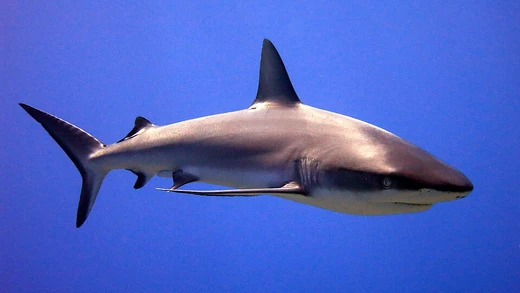
Spinner shark
A swift, spinning predator of tropical and warm temperate seas.
Last updated

Jean-Lou Justine · via Wikipedia: Spinner shark · CC BY-SA 3.0
People named the spinner shark for its habit of spinning through schools of fish.[1] It lives in warm coastal waters around the world, from the surface down to about 100 meters deep.[2]
Scientific classification
- KingdomAnimalia
- PhylumChordata
- ClassChondrichthyes
- SubclassElasmobranchii
- DivisionSelachii
- OrderCarcharhiniformes
- FamilyCarcharhinidae
- GenusCarcharhinus
- SpeciesCarcharhinus brevipinna
Named by (J. P. Müller & Henle, 1839)
Close relatives
Other species of Carcharhinus with a Codexery entry.
- Blacktip shark Carcharhinus limbatus
- Copper shark Carcharhinus brachyurus
- Australian blackspot shark Carcharhinus coatesi
- Australian blacktip shark Carcharhinus tilstoni
- Bignose shark Carcharhinus altimus
Sources: Wikipedia taxobox: Spinner shark (CC BY-SA 4.0) · order, family and genus agree with WoRMS AphiaID 105788 (CC BY 4.0)
Conservation status
Vulnerable (VU)
- LC
- NT
- VU▲ this species
- EN
- CR
- EW
- EX
Source: IUCN Red List assessment · GBIF copy of the Red List category
How big is it?
Largest length in the source, 3 m, next to a 1.8 m person.
Diagram: drawn by Codexery, schematic shapes to scale (not a likeness). Length: Wikipedia: Spinner shark
Where the spinner shark has been recorded
Each dot is a place where the species has been observed and reported (1,726 records, half-degree grid) — not a modelled range. 92 inland records left out (institution coordinates).
Map: drawn by Codexery. Data: GBIF occurrence search (records CC0 / CC BY) · Natural Earth basemap (public domain) · place coordinates: Wikipedia (CC BY-SA 4.0)
Description
Its body is slim and streamlined, with a long, pointed snout and small, circular eyes.[3][4] The upper jaw holds 15 to 18 tooth rows on each side, and the lower jaw holds 14 to 17.[4] You can tell adults from the similar blacktip shark by the black tip on the anal fin and the more triangular first dorsal fin placed farther back.[2] A typical spinner shark measures about 2 meters long and weighs 56 kilograms, but the biggest ones can reach 3 meters and 90 kilograms.[3]
You'll find deep grooves at the corners of its mouth.[4] The upper teeth have long, narrow tips with fine serrations, while the lower teeth are completely smooth.[4] This shark has five long gill slits on each side.[4] Young sharks have plain fins, but as they get bigger, black tips appear on the second dorsal fin, pectoral fins, anal fin, and the lower part of the tail fin.[2]
Biology and ecology
Groups chase prey at high speed, and individuals seize and swallow their food whole because their teeth are not suited for cutting.[5] Known parasites include several species of copepods, which are tiny crustaceans, that infest the gills, skin, mouth, and fins.[3] Females give birth to live young, which develop inside the mother.[6] Embryos are first fed by a yolk sac, and when they reach about 19 centimeters long, the yolk is gone and the empty sac becomes a placental connection for the mother to provide nutrients.[6]
Newborns grow about 30 centimeters per year, one-year-olds about 25, adolescents about 10, and adults about 5.[7] When hunting a school of small fish, a spinner shark shoots straight up through the school, spinning around with its mouth wide open.[5] The force of that spin often launches the shark into the air, which is how it got its name.[1] Bigger sharks sometimes eat smaller spinner sharks.[8]
Distribution and habitat
Distribution data is uncertain because people easily confuse spinner sharks with blacktip sharks.[9] Young sharks sometimes enter bays but stay away from brackish water.[2] The northwest Atlantic group migrates: they move into warm inshore waters in spring and summer, then head south into deeper water in winter.[2]
Human interactions
Spinner sharks usually leave people alone, but they can get excited around food, so watch out when spearfishing.[10] In the United States, the meat is sold as "blacktip shark" because shoppers think that species is better.[11]
Taxonomy and phylogeny
However, a 1992 analysis of allozymes, which are different forms of an enzyme, suggested these similarities may come from convergent evolution and that the closest relative may be the copper shark.[12] A 2007 ribosomal DNA study found the spinner shark to be the most genetically distinct of all requiem sharks examined except the tiger shark. It is less related to other Carcharhinus species than the lemon shark is.[12] Johannes Peter Müller and Friedrich Gustav Jakob Henle first described the spinner shark in 1839 from a 79-centimeter-long mounted skin collected off Java. They named it Carcharhinus brevipinna.[13] Based on similarities in shape, teeth, and behavior, scientists originally thought its closest relatives were the blacktip shark and the graceful shark.[12]
Fossils also turn up in the Late Miocene of Odisha, India, and possibly in the mid-Miocene to Early Pliocene of Florida, US.[14]
References
- Wikipedia, "Spinner shark" (CC BY-SA 4.0), which cites: Compagno, L.J.V., "Sharks of the World: An Annotated and Illustrated Catalogue of Shark Species Known to Date", Food and Agricultural Organization, 1984, p. 466–468; "Carcharhinus brevipinna, Spinner Shark", MarineBio.org; Bester, C. Biological Profiles: Spinner Shark . Florida Museum of Natural History Ichthyology Department. Retrieved on May 7, 2009. (we also read that source) en.wikipedia.org
- Wikipedia, "Spinner shark" (CC BY-SA 4.0), which cites: Compagno, L.J.V., "Sharks of the World: An Annotated and Illustrated Catalogue of Shark Species Known to Date", Food and Agricultural Organization, 1984, p. 466–468; Bester, C. Biological Profiles: Spinner Shark . Florida Museum of Natural History Ichthyology Department. Retrieved on May 7, 2009. (we also read that source) en.wikipedia.org
- Wikipedia, "Spinner shark" (CC BY-SA 4.0), which cites: Bester, C. Biological Profiles: Spinner Shark . Florida Museum of Natural History Ichthyology Department. Retrieved on May 7, 2009. (original not read by us) en.wikipedia.org
- Wikipedia, "Spinner shark" (CC BY-SA 4.0), which cites: Compagno, L.J.V., "Sharks of the World: An Annotated and Illustrated Catalogue of Shark Species Known to Date", Food and Agricultural Organization, 1984, p. 466–468 (we also read that source) en.wikipedia.org
- Wikipedia, "Spinner shark" (CC BY-SA 4.0), which cites: "Carcharhinus brevipinna - Spinner Shark - Animal Diversity Web", Animal Diversity Web; Compagno, L.J.V., "Sharks of the World: An Annotated and Illustrated Catalogue of Shark Species Known to Date", Food and Agricultural Organization, 1984, p. 466–468; Heemstra, E., "Coastal Fishes of Southern Africa", NISC (PTY) LTD., 2004, p. 58; "A Guide to the Common Sea Fishes of Southern Africa", Struik, 1993, p. 36 (we also read that source) en.wikipedia.org
- Wikipedia, "Spinner shark" (CC BY-SA 4.0), which cites: Capape, C., "Distribution and reproductive biology of the spinner shark, Carcharhinus brevipinna (Muller and Henle, 1841) (Chondrichthyes: Carcharhinidae)", Israel Journal of Zoology, 2003, p. 269–286 (we also read that source) en.wikipedia.org
- Wikipedia, "Spinner shark" (CC BY-SA 4.0), which cites: Fowler, S.L., "Sharks, Rays and Chimaeras: The Status of the Chondrichthyan Fishes", International Union for Conservation of Nature and Natural Resources, 2005, p. 106–109, 287–288; Capape, C., "Distribution and reproductive biology of the spinner shark, Carcharhinus brevipinna (Muller and Henle, 1841) (Chondrichthyes: Carcharhinidae)", Israel Journal of Zoology, 2003, p. 269–286; "A Guide to the Common Sea Fishes of Southern Africa", Struik, 1993, p. 36 (we also read that source) en.wikipedia.org
- Wikipedia, "Spinner shark" (CC BY-SA 4.0), which cites: Compagno, L.J.V, "Sharks of the World", Princeton University Press, 2005, p. 293–294; "A Guide to the Common Sea Fishes of Southern Africa", Struik, 1993, p. 36 (original not read by us) en.wikipedia.org
- Wikipedia, "Spinner shark" (CC BY-SA 4.0), which cites: Compagno, L.J.V., "Sharks of the World: An Annotated and Illustrated Catalogue of Shark Species Known to Date", Food and Agricultural Organization, 1984, p. 466–468; Bester, C. Biological Profiles: Spinner Shark . Florida Museum of Natural History Ichthyology Department. Retrieved on May 7, 2009.; Castri, F., "Biological Invasions in Europe and the Mediterranean Basin", Springer, 1990, p. 300 (we also read that source) en.wikipedia.org
- Wikipedia, "Spinner shark" (CC BY-SA 4.0), which cites: Compagno, L.J.V., "Sharks of the World: An Annotated and Illustrated Catalogue of Shark Species Known to Date", Food and Agricultural Organization, 1984, p. 466–468; ISAF Statistics on Attacking Species of Shark. International Shark Attack File, Florida Museum of Natural History, University of Florida. Retrieved on May 7, 20 (we also read that source) en.wikipedia.org
- Wikipedia, "Spinner shark" (CC BY-SA 4.0), which cites: Fowler, S.L., "Sharks, Rays and Chimaeras: The Status of the Chondrichthyan Fishes", International Union for Conservation of Nature and Natural Resources, 2005, p. 106–109, 287–288; Goldstein, R.J., "Coastal Fishing in the Carolinas: From Surf, Pier, and Jetty", John F. Blair, 2000, p. 129 (we also read that source) en.wikipedia.org
- Wikipedia, "Spinner shark" (CC BY-SA 4.0), which cites: Garrick, J.A.F. (1982). "Sharks of the genus Carcharhinus". NOAA Technical Report, NMFS CIRC-445.; Naylor, G.J.P., "The phylogenetic relationships among requiem and hammerhead sharks: inferring phylogeny when thousands of equally most parsimonious trees result", Cladistics, 1992, p. 295–318; Dosay-Akbulut, M., "The phylogenetic relationship within the genus Carcharhinus", Comptes Rendus Biologies, 2008, p. 500–509 (we also read that source) en.wikipedia.org
- Wikipedia, "Spinner shark" (CC BY-SA 4.0), which cites: Compagno, L.J.V., "Sharks of the World: An Annotated and Illustrated Catalogue of Shark Species Known to Date", Food and Agricultural Organization, 1984, p. 466–468; Bester, C. Biological Profiles: Spinner Shark . Florida Museum of Natural History Ichthyology Department. Retrieved on May 7, 2009.; Compagno, L.J.V., "Sharks of the World: An Annotated and Illustrated Catalogue of Shark Species Known to Date", Food and Agricultural Organization, 1984, p. 466–468; (we also read that source) en.wikipedia.org
- Wikipedia, "Spinner shark" (CC BY-SA 4.0), which cites: Perez, "Late Miocene chondrichthyans from Lago Bayano, Panama: Functional diversity, environment and biogeography", Journal of Paleontology, 2017, p. 512–547; Bhalla, "A Preliminary Note on Miocene Elasmobranchs from Orissa", Journal Geological Society of India, 1975-03-01, p. 98–99; "Baripada Beds Formation", indplex.geolex.org; Höltke, "A Review of the Paleobiology of Some Neogene Sharks and the Fossil Records of Extant Shark Species", Diversity, 2024-02-26, p. 147 (we also read that source) en.wikipedia.org
Each numbered sentence above was checked against the source it cites before publication. Sentences citing Wikipedia adapt text from the English Wikipedia article Spinner shark (contributors), used under CC BY-SA 4.0; this entry is available under the same licence. Other sources were used for facts only; no text or images are copied from them.
More in Reef sharks
Elsewhere in Sharks
Test yourself
Three questions drawn from this entry’s sources. Pick an answer to check it.
Answers checked against the source article
Sources
Compiled from Wikipedia and the sources listed below. Text from Wikipedia is available under CC BY-SA 4.0; this entry is adapted from it.
- Wikipedia: Spinner shark (CC BY-SA 4.0).
- Classification: the source article's taxobox; order, family and genus checked against WoRMS, the World Register of Marine Species (CC BY 4.0).
- Conservation status: IUCN Red List assessment.
- Occurrence records: GBIF (CC0 / CC BY). Basemap: Natural Earth (public domain).
- Word definitions: the Codexery glossary, each quoted from its Wikipedia article.
Spotted an error? Know more?
Reader corrections go straight into our review queue. Suggest an edit · How this site is sourced