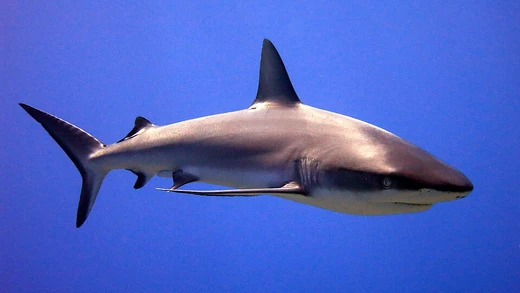
Spot-tail shark
A near-threatened requiem shark with black-tipped fins.
Last updated

Müller & Henle · via Wikipedia: Spot-tail shark · Public domain
This shark has a spindle-shaped body that reaches about 1.6 meters in length.[1] This shark has a long, pointy nose and eyes that are a bit bigger than average.[1] A raised line runs along the back between the two top fins, and there's a small dip just ahead of the upper tail fin.[1] The teeth in the upper jaw are triangular, slanted, and have serrated edges.[1]
Dark tips show up on the second top fin, the side fins, and the bottom part of the tail fin.[1]
Scientific classification
- KingdomAnimalia
- PhylumChordata
- ClassChondrichthyes
- SubclassElasmobranchii
- DivisionSelachii
- OrderCarcharhiniformes
- FamilyCarcharhinidae
- GenusCarcharhinus
- SpeciesCarcharhinus sorrah
Named by (J. P. Müller & Henle, 1839)
Close relatives
Other species of Carcharhinus with a Codexery entry.
- Australian blacktip shark Carcharhinus tilstoni
- Australian blackspot shark Carcharhinus coatesi
- Bignose shark Carcharhinus altimus
- Blacknose shark Carcharhinus acronotus
- Blackspot shark Carcharhinus sealei
- Blacktip reef shark Carcharhinus melanopterus
- Blacktip shark Carcharhinus limbatus
- Borneo shark Carcharhinus borneensis
Sources: Wikipedia taxobox: Spot-tail shark (CC BY-SA 4.0) · order, family and genus agree with WoRMS AphiaID 217339 (CC BY 4.0)
Conservation status
Near Threatened (NT)
- LC
- NT▲ this species
- VU
- EN
- CR
- EW
- EX
Source: IUCN Red List assessment · GBIF copy of the Red List category
How big is it?
Largest length in the source, 1.6 m, next to a 1.8 m person.
Diagram: drawn by Codexery, schematic shapes to scale (not a likeness). Length: Wikipedia: Spot-tail shark
Where the spot-tail shark has been recorded
Each dot is a place where the species has been observed and reported (9,294 records, half-degree grid) — not a modelled range. 62 inland records left out (institution coordinates). 1 isolated far-off record not drawn.
Map: drawn by Codexery. Data: GBIF occurrence search (records CC0 / CC BY) · Natural Earth basemap (public domain)
Biology and ecology
They grow quickly in their first year, adding about 20 centimeters in length, but growth slows after that.[2] Females have one litter each year, with anywhere from one to eight babies born alive.[2] The pregnancy lasts ten months, and newborn pups are about 50 centimeters long.[2] Young sharks grow up in shallow waters close to shore.[2]
Females are ready to have babies when they're two to three years old, and they can live up to seven years; males top out at five years.[3]
Distribution and habitat
It lives on continental and island shelves, usually down to about 73 meters deep, and maybe as deep as 140 meters.[4]
Human interactions
Small-scale fishing operations catch this shark on lines and in gillnets across much of its range.[5] Fisheries in northern Australia are doing a pretty good job of keeping things under control.[2]
Taxonomy and phylogeny
The spot-tail shark belongs to the family Carcharhinidae, the order Carcharhiniformes, and the class Elasmobranchii.[6][7]
References
- Wikipedia, "Spot-tail shark" (CC BY-SA 4.0), which cites: Daley, "Field Guide to Australian Sharks and Rays", Csiro Publishing, 2002, p. 34; Compagno, L.J.V., "Spot-tail shark (Carcharhinus sorrah)", Sharks of the World (we also read that source) en.wikipedia.org
- Wikipedia, "Spot-tail shark" (CC BY-SA 4.0), which cites: "Carcharhinus sorrah", 2021 (we also read that source) en.wikipedia.org
- Wikipedia, "Spot-tail shark" (CC BY-SA 4.0), which cites: "Age and growth of two commercially imported sharks (Carcharhinus tilstoni and C. sorrah) from Northern Australia", Australian Journal of Marine and Freshwater Research, 1988, p. 417–433 (we also read that source) en.wikipedia.org
- Wikipedia, "Spot-tail shark" (CC BY-SA 4.0), which cites: "Carcharhinus sorrah (Müller & Henle, 1839)", FishBase; Compagno, L.J.V., "Spot-tail shark (Carcharhinus sorrah)", Sharks of the World (original not read by us) en.wikipedia.org
- Wikipedia, "Spot-tail shark" (CC BY-SA 4.0), which cites: "Carcharhinus sorrah (Müller & Henle, 1839)", FishBase (original not read by us) en.wikipedia.org
- World Register of Marine Species, Carcharhinus sorrah (AphiaID 217339). CC BY 4.0. marinespecies.org
- GBIF Backbone Taxonomy and occurrence index, Carcharhinus sorrah (taxon key 2418184). CC BY 4.0 (backbone); counts are facts. gbif.org
Each numbered sentence above was checked against the source it cites before publication. Sentences citing Wikipedia adapt text from the English Wikipedia article Spot-tail shark (contributors), used under CC BY-SA 4.0; this entry is available under the same licence. Other sources were used for facts only; no text or images are copied from them.
More in Reef sharks
Elsewhere in Sharks
Test yourself
Three questions drawn from this entry’s sources. Pick an answer to check it.
Answers checked against the source article
Sources
Compiled from Wikipedia and the sources listed below. Text from Wikipedia is available under CC BY-SA 4.0; this entry is adapted from it.
- Wikipedia: Spot-tail shark (CC BY-SA 4.0).
- Classification: the source article's taxobox; order, family and genus checked against WoRMS, the World Register of Marine Species (CC BY 4.0).
- Conservation status: IUCN Red List assessment.
- Occurrence records: GBIF (CC0 / CC BY). Basemap: Natural Earth (public domain).
- Word definitions: the Codexery glossary, each quoted from its Wikipedia article.
Spotted an error? Know more?
Reader corrections go straight into our review queue. Suggest an edit · How this site is sourced