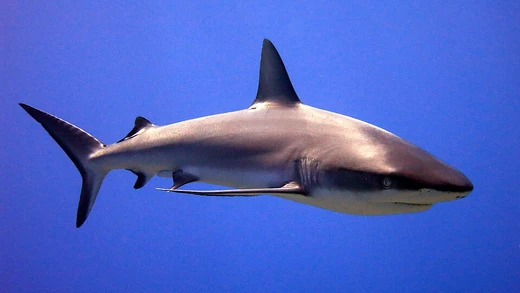
Megalodon
The giant prehistoric shark known from its massive teeth and uncertain size.
Last updated

Géry PARENT · CC BY-SA 4.0
Megalodon was a giant prehistoric shark that lived in oceans around the world.[1][2] It is best known for its enormous size. Some individuals may have reached over 20 meters in length.[3][4] Megalodon likely went extinct around the end of the Pliocene, about 2.6 million years ago.[5]
Scientific classification
- KingdomAnimalia
- PhylumChordata
- ClassChondrichthyes
- SubclassElasmobranchii
- DivisionSelachii
- OrderLamniformes
- Family†Otodontidae
- Genus†Otodus
- SpeciesOtodus megalodon
Named by (Agassiz, 1835)
Sources: Wikipedia taxobox: Megalodon (CC BY-SA 4.0)
Quick Facts
- Genus
- Otodus
Facts from the source article.
Description
Megalodon probably looked like a bulkier great white shark, with a blunter, wider jaw.[6] It likely had small, deep-set eyes and a crescent-shaped tail fin.[6][7] The anal fin and second dorsal fin were small, and it had a keel on each side of the tail.[7] In 2024, researchers suggested megalodon had a longer, more stretched-out body than we used to think.[8]
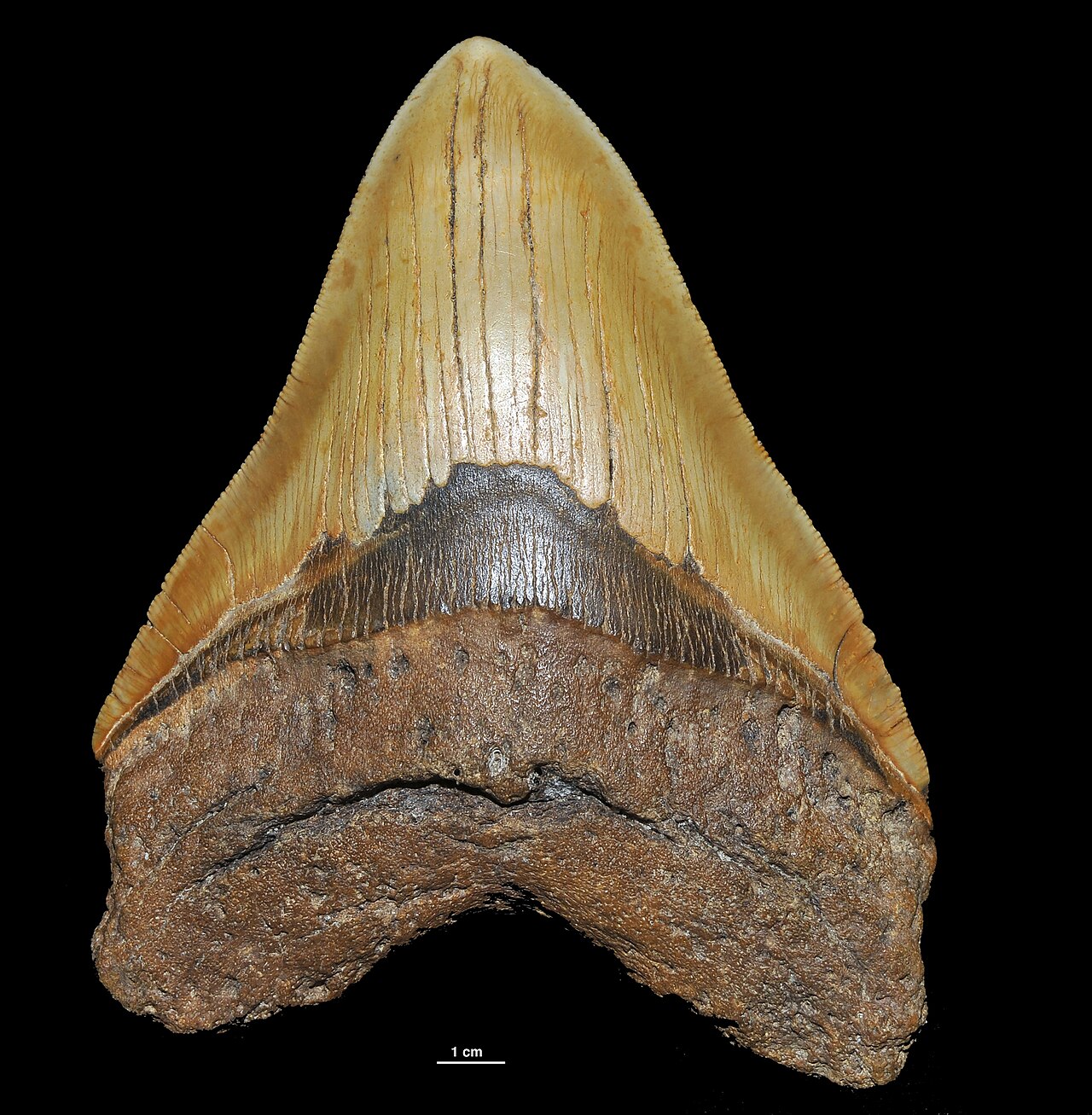
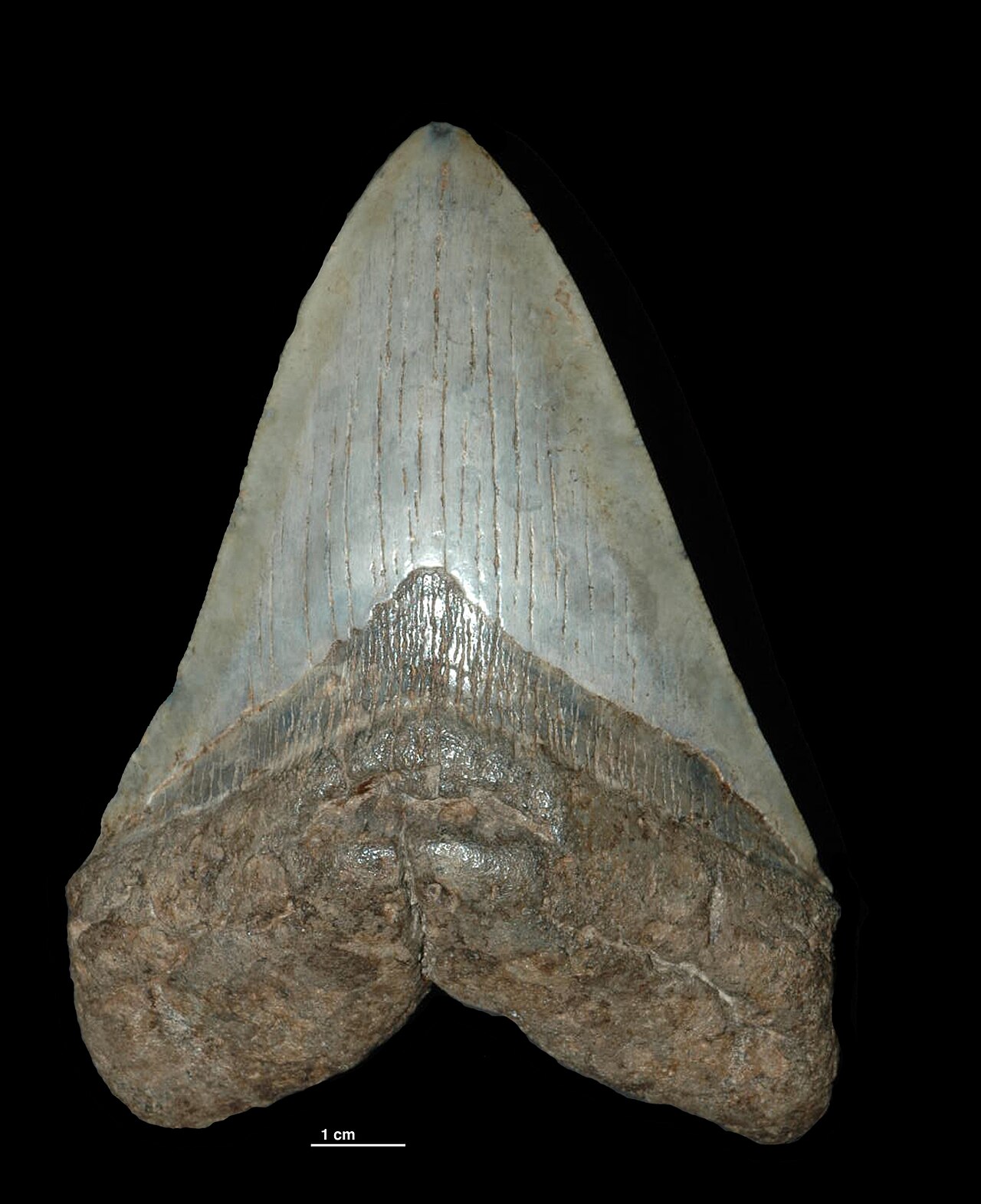
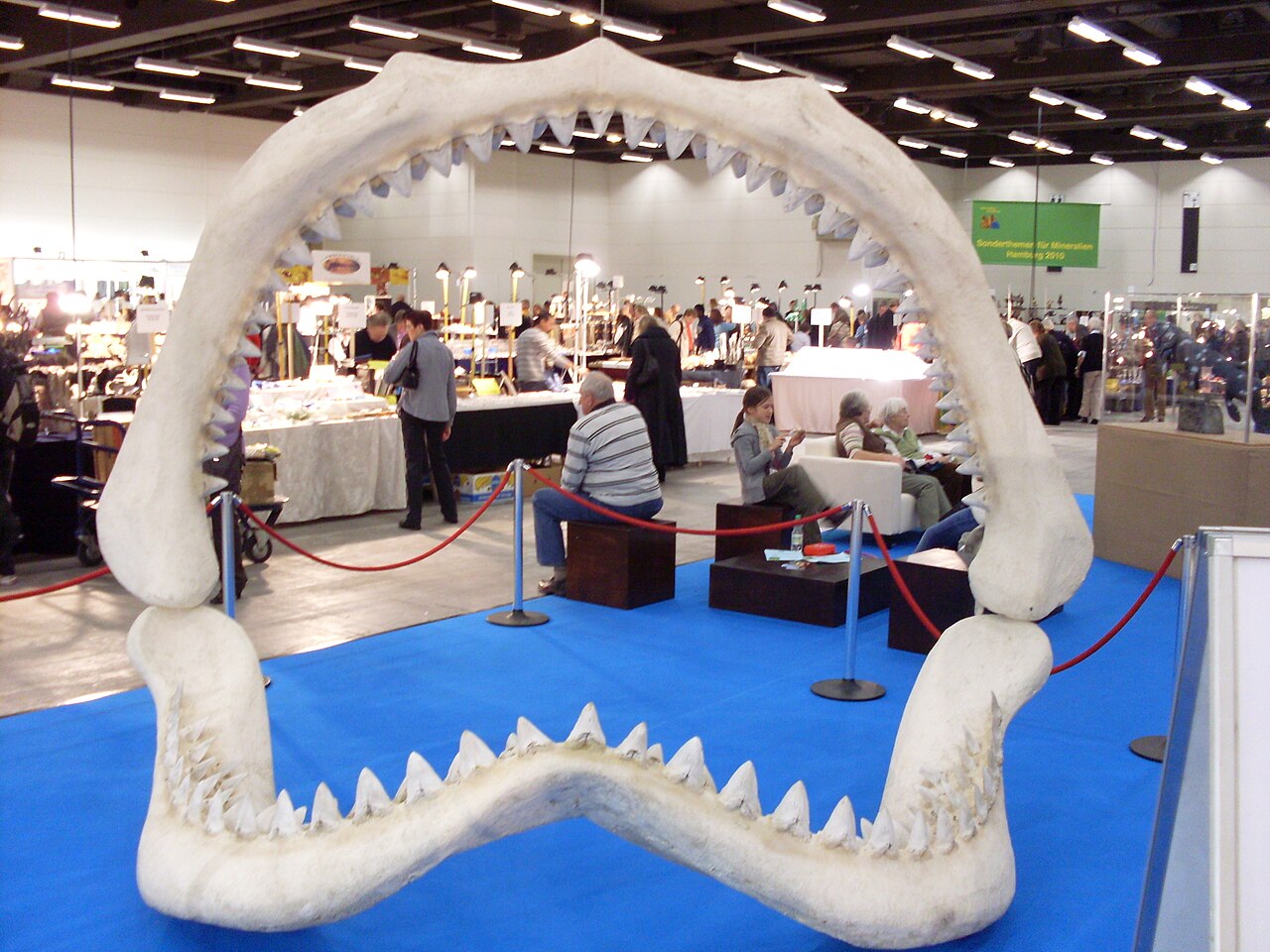
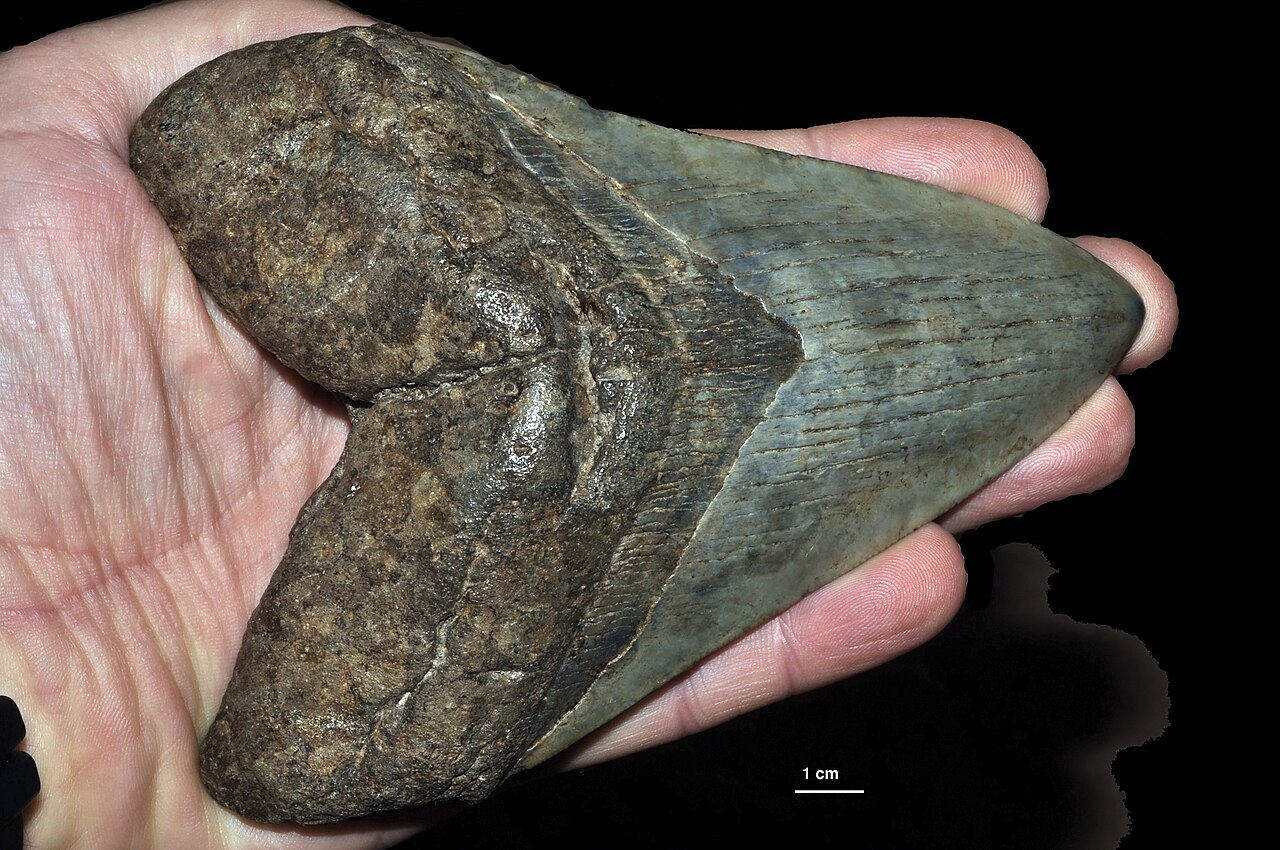
Its tiny tooth-like scales, called placoid scales, were found in 2023. They measure 0.3 to 0.8 mm across and have widely spaced ridges.[9] Megalodon teeth are the largest of any known shark. Some exceed 180 mm in slant height.[10] The teeth are triangular, thick, finely serrated, and lack small side cusps called lateral denticles.[11] A full set of jaws held over 250 teeth in five rows.[12]
Biology and ecology
Megalodon sat at the top of the food chain and likely ate many kinds of animals.[13] Its diet included whales, dolphins, seals, sea turtles, fish, and other sharks.[14] Bite marks on whale fossils suggest megalodon went for the heart and lungs, unlike great whites.[15] It may have rammed small whales from below before killing them.[16]
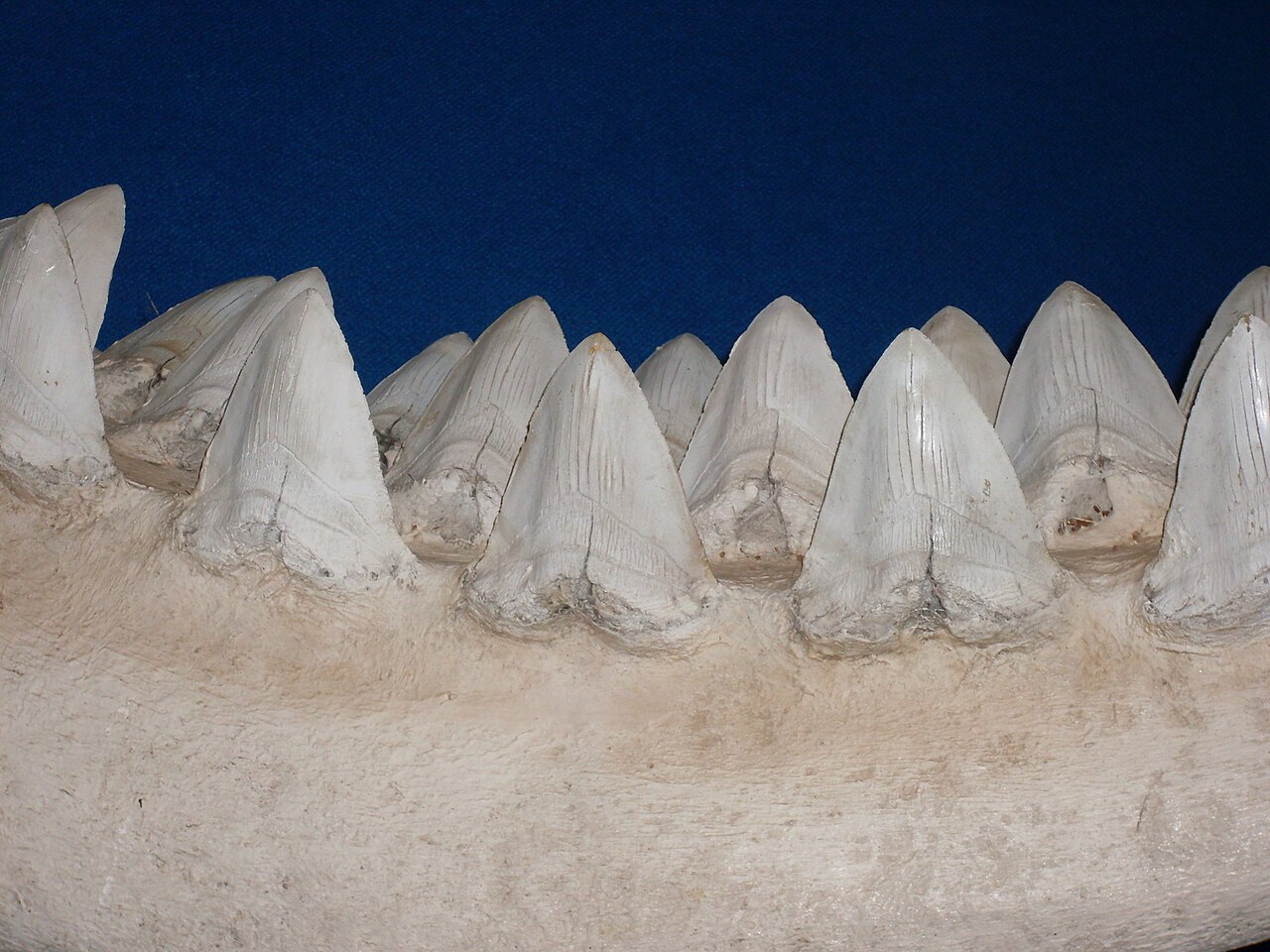
Megalodon likely gave birth to live young and used warm coastal nurseries.[17]
Distribution and habitat
This shark lived in many environments, from shallow coasts to deep offshore waters.[18] Fossils suggest megalodons were larger on average in the Southern Hemisphere than in the Northern, possibly due to different prey or water temperatures.[19]
Human interactions
Megalodon teeth have been collected and used by humans for thousands of years.[20] Pre-Columbian cultures in the Americas turned them into tools, jewelry, and ceremonial items.[20] Medieval and Renaissance nobles wore them as amulets to protect against poison.[21] By the 16th century, people even ground up the teeth to eat as medicine.[21]
Taxonomy and phylogeny
Swiss naturalist Louis Agassiz named megalodon in his 1833–1843 work on fossil fish.[22] He called it Carcharias megalodon in 1835, then changed the name to Carcharodon megalodon in 1843.[22][23] The name means "big tooth," from the Greek words megálos and odṓn.[22] It belongs to a shark family called Otodontidae, not the same family as the great white shark.[24]
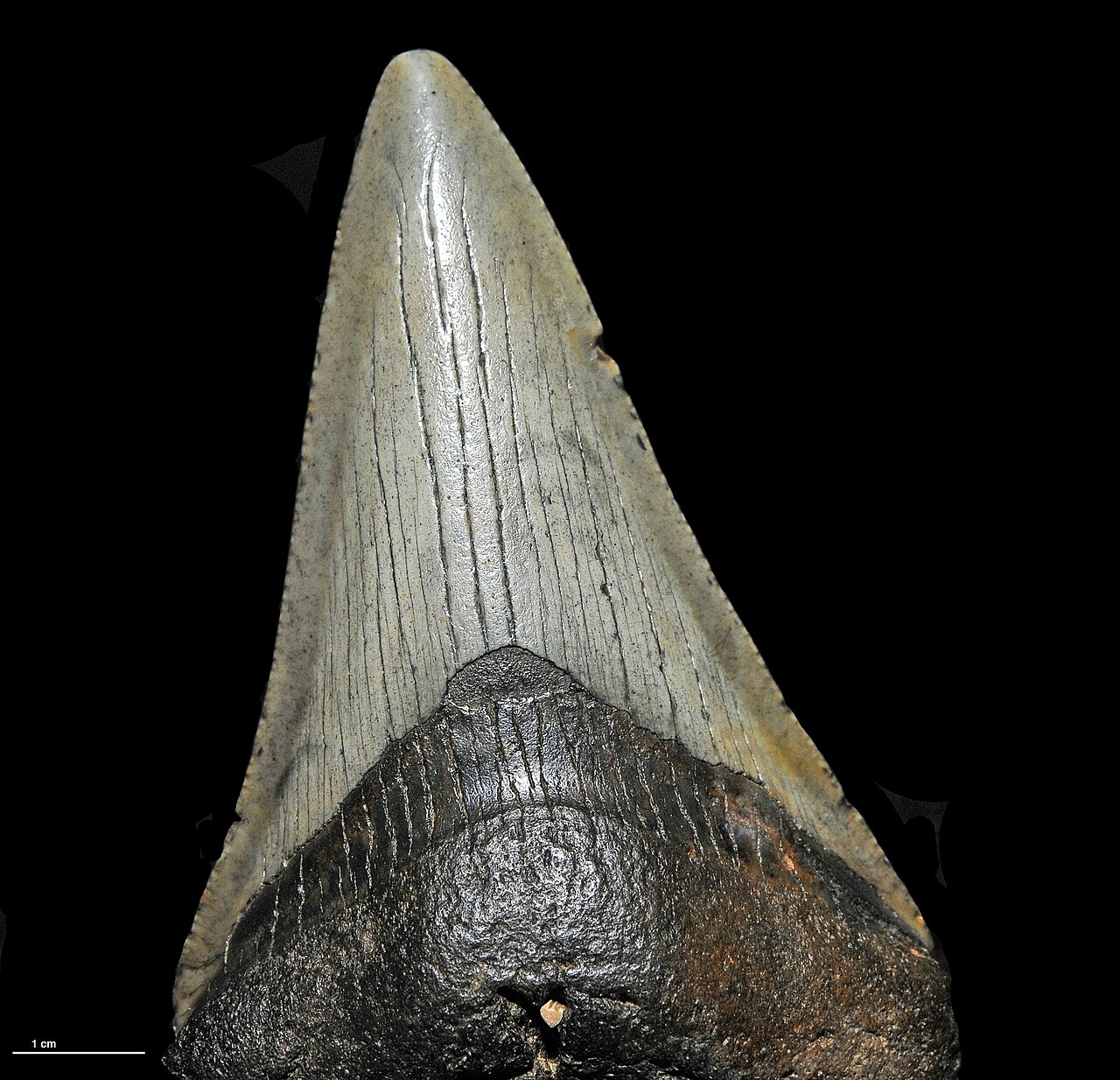
Megalodon's closest relatives include the extinct shark Otodus obliquus and other species in the Carcharocles group.[25][26] The earliest megalodon remains may date to around 28 million years ago.[5]
References
- Wikipedia, "Megalodon" (CC BY-SA 4.0), which cites: Pimiento, "Geographical distribution patterns of Carcharocles megalodon over time reveal clues about extinction mechanisms", Journal of Biogeography, 2016, p. 1645–1655; Pimiento, "Sharks and Rays (Chondrichthyes, Elasmobranchii) from the Late Miocene Gatun Formation of Panama", Journal of Paleontology, 2013, p. 755–774; Klimley, "Great White Sharks: The Biology of Carcharodon carcharias", Academic Press, 1996; Fitzgerald, "A review of the Tertiary fossil Cetacea (Mammalia) localities in Australia", Memoirs of Museum Victoria, 2004, p. 183–20 en.wikipedia.org
- Wikipedia, "Megalodon" (CC BY-SA 4.0), which cites: ; ; Leblanc, "A guide to macrofossils of Libya (2000)", Unpublished, 2000; Tanaka, "Paleozoic, Mesozoic and Cenozoic Chondrichthyes from the Japanese Islands.", National Museum of Nature and Science Monographs, 2025, p. 1–184; Tanaka, "Paleozoic, Mesozoic and Cenozoic Chondrichthyes from the Japanese Islands.", National Museum of Nature and Science Monographs, 2025, p. 1–184; Tanaka, "Paleozoic, Mesozoic and Cenozoic Chondrichthyes from the Japanese Islands.", National Museum of Nature and Science Monographs, 2025, p. 1–184; Tanaka, "Paleozoi en.wikipedia.org
- Wikipedia, "Megalodon" (CC BY-SA 4.0), which cites: Gottfried, "Great White Sharks: The Biology of Carcharodon carcharias", Academic Press, 1996, p. 55–89; Shimada, "The size of the megatooth shark, Otodus megalodon (Lamniformes: Otodontidae), revisited", Historical Biology, 2019, p. 1–8; "Reassessment of the possible size, form, weight, cruising speed, and growth parameters of the extinct megatooth shark, Otodus megalodon (Lamniformes: Otodontidae), and new evolutionary insights into its gigantism, life ; Gottfried, "Great White Sharks: The Biology of Carcharodon carcharias", Academic Press, en.wikipedia.org
- Wikipedia, "Megalodon" (CC BY-SA 4.0), which cites: Perez, "Body length estimation of Neogene macrophagous lamniform sharks (Carcharodon and Otodus) derived from associated fossil dentitions", Palaeontologia Electronica, 2021, p. 1–28; Cooper, "The extinct shark Otodus megalodon was a transoceanic superpredator: Inferences from 3D modeling", Science Advances, 2022 (we also read that source) en.wikipedia.org
- Wikipedia, "Megalodon" (CC BY-SA 4.0), which cites: Yabe, "Age of Carcharocles megalodon (Lamniformes: Otodontidae): A review of the stratigraphic records", The Palaeontological Society of Japan, 2004, p. 7–15; Gottfried, "An associated specimen of Carcharodon angustidens (Chondrichthyes, Lamnidae) from the Late Oligocene of New Zealand, with comments on Carcharodon interrelationships", Journal of Vertebrate Paleontology, 2001,; Pimiento, "Geographical distribution patterns of Carcharocles megalodon over time reveal clues about extinction mechanisms", Journal of Biogeography, 2016, p. 1645–165 en.wikipedia.org
- Wikipedia, "Megalodon" (CC BY-SA 4.0), which cites: Gottfried, "Great White Sharks: The Biology of Carcharodon carcharias", Academic Press, 1996, p. 55–89 (we also read that source) en.wikipedia.org
- Wikipedia, "Megalodon" (CC BY-SA 4.0), which cites: Renz, "Megalodon: Hunting the Hunter", PaleoPress, 2002, p. 1–159 (we also read that source) en.wikipedia.org
- Wikipedia, "Megalodon" (CC BY-SA 4.0), which cites: Sternes, "White shark comparison reveals a slender body for the extinct megatooth shark, Otodus megalodon (Lamniformes: Otodontidae)", Palaeontologia Electronica, 2024 (original not read by us) en.wikipedia.org
- Wikipedia, "Megalodon" (CC BY-SA 4.0), which cites: Shimada, "Tessellated calcified cartilage and placoid scales of the Neogene megatooth shark, Otodus megalodon (Lamniformes: Otodontidae), offer new insights into its biology and the evolution of regional endothermy and g (original not read by us) en.wikipedia.org
- Wikipedia, "Megalodon" (CC BY-SA 4.0), which cites: Renz, "Megalodon: Hunting the Hunter", PaleoPress, 2002, p. 1–159; Gottfried, "Great White Sharks: The Biology of Carcharodon carcharias", Academic Press, 1996, p. 55–89 (we also read that source) en.wikipedia.org
- Wikipedia, "Megalodon" (CC BY-SA 4.0), which cites: Klimley, "Great White Sharks: The Biology of Carcharodon carcharias", Academic Press, 1996; Pimiento, "Ancient Nursery Area for the Extinct Giant Shark Megalodon from the Miocene of Panama", PLOS ONE, 2010 (original not read by us) en.wikipedia.org
- Wikipedia, "Megalodon" (CC BY-SA 4.0), which cites: Klimley, "Great White Sharks: The Biology of Carcharodon carcharias", Academic Press, 1996; Renz, "Megalodon: Hunting the Hunter", PaleoPress, 2002, p. 1–159; Renz, "Megalodon: Hunting the Hunter", PaleoPress, 2002, p. 1–159; Nyberg, "Tracing the ancestry of the great white shark, Carcharodon carcharias, using morphometric analyses of fossil teeth", Journal of Vertebrate Paleontology, 2006, p. 806–814; Renz, "Megalodon: Hunting the Hunter", PaleoPress, 2002, p. 1–159; Gottfried, "Great White Sharks: The Biology of Carcharodon carcharias", Aca en.wikipedia.org
- Wikipedia, "Megalodon" (CC BY-SA 4.0), which cites: Cooper, "The extinct shark Otodus megalodon was a transoceanic superpredator: Inferences from 3D modeling", Science Advances, 2022; Martin, "Calcium isotopes reveal the trophic position of extant and fossil elasmobranchs", Chemical Geology, 2015, p. 118–125; Martin, "Calcium isotopes reveal the trophic position of extant and fossil elasmobranchs", Chemical Geology, 2015, p. 118–125; McCormack, "Miocene marine vertebrate trophic ecology reveals megatooth sharks as opportunistic supercarnivores", Earth and Planetary Science Letters, 2025 (origi en.wikipedia.org
- Wikipedia, "Megalodon" (CC BY-SA 4.0), which cites: Paredes-Aliaga, "Analysing Trophic Competition in †Otodus megalodon and Carcharodon carcharias through 2D-SEM Dental Microwear", Spanish Journal of Palaeontology, 19 June 2024, p. 102; Prothero, "The Story of Life in 25 Fossils", Columbia University Press, 2015, p. 96–110; Collareta, "Did the giant extinct shark Carcharocles megalodon target small prey? Bite marks on marine mammal remains from the late Miocene of Peru", Palaeogeography, Palaeoclimatology, Palaeoecology, 2017, p. 84–91; Morgan, "Whither the giant white shark?", Paleontology To en.wikipedia.org
- Wikipedia, "Megalodon" (CC BY-SA 4.0), which cites: Prothero, "The Story of Life in 25 Fossils", Columbia University Press, 2015, p. 96–110 (original not read by us) en.wikipedia.org
- Wikipedia, "Megalodon" (CC BY-SA 4.0), which cites: Godfrey, "A Miocene Cetacean Vertebra Showing a Partially Healed Compression Factor, the Result of Convulsions or Failed Predation by the Giant White Shark, Carcharodon megalodon", Jeffersoniana, 2005, p. 1–12 (original not read by us) en.wikipedia.org
- Wikipedia, "Megalodon" (CC BY-SA 4.0), which cites: Pimiento, "Ancient Nursery Area for the Extinct Giant Shark Megalodon from the Miocene of Panama", PLOS ONE, 2010; "Identifican en Canarias fósiles de 'megalodón', el tiburón más grande que ha existido", Europa Press Noticias SA, 2013; Herraiz, "The Iberian fossil record of † Otodus megalodon rejects Mediterranean dwarfism and supports nursery use", Biology Letters, 21 January 2026; Shimada, "Revisiting body size trends and nursery areas of the Neogene megatooth shark, Otodus megalodon (Lamniformes: Otodontidae), reveals Bergmann's rule possi en.wikipedia.org
- Wikipedia, "Megalodon" (CC BY-SA 4.0), which cites: Renz, "Megalodon: Hunting the Hunter", PaleoPress, 2002, p. 1–159; "Giant-toothed White Sharks and Wide-toothed Mako (Lamnidae) from the Venezuela Neogene: Their Role in the Caribbean, Shallow-water Fish Assemblage", Caribbean Journal of Science, 2004, p. 362–368 (original not read by us) en.wikipedia.org
- Wikipedia, "Megalodon" (CC BY-SA 4.0), which cites: Pimiento, "Body-size trends of the extinct giant shark Carcharocles megalodon: a deep-time perspective on marine apex predators", Paleobiology, 22 September 2024, p. 479–490 (original not read by us) en.wikipedia.org
- Wikipedia, "Megalodon" (CC BY-SA 4.0), which cites: "Integrated geology, paleontology, and archaeology: Native American use of fossil shark teeth in the Chesapeake Bay region", Archaeology of Eastern North America, 2011, p. 93–108; Farrell, A.D., "A Use-Wear and Functional Analysis of Precontact Shark Teeth Assemblages from Florida", Florida State University, 2021; Farrell, A.D., "A Use-Wear and Functional Analysis of Precontact Shark Teeth Assemblages from Florida", Florida State University, 2021; Jacobs, J., "Hopewell Culture National Historical Park Sharks Teeth HOCU - 2832 and 4222", Natio en.wikipedia.org
- Wikipedia, "Megalodon" (CC BY-SA 4.0), which cites: Duffin, C.J., "Toxicology of the Middle Ages and Renaissance", 2017, p. 125–133 (original not read by us) en.wikipedia.org
- Wikipedia, "Megalodon" (CC BY-SA 4.0), which cites: Agassiz, L., "Recherches sur les poissons fossiles", Imprimerie de Petitpierre, 1843; Brignon, A., "Historical and nomenclatural remarks on some megatoothed shark teeth (Elasmobranchii, Otodontidae) from the Cenozoic of New Jersey (U.S.A.)", Rivista Italiana di Paleontologia e Stratigrafia, 2021, p. 595–6; ; (original not read by us) en.wikipedia.org
- Wikipedia, "Megalodon" (CC BY-SA 4.0), which cites: Brignon, A., "Historical and nomenclatural remarks on some megatoothed shark teeth (Elasmobranchii, Otodontidae) from the Cenozoic of New Jersey (U.S.A.)", Rivista Italiana di Paleontologia e Stratigrafia, 2021, p. 595–6; Agassiz, L., "Recherches sur les poissons fossiles", Imprimerie de Petitpierre, 1843; Agassiz, L., "Recherches sur les poissons fossiles", Imprimerie de Petitpierre, 1843; Woodward, A.S., "Catalogue of the fossil fishes in the British Museum (Natural History), Part I. Containing the Elasmobranchii", British Museum (Natural H en.wikipedia.org
- Wikipedia, "Megalodon" (CC BY-SA 4.0), which cites: Pimiento, "Geographical distribution patterns of Carcharocles megalodon over time reveal clues about extinction mechanisms", Journal of Biogeography, 2016, p. 1645–1655; Pimiento, "Body-size trends of the extinct giant shark Carcharocles megalodon: a deep-time perspective on marine apex predators", Paleobiology, 22 September 2024, p. 479–490; Pimiento, "When Did Carcharocles megalodon Become Extinct? A New Analysis of the Fossil Record", PLOS ONE, 2014; Shimada, "A new elusive otodontid shark (Lamniformes: Otodontidae) from the lower Miocene, en.wikipedia.org
- Wikipedia, "Megalodon" (CC BY-SA 4.0), which cites: Renz, "Megalodon: Hunting the Hunter", PaleoPress, 2002, p. 1–159; Renz, "Megalodon: Hunting the Hunter", PaleoPress, 2002, p. 1–159; Andres, "C. megalodon — Megatooth Shark, Carcharodon versus Carcharocles", fossilguy.com, 2002; Perez, "The transition between Carcharocles chubutensis and Carcharocles megalodon (Otodontidae, Chondrichthyes): lateral cusplet loss through time", Journal of Vertebrate Paleontology, 2019; Perez, "The transition between Carcharocles chubutensis and Carcharocles megalodon (Otodontidae, Chondrichthyes): lateral cusp en.wikipedia.org
- Wikipedia, "Megalodon" (CC BY-SA 4.0), which cites: "Exceptional preservation of the white shark Carcharodon from the early Pliocene of Peru", Journal of Vertebrate Paleontology, 2009, p. 1–13; Andres, "C. megalodon — Megatooth Shark, Carcharodon versus Carcharocles", fossilguy.com, 2002; Shimada, "A new elusive otodontid shark (Lamniformes: Otodontidae) from the lower Miocene, and comments on the taxonomy of otodontid genera, including the 'megatoothed' clade", Historical Biology, 2016, p. 1–11; "Cenomanian–Campanian (Late Cretaceous) mid-palaeolatitude sharks of Cretalamna appendiculata type en.wikipedia.org
Each numbered sentence above was checked against the source it cites before publication. Sentences citing Wikipedia adapt text from the English Wikipedia article Megalodon (contributors), used under CC BY-SA 4.0; this entry is available under the same licence. Other sources were used for facts only; no text or images are copied from them.
More in Mackerel sharks
Elsewhere in Sharks
Test yourself
Three questions drawn from this entry’s sources. Pick an answer to check it.
Answers checked against the source article
Sources
Compiled from Wikipedia and the sources listed below. Text from Wikipedia is available under CC BY-SA 4.0; this entry is adapted from it.
- Wikipedia: Megalodon (CC BY-SA 4.0).
- Word definitions: the Codexery glossary, each quoted from its Wikipedia article.
Spotted an error? Know more?
Reader corrections go straight into our review queue. Suggest an edit · How this site is sourced