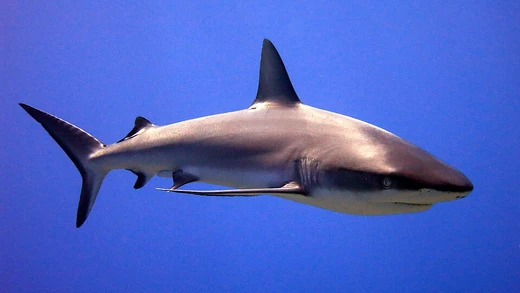
Northern river shark
A rare requiem shark of turbid tidal rivers and coastal waters.
Last updated

CSIRO National Fish Collection · via Wikipedia: Northern river shark · CC BY 3.0
The northern river shark is a rare requiem shark that patrols the murky rivers and coastal waters of northern Australia and Papua New Guinea.[1] It is one of the most threatened sharks on the planet, with perhaps no more than 250 mature individuals left in the wild.[2]
Scientific classification
- KingdomAnimalia
- PhylumChordata
- ClassChondrichthyes
- SubclassElasmobranchii
- DivisionSelachii
- OrderCarcharhiniformes
- FamilyCarcharhinidae
- GenusGlyphis
- SpeciesGlyphis garricki
Named by Compagno, W. T. White & Last, 2008
Close relatives
Other species of Glyphis with a Codexery entry.
- Speartooth shark Glyphis glyphis
- Ganges shark Glyphis gangeticus
Sources: Wikipedia taxobox: Northern river shark (CC BY-SA 4.0) · order, family and genus agree with WoRMS AphiaID 398263 (CC BY 4.0)
Conservation status
Vulnerable (VU)
- LC
- NT
- VU▲ this species
- EN
- CR
- EW
- EX
Source: IUCN Red List assessment · GBIF copy of the Red List category
How big is it?
Largest length in the source, 2.5 m, next to a 1.8 m person.
Diagram: drawn by Codexery, schematic shapes to scale (not a likeness). Length: Wikipedia: Northern river shark
Where the northern river shark has been recorded
Each dot is a place where the species has been observed and reported (1,963 records, half-degree grid) — not a modelled range. 16 inland records left out (institution coordinates).
Map: drawn by Codexery. Data: GBIF occurrence search (records CC0 / CC BY) · Natural Earth basemap (public domain) · place coordinates: Wikipedia (CC BY-SA 4.0)
Description
Its snout is broadly rounded, and its tiny eyes have nictitating membranes, which are clear eyelids that protect the eye.[3] The skin is covered in small, oval, overlapping scales called dermal denticles, each with three horizontal ridges.[3] This shark has a chunky body and a broad, flat head, just like its close relatives.[3] A triangular flap of skin splits each nostril into one big opening and one tiny one.[3]
The upper teeth stand upright, are triangle-shaped, and have serrated edges; the lower teeth are skinnier and go straight or curve just a little.[3] Pelvic fins are triangle-shaped and have rear edges that are almost straight.[3] On top, this shark is steel-gray, and underneath it's white; the line between those colors is sharp and sits well below the eye.[3] The biggest one ever recorded measured 2.5 meters long.[3]
You can tell this species apart from the speartooth shark by its fewer vertebrae (137 to 151, not 213 to 222) and a lower, jagged gray-white color line.[3]
Biology and ecology
The northern river shark seems built for hunting fish in murky water, with slender teeth, small eyes, and lots of ampullae of Lorenzini—sensory organs that pick up electrical fields.[4] Young are born at under 67 centimeters long.[5] Like all requiem sharks, the northern river shark gives birth to live young; the babies first use up their yolk sac and then form a placental connection to their mom.[4] One female that scientists looked at was carrying nine babies.[5]
Males become mature when they're between 1.2 and 1.4 meters long, and females mature between 1.4 and 1.7 meters.[5]
Distribution and habitat
People have spotted the northern river shark in King Sound, the Ord River, and Doctors Creek near Derby in Western Australia; the Adelaide and Alligator Rivers in the Northern Territory; and around Daru and possibly the Fly River in Papua New Guinea.[1]
Human interactions
This shark seems very rare, though there might be more groups of them out there in Australia and Papua New Guinea that we haven't found yet.[2] In Papua New Guinea, there are no rules that stop people from catching this shark.[6] Habitat degradation may pose a further threat.[2]
Taxonomy and phylogeny
The very first northern river sharks ever found were two newborn males from Papua New Guinea, discovered by New Zealand fish expert Jack Garrick—and that's who the species is named after.[3]
References
- Wikipedia, "Northern river shark" (CC BY-SA 4.0), which cites: Compagno, L.J.V., "Descriptions of new Australian Chondrichthyans", CSIRO Marine and Atmospheric Research, 2008, p. 203–226}} (ISBN corrected) {{Listed Invalid ISBN; Pillans, R.D., "Observations on the distribution, biology, short-term movements and habitat requirements of river sharks Glyphis spp. in northern Australia", Endangered Species Research, 25 August 2009, p. 321–332; White, W.T., "Rediscovery of the Threatened River Sharks, Glyphis garricki and G. glyphis, in Papua New Guinea", PLOS ONE, 7 October 2015 (we also rea en.wikipedia.org
- Wikipedia, "Northern river shark" (CC BY-SA 4.0), which cites: Kyne, P.M., "Glyphis garricki", 2021 (we also read that source) en.wikipedia.org
- Wikipedia, "Northern river shark" (CC BY-SA 4.0), which cites: Compagno, L.J.V., "Descriptions of new Australian Chondrichthyans", CSIRO Marine and Atmospheric Research, 2008, p. 203–226}} (ISBN corrected) {{Listed Invalid ISBN (original not read by us) en.wikipedia.org
- Wikipedia, "Northern river shark" (CC BY-SA 4.0), which cites: Kyne, P.M., "Glyphis garricki", 2021; Thorburn, D.C., D.L. Morgan, A.J. Rowland and H.S. Gill. (February 2004). The northern river shark (Glyphis sp. C) in Western Australia . Report to the National (we also read that source) en.wikipedia.org
- Wikipedia, "Northern river shark" (CC BY-SA 4.0), which cites: Pillans, R.D., "Observations on the distribution, biology, short-term movements and habitat requirements of river sharks Glyphis spp. in northern Australia", Endangered Species Research, 25 August 2009, p. 321–332; Compagno, L.J.V., "Descriptions of new Australian Chondrichthyans", CSIRO Marine and Atmospheric Research, 2008, p. 203–226}} (ISBN corrected) {{Listed Invalid ISBN (we also read that source) en.wikipedia.org
- Wikipedia, "Northern river shark" (CC BY-SA 4.0), which cites: Kyne, P.M., "Glyphis garricki", 2021; White, W.T., "Rediscovery of the Threatened River Sharks, Glyphis garricki and G. glyphis, in Papua New Guinea", PLOS ONE, 7 October 2015 (we also read that source) en.wikipedia.org
Each numbered sentence above was checked against the source it cites before publication. Sentences citing Wikipedia adapt text from the English Wikipedia article Northern river shark (contributors), used under CC BY-SA 4.0; this entry is available under the same licence. Other sources were used for facts only; no text or images are copied from them.
More in Reef sharks
Elsewhere in Sharks
Test yourself
Three questions drawn from this entry’s sources. Pick an answer to check it.
Answers checked against the source article
Sources
Compiled from Wikipedia and the sources listed below. Text from Wikipedia is available under CC BY-SA 4.0; this entry is adapted from it.
- Wikipedia: Northern river shark (CC BY-SA 4.0).
- Classification: the source article's taxobox; order, family and genus checked against WoRMS, the World Register of Marine Species (CC BY 4.0).
- Conservation status: IUCN Red List assessment.
- Occurrence records: GBIF (CC0 / CC BY). Basemap: Natural Earth (public domain).
- Word definitions: the Codexery glossary, each quoted from its Wikipedia article.
Spotted an error? Know more?
Reader corrections go straight into our review queue. Suggest an edit · How this site is sourced