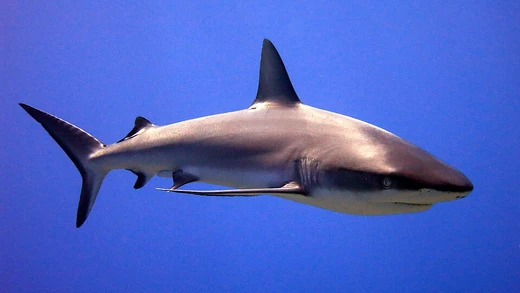
Speartooth shark
A rare river shark adapted to turbid tidal waters.
Last updated

Bill Harrison from Wellington, New Zealand · via Wikipedia: Speartooth shark · CC BY 2.0
The speartooth shark is one of only a few shark species that spend much of their lives in freshwater.[1] Nobody had ever seen an adult speartooth shark until 2014.[2] You'll find the speartooth shark, a rare river shark, living in just a handful of tropical rivers across northern Australia and southern Papua New Guinea.[3][1]
Scientific classification
- KingdomAnimalia
- PhylumChordata
- ClassChondrichthyes
- SubclassElasmobranchii
- DivisionSelachii
- OrderCarcharhiniformes
- FamilyCarcharhinidae
- GenusGlyphis
- SpeciesGlyphis glyphis
Named by (J. P. Müller & Henle, 1839)
Close relatives
Other species of Glyphis with a Codexery entry.
- Ganges shark Glyphis gangeticus
- Northern river shark Glyphis garricki
Sources: Wikipedia taxobox: Speartooth shark (CC BY-SA 4.0) · order, family and genus agree with WoRMS AphiaID 277184 (CC BY 4.0)
Conservation status
Vulnerable (VU)
- LC
- NT
- VU▲ this species
- EN
- CR
- EW
- EX
Source: IUCN Red List assessment · GBIF copy of the Red List category
How big is it?
Largest length in the source, 2.6 m, next to a 1.8 m person.
Diagram: drawn by Codexery, schematic shapes to scale (not a likeness). Length: Wikipedia: Speartooth shark
Where the speartooth shark has been recorded
5 inland records left out (institution coordinates).
Map: drawn by Codexery. Data: Natural Earth basemap (public domain) · place coordinates: Wikipedia (CC BY-SA 4.0)
Description
Its body is plain slate-gray on top and white underneath, with the color boundary running through the bottom rim of the eye and through the gill slits.[4] The speartooth shark has a short, wide head and a streamlined, fairly sturdy body.[5] The teeth stand tall and upright: the upper jaw has wide, serrated triangles, while the lower jaw has narrow, spear-like teeth.[4] A white ring circles each eye.[4]
Thanks to the first known adults found in 2014, we now know this species can reach about 2.6 meters in length.[5]
Biology and ecology
Like other requiem sharks, it is viviparous, meaning the young develop inside the mother and receive nourishment through a placental connection.[6] The speartooth shark seems pretty laid-back, riding the tides to save energy instead of fighting the current.[2] It's equally active day and night, which makes sense given the low light of its murky, muddy home.[2] Young speartooth sharks feed on a variety of small fish and crustaceans, including prawns, gobies, catfish, and bream.[6]
Distribution and habitat
Newborn to subadult sharks live only in areas with fast tidal currents and muddy bottoms, where less than one percent of sunlight reaches beyond one meter depth.[2] Younger sharks are generally found further upstream than older ones.[2]
Human interactions
Commercial fisheries catch this species by accident in gillnets and longlines.[7] Recreational anglers and bow fishers also catch many of them.[8] Mining and dredging projects also damage their habitat.[8] There's no record of a speartooth shark ever hurting a person.[7]
Experts think there are no more than 2,500 mature speartooth sharks left in the whole world.[7] People might eat the sharks they catch, use them as crab pot bait, or just toss them on land.[8] Australian federal law lists it as critically endangered.[9]
Taxonomy and phylogeny
German biologists Johannes Müller and Jakob Henle first described the speartooth shark in their 1839–41 work.[10] They based their description on a stuffed juvenile female that was one meter long, and nobody knows where it originally came from.[10]
References
- "Rare and threatened shark found in the Roper River for the first time Charles Darwin University", www.cdu.edu.au, 2024-02-19. facts only, no text reused. cdu.edu.au
- Wikipedia, "Speartooth shark" (CC BY-SA 4.0), which cites: Pillans, R.D., "Observations on the distribution, biology, short-term movements and habitat requirements of river sharks Glyphis spp. in northern Australia", Endangered Species Research, 25 August 2009, p. 321–332 (we also read that source) en.wikipedia.org
- Wikipedia, "Speartooth shark" (CC BY-SA 4.0), which cites: Roberts, T. R., "A new record for the speartooth carcharhinid shark Glyphis glyphis from Pulo Condor, South China Sea", Natural History Bulletin of the Siam Society, 21 May 2007, p. 279–283; Peverell, S.C., "New records of the River Shark Glyphis (Carcharhinidae) reported from Cape York Peninsula, northern Australia", Zootaxa, 2006, p. 53–68 (we also read that source) en.wikipedia.org
- Wikipedia, "Speartooth shark" (CC BY-SA 4.0), which cites: Compagno, L.J.V., "Descriptions of new Australian Chondrichthyans", CSIRO Marine and Atmospheric Research, 2008, p. 203–226}} (ISBN corrected) {{Listed Invalid ISBN; "Sharks and Rays of Australia", Harvard University Press, 2009, p. 276–277 (we also read that source) en.wikipedia.org
- Wikipedia, "Speartooth shark" (CC BY-SA 4.0), which cites: White, W.T., "Rediscovery of the Threatened River Sharks, Glyphis garricki and G. glyphis, in Papua New Guinea", PLOS ONE, 7 October 2015 (we also read that source) en.wikipedia.org
- Wikipedia, "Speartooth shark" (CC BY-SA 4.0), which cites: Peverell, S.C., "New records of the River Shark Glyphis (Carcharhinidae) reported from Cape York Peninsula, northern Australia", Zootaxa, 2006, p. 53–68; Pillans, R.D., "Observations on the distribution, biology, short-term movements and habitat requirements of river sharks Glyphis spp. in northern Australia", Endangered Species Research, 25 August 2009, p. 321–332; White, W.T., "Rediscovery of the Threatened River Sharks, Glyphis garricki and G. glyphis, in Papua New Guinea", PLOS ONE, 7 October 2015 (we also read that source) en.wikipedia.org
- Wikipedia, "Speartooth shark" (CC BY-SA 4.0), which cites: ; Kyne, P.M., "Glyphis glyphis", 2021 (we also read that source) en.wikipedia.org
- Wikipedia, "Speartooth shark" (CC BY-SA 4.0), which cites: Kyne, P.M., "Glyphis glyphis", 2021; Department of the Environment, Water, Heritage and the Arts (2010). Glyphis glyphis – Speartooth Shark. Species Profile and Threats Database, Department o; Stevens, J.D., R.D. Pillans and J. Salini (2005). Conservation Assessment of Glyphis sp. A (Speartooth Shark), Glyphis sp. C (Northern River Shark), Pristis mic (we also read that source) en.wikipedia.org
- Wikipedia, "Speartooth shark" (CC BY-SA 4.0), which cites: Kyne, P.M., "Glyphis glyphis", 2021 (we also read that source) en.wikipedia.org
- Wikipedia, "Speartooth shark" (CC BY-SA 4.0), which cites: "Systematische Beschreibung der Plagiostomen", Veit und Comp, 1838–41, p. 40; Roberts, T. R., "A new record for the speartooth carcharhinid shark Glyphis glyphis from Pulo Condor, South China Sea", Natural History Bulletin of the Siam Society, 21 May 2007, p. 279–283 (original not read by us) en.wikipedia.org
Each numbered sentence above was checked against the source it cites before publication. Sentences citing Wikipedia adapt text from the English Wikipedia article Speartooth shark (contributors), used under CC BY-SA 4.0; this entry is available under the same licence. Other sources were used for facts only; no text or images are copied from them.
More in Reef sharks
Elsewhere in Sharks
Test yourself
Three questions drawn from this entry’s sources. Pick an answer to check it.
Answers checked against the source article
Sources
Compiled from Wikipedia and the sources listed below. Text from Wikipedia is available under CC BY-SA 4.0; this entry is adapted from it.
- Wikipedia: Speartooth shark (CC BY-SA 4.0).
- Classification: the source article's taxobox; order, family and genus checked against WoRMS, the World Register of Marine Species (CC BY 4.0).
- Conservation status: IUCN Red List assessment.
- Occurrence records: GBIF (CC0 / CC BY). Basemap: Natural Earth (public domain).
- Word definitions: the Codexery glossary, each quoted from its Wikipedia article.
Spotted an error? Know more?
Reader corrections go straight into our review queue. Suggest an edit · How this site is sourced