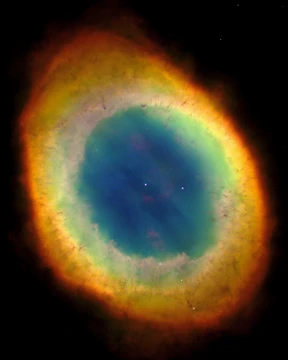
Emission, Dark and Reflection Nebulae
47 entries in the Emission, Dark and Reflection Nebulae, Part 2 compendium.
Scorpius OB1Young OB association with massive stars and active star formation.Sh 2-101Tulip-shaped emission nebula near the black hole Cygnus X-1.Sh 2-264A star-forming ring nebula in Orion, ionized by blue giant λ Orionis.Sharpless catalogCatalog of 313 H II regions, planetary nebulae, and supernova remnants.Star-forming regions of CassiopeiaA northern sky region of multiple star-forming complexes at varying distances.Star-forming regions of VelaOverlapping star-forming systems along the line of sight in Vela.Westerhout 40One of the nearest sites of massive star formation.Westerhout 49A giant HII region hosting some of the most massive stars known.HH 1/2First recognized Herbig-Haro objects, a bright bow-shock pair in Orion.HH 46/47A protostellar jet complex that revealed the nature of Herbig–Haro objects.HH 111A prototype of highly collimated optical jet sources in Orion.DQ HerculisPrototype intermediate polar and bright nova of 1934.FH SerpentisA 1970 nova observed across multiple wavelengths with an expanding shell.HR DelphiniA slow nova with a jittering light curve and a bipolar remnant nebula.RR PictorisA slow nova discovered in 1925 by an amateur astronomer.T PyxidisA recurrent nova that may become a Type Ia supernova.V476 CygniA fast nova with a dust dip and an expanding shell.V1500 CygniSecond intrinsically brightest nova of the 20th century.V1974 CygniFirst nova observed across the full electromagnetic spectrum.BAT99-98Massive Wolf–Rayet star near the R136 cluster in the Tarantula Nebula.HD 38282A massive spectroscopic binary of two luminous Wolf-Rayet stars.R136Central starburst cluster in the Tarantula Nebula, LMC.R136a1The most massive and luminous star known, in the Tarantula Nebula.R136a2One of the most massive and luminous stars known.R136a3A massive Wolf–Rayet star in the R136 cluster.R145A binary system of two exceptionally luminous stars in the Tarantula Nebula.VFTS 102A rapidly rotating runaway star in the Tarantula Nebula.VFTS 352The most massive overcontact binary system known.VFTS 682An extremely massive, isolated Wolf–Rayet star in the Tarantula Nebula.Wolf–Rayet nebulaNebulae sculpted by the fierce winds of Wolf–Rayet stars.Protoplanetary nebulaA short-lived infrared reflection nebula between AGB and planetary nebula phases.AS 314A protoplanetary nebula reclassified from hypergiant to post-AGB star.Boomerang NebulaThe coldest natural place in the known universe.Calabash NebulaA protoplanetary nebula in Puppis, near NGC 2438.Cotton Candy NebulaA faint bipolar protoplanetary nebula in Scorpius.Egg NebulaA bipolar protoplanetary nebula with bright arcs and polarized light.Frosty Leo NebulaFirst bipolar protoplanetary nebula with point reflection symmetry.IRAS 19475+3119A protoplanetary nebula with a quadrupolar structure and pulsating central star.LL PegasiA binary carbon star hidden in a precise Archimedean spiral nebula.CW LeonisA carbon star embedded in a thick dust envelope.M1-92Bipolar protoplanetary nebula in Cygnus, also called the Footprint Nebula.Post-AGB starLuminous low-mass supergiants in a late phase of stellar evolution.Red RectangleA protoplanetary nebula with a rectangular shape and X-shaped spikes.Red Square NebulaA nearly perfectly symmetrical square nebula around star MWC 922.Westbrook NebulaA bipolar protoplanetary nebula in Auriga, transitioning toward a planetary nebula.UW Canis MajorisA Beta Lyrae eclipsing contact binary in Canis Major.WR 104Triple star system with a pinwheel nebula and potential gamma-ray burst risk.
Browse Emission, Dark and Reflection Nebulae in the interactive codex →