FH Serpentis
A 1970 nova observed across multiple wavelengths with an expanding shell.
Last updated
FH Serpentis, also known as Nova Serpentis 1970, is a nova that flared up in the constellation Serpens during 1970, peaking at a brightness of magnitude 4.4. Japanese astronomer Minoru Honda first spotted it on February 13, 1970, from Kurashiki. Subsequent studies by other astronomers used the fading pattern of its light curves to estimate its distance.
This nova holds scientific significance as one of the earliest to be observed across multiple wavelengths—infrared, visible, ultraviolet, and radio. Notably, it became brightest in the infrared about 100 days after its initial discovery. The NASA space observatory OAO-2 Stargazer, which operated from 1968 to 1973, also recorded the event.
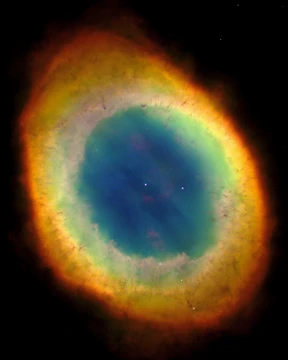
A faint emission nebula, or shell, surrounds the star, resembling a planetary nebula. Images captured in 1996 and 2018 by Santamaria et al. reveal that this shell is clearly expanding. Slightly elliptical in shape, its major and minor axes measured 12.4 by 10.6 arc seconds as of 2018. The shell expands at a rate of 0.125 by 0.109 arc seconds per year, which translates to a physical expansion speed of 630 by 540 kilometers per second.
Quick Facts
- Discovery date
- February 13, 1970
- Discoverer
- Minoru Honda
- Discovery location
- Kurashiki, Japan
- Peak magnitude
- 4.4
- Nebula expansion rate
- 0.125 × 0.109 arc seconds per year
- Physical expansion rate
- 630 × 540 km/sec
Facts from the source article.
Lore & Background
FH Serpentis was discovered on February 13, 1970 by Minoru Honda at Kurashiki, Japan. It reached magnitude 4.4. Other astronomers later studied this nova and calculated its distances based on the decay time of its light curves. The nova was also observed by the NASA space observatory OAO-2 Stargazer, active from 1968 to 1973.
The nova became brightest in the infrared 100 days after its discovery. A small emission nebula (shell) is visible around the star, which resembles a planetary nebula. Santamaria et al. examined images of the nebula taken in 1996 and 2018 and found that the shell is clearly expanding. It is slightly elliptical, with major and minor axes of 12.4×10.6 arc seconds (as of 2018) expanding at a rate of 0.125×0.109 arc seconds per year, implying a physical expansion rate of 630×540 km/sec.
Reader's Guide
FH Serpentis holds significance as one of the first novae to be studied across multiple wavelength bands—infrared, visible, ultraviolet, and radio—providing a more complete picture of the nova phenomenon. The observation that it became brightest in the infrared 100 days after discovery highlighted the role of dust formation in nova ejecta.
The light curve shows a local minimum in brightness around the end of May 1970, termed a 'dust dip,' which occurs when dust forms as the expelled material expands and cools. The expanding shell, imaged 22 years apart, offers direct evidence of the nova's ejecta dynamics, with measured expansion rates of 0.125×0.109 arc seconds per year, corresponding to physical speeds of 630×540 km/sec. This makes FH Serpentis a key object for understanding nova shell evolution and dust production in stellar explosions.
More in Emission, Dark and Reflection Nebulae
Sources
Compiled from Wikipedia and the sources listed below. Text from Wikipedia is available under CC BY-SA 4.0; this entry is adapted from it.
- Wikipedia: FH Serpentis (CC BY-SA 4.0).
- Word definitions: the Codexery glossary, each quoted from its Wikipedia article.
Spotted an error? Know more?
Reader corrections go straight into our review queue. Suggest an edit · How this site is sourced