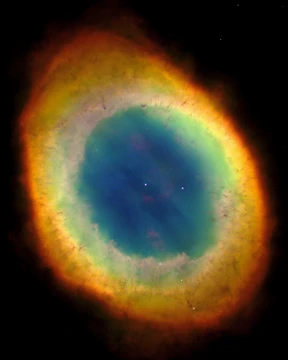
Westbrook Nebula
A bipolar protoplanetary nebula in Auriga, transitioning toward a planetary nebula.
Last updated
The Westbrook Nebula, also cataloged as CRL 618, is a bipolar protoplanetary nebula roughly 3,600 light-years away in the constellation Auriga. It forms around a star that has moved past the red giant stage and stopped nuclear fusion in its core. That star, hidden at the nebula’s center, ejects gas and dust at speeds up to 200 km/s. The nebula is named for William E. Westbrook, who died in 1975.
Formation began about 200 years ago, and the nebula consists mostly of molecular gas. Its outer region results from the interaction between a fast bipolar outflow and gas expelled earlier, when the star was on the asymptotic giant branch (AGB). The lobes are tilted roughly 24° relative to our line of sight. The nebula’s radiation comes from three sources: starlight scattered from the core, light from a compact HII region around the star, and energy from shock-excited gas in the lobes.
The dynamics of the molecular gas envelope can be studied through microwave emission-line spectra from carbon monoxide rotational transitions. These spectra reveal two distinct velocity components.
The narrow cores of the spectral lines show the familiar parabolic profile of a slow (20 km/s), high optical depth stellar wind from the AGB phase—material expelled before the object became a protoplanetary nebula, making up most of the nebula’s mass. A second component comes from the much faster post-AGB wind (over 190 km/s). This fast wind component becomes more prominent in higher-frequency, higher-energy spectral lines because it is hotter than the slow AGB wind.
The central star is thought to be spectral class B0, with 12,200 times the Sun’s luminosity. Its photosphere is now hot enough to have begun ionizing the nebula, and the ionization region is expanding rapidly.
The size and growth rate of this region indicate that ionization started around 1971. Once a substantial portion of the nebula is ionized, it will become a planetary nebula. This places the Westbrook Nebula at a slightly more advanced evolutionary stage than the Egg Nebula, whose F5 star has not yet begun ionizing its surrounding material.
Lore & Background
The Westbrook Nebula began to form about 200 years ago and primarily consists of molecular gas. Its outer structure results from the interaction between a rapid bipolar outflow and gas ejected during the star's AGB phase. The lobes are inclined about 24° to the line of sight. The central star, concealed at the nebula's core, is ejecting gas and dust at velocities up to 200 km/s.
The nebula's molecular gas envelope can be studied through microwave emission-line spectra of carbon monoxide rotational transitions. These spectra reveal two distinct velocity components: a slow (20 km/s), high optical depth wind from the AGB phase that constitutes the bulk of the nebula's mass, and a faster (>190 km/s) post-AGB wind that becomes more prominent in higher-frequency, higher-energy spectral lines due to its higher temperature.
The central star, of spectral class B0 and 12,200 times solar luminosity, has a photosphere hot enough to have begun ionizing the nebula. The ionization region is expanding rapidly, and its size and rate of growth indicate that ionization began around the year 1971. Once a sizeable portion of the nebula is ionized, it will become a planetary nebula, placing the Westbrook Nebula at a somewhat more advanced evolutionary stage than the Egg Nebula.
Reader's Guide
The Westbrook Nebula is significant as a protoplanetary nebula that captures a brief but critical evolutionary phase between the AGB and planetary nebula stages. Its bipolar morphology and dual-velocity wind system provide a clear laboratory for studying how mass loss evolves as a star transitions off the AGB. The detection of two distinct carbon monoxide spectral components—a slow, dense AGB wind and a fast, hot post-AGB outflow—allows astronomers to disentangle the history of mass ejection and the onset of bipolar shaping.
The fact that the central star has already begun ionizing its surroundings, with ionization starting around 1971, marks the Westbrook Nebula as a relatively young object in this transition, more evolved than the Egg Nebula but not yet a fully developed planetary nebula. Its legacy lies in offering direct observational evidence of the dynamical and chemical processes that shape planetary nebulae, including the role of fast winds in sculpting bipolar structures and the gradual ionization of the circumstellar envelope. The nebula's naming after William E. Westbrook honors a contributor to the field who died in 1975.
More in Emission, Dark and Reflection Nebulae
Sources
Compiled from Wikipedia and the sources listed below. Text from Wikipedia is available under CC BY-SA 4.0; this entry is adapted from it.
- Wikipedia: Westbrook Nebula (CC BY-SA 4.0).
- Word definitions: the Codexery glossary, each quoted from its Wikipedia article.
Spotted an error? Know more?
Reader corrections go straight into our review queue. Suggest an edit · How this site is sourced