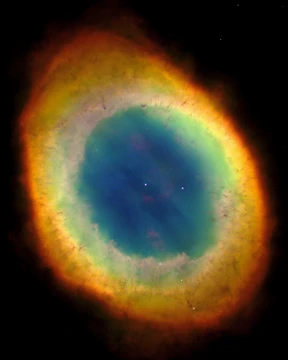
HH 1/2
First recognized Herbig-Haro objects, a bright bow-shock pair in Orion.
Last updated
HH 1/2 is a pair of Herbig-Haro objects in the constellation Orion, near NGC 1999. They were the first objects to be recognized as Herbig-Haro objects, discovered by George Herbig and Guillermo Haro, and are among the brightest such objects in the sky. The pair consists of two oppositely oriented bow shocks separated by 2.5 arcminutes, corresponding to a projected separation of about 1.1 light-year.
Lore & Background
HH 1/2 were discovered by George Herbig and Guillermo Haro and were the first objects to be identified as Herbig-Haro objects. They are located about 1343 light-years away in Orion, near NGC 1999.
The pair comprises two oppositely oriented bow shocks separated by 2.5 arcminutes, with a projected separation of about 1.1 light-year. HH 1/2 were the first Herbig-Haro objects with detected proper motion, and HH 2 was the first Herbig-Haro object detected in X-rays. Some structures within these objects move at speeds of 400 km/s.
The central region contains an opaque cloud core with an astrophysical jet and a highly embedded multiple-star system that remains invisible below 3 microns. These sources were first detected with the Very Large Array and are named VLA 1 and VLA 2.
The source HH 1-2 VLA 1 drives the HH 1/2 pair, while VLA 2 drives the Herbig-Haro objects HH 144/145. There might be a third outflow in the central region, indicating a third member. The jet toward HH 1 is visible in optical images, while the counterjet toward HH 2 was detected in the infrared with the Spitzer Space Telescope.
Reader's Guide
HH 1/2 holds a foundational place in the study of Herbig-Haro objects as the first recognized pair, establishing the class. Their discovery by Herbig and Haro marked the beginning of systematic identification of these shock features. As the first Herbig-Haro objects with detected proper motion, they provided direct evidence of high-speed outflows from young stellar objects. HH 2's detection in X-rays was a milestone, revealing that these objects emit across the electromagnetic spectrum beyond optical and infrared.
The central region's embedded multiple-star system, detected only at radio wavelengths via the Very Large Array, underscores the complexity of the driving sources. The detection of the counterjet toward HH 2 in the infrared by Spitzer demonstrated that parts of these outflows can be obscured at optical wavelengths. The possibility of a third outflow suggests that the region may host more than two young stellar objects, adding to the dynamical richness of the system. HH 1/2 remains a benchmark for understanding jet-driven shocks and the interaction of protostellar outflows with the interstellar medium.
Frequently Asked Questions
What exactly is HH 1/2?
HH 1/2 is a pair of Herbig-Haro objects located in the constellation Orion, situated near the reflection nebula NGC 1999. It consists of two oppositely oriented bow shocks driven by outflows from a young stellar source.
Who identified HH 1/2 and why does the naming matter?
George Herbig and Guillermo Haro recognized these features, and the pair was the very first set of objects formally classified as Herbig-Haro objects. That is why the entire class of young-star outflow phenomena carries their combined names.
How far apart are the two bow shocks in HH 1/2?
The two components are separated by roughly 2.5 arcminutes on the sky, which translates to a projected physical distance of about 1.1 light-years given the system's distance of approximately 1,343 light-years (412 parsecs).
More in Emission, Dark and Reflection Nebulae
Sources
Compiled from Wikipedia and the sources listed below. Text from Wikipedia is available under CC BY-SA 4.0; this entry is adapted from it.
- Wikipedia: HH 1/2 (CC BY-SA 4.0).
- Word definitions: the Codexery glossary, each quoted from its Wikipedia article.
Spotted an error? Know more?
Reader corrections go straight into our review queue. Suggest an edit · How this site is sourced