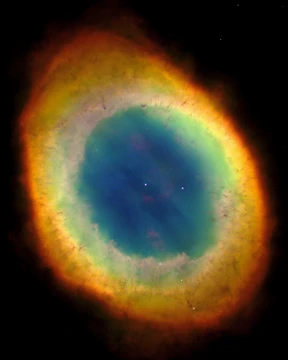
Star-forming regions of Vela
Overlapping star-forming systems along the line of sight in Vela.
Last updated
The star-forming regions seen in the direction of the southern constellation Vela are a mix of molecular clouds and ionized gas where stars are actively being born. Despite appearing close together in the sky, these structures are not a single, connected system. Instead, they are often independent clouds located at very different distances from Earth, simply aligned along our line of sight.
The nearest of these regions are the cometary globules, molecular gas clouds roughly 450 parsecs away. They are part of the vast Gum Nebula and have been heavily eroded by the stellar winds from nearby massive stars. Here, medium- and low-mass stars are forming.
OB associations
The largest nebular complexes in this direction belong to a superstructure known as the Vela Molecular Ridge. This uneven system stretches mainly along the northwestern edge of the constellation, where the most prominent H II regions—cataloged as Gum 14 and Gum 15—are found. Massive stars in this area have formed extensive OB associations called Vela R2 and Puppis R2, located about 850 and 950 parsecs away, respectively.
Galactic environment
The most distant nebular systems visible toward Vela lie primarily in the Perseus Arm, one of the Milky Way’s major spiral arms, and in the region of the so-called New Outer Arm, which is likely an extension of the Cygnus Arm.
Observation
Observation
The constellation Vela sits at strongly southern declinations, typically between -40° and -50°, making it quite hard to observe from the Northern Hemisphere. From latitudes like those of Central Europe, it is practically invisible. At 40°N—roughly the latitude of the Mediterranean Sea and the central United States—visibility is severely limited because it stays very low above the southern horizon. To see the whole constellation, you need to be at least at 34°N. In the northern tropics, visibility is good, and it is optimal from the entire Southern Hemisphere.
The nebular parts of Vela are difficult to see directly, often requiring special filters for any decent view. Astronomical photography works much better, especially in the western part of the constellation, where a faint diffuse nebulosity wraps around rich star fields. This glow is the eastern part of the Gum Nebula, an ancient supernova remnant about 450 parsecs from the Sun.
Lore & Background
The star-forming regions closest to the Solar System in this direction are the cometary globules, molecular gas clouds located about 450 parsecs away and associated with the vast Gum Nebula. These clouds have been heavily eroded by the stellar wind of nearby massive stars, where the formation of medium- and low-mass stars occurs. The most extensive nebular complexes are part of a superstructure called the Vela Molecular Ridge, which extends particularly along the northwestern edge of the constellation, where the most prominent H II regions, catalogued as Gum 14, are located. Massive stars in this region form extensive OB associations designated as Vela R2 and Puppis R2, situated at distances of approximately 850 and 950 parsecs, respectively.
The most distant nebular systems observable in the direction of Vela are primarily located in the Perseus Arm, one of the major spiral arms of the Milky Way, and in the region corresponding to the so-called New Outer Arm, likely an extension of the Cygnus Arm. The Vela Molecular Ridge is an extensive complex of giant molecular clouds associated with several H II regions, appearing aligned with the Gum Nebula and corresponding to the Vela OB1 association, which occupies the central part of the constellation. Approximately 500 parsecs from the central clouds of the complex is the association Cr 121, visible in the direction of Canis Major, physically linked to Canis Major OB1, an extensive OB association originating from the region hosting the cloud known as the Seagull Nebula.
A Layered Illusion of Depth
The star-forming regions visible toward Vela present a fascinating optical trick. What appears to be a single, unified stellar nursery is actually a succession of independent systems stacked along our line of sight, separated by hundreds or even thousands of parsecs.
The nearest structures—cometary globules nestled within the Gum Nebula at roughly 450 parsecs—give way to the sprawling Vela Molecular Ridge at 700 to 1000 parsecs, and beyond that, the most distant nebulae belong to the Perseus Arm or the so-called New Outer Arm, a probable extension of the Cygnus Arm. These systems share no physical connection; they merely project onto the same patch of sky. This layered arrangement means that a single glance in the direction of Vela actually reveals multiple, unrelated episodes of star formation occurring at vastly different distances, all superimposed by the geometry of our vantage point within the Milky Way.
The Vela Molecular Ridge and Its Stellar Associations
The most extensive nebular architecture in this direction is the Vela Molecular Ridge, a heterogeneous collection of giant molecular clouds that stretches prominently along the northwestern boundary of the constellation. Within this complex, two of the most luminous H II regions—catalogued as Gum 14 and Gum 17—anchor the structure's most active star-forming zones. The massive stars born in these clouds organize themselves into two distinct OB associations: Vela R2 at approximately 850 parsecs and Puppis R2 at roughly 950 parsecs.
The ridge's central clouds are physically linked to the Vela OB1 association, which occupies the heart of the constellation and is visible as a rich field of blue stars between λ Velorum and γ Velorum. About 500 parsecs from the ridge's core, the Cr 121 association extends toward Canis Major, connecting physically to Canis Major OB1 and the Seagull Nebula region. The outermost sections of the ridge, including clouds VMR B and Gum 21, reach distances of 1800 to 2000 parsecs, sharing their galactic neighborhood with the famous supernova remnant Puppis A.
Observing from the Southern Sky
Vela's strongly southern declination, typically between -40° and -50°, makes it fundamentally a constellation of the Southern Hemisphere. From Central European latitudes it is essentially invisible, and even at 40°N—spanning the Mediterranean and the central United States—its low elevation above the southern horizon renders observation severely limited. A minimum latitude of 34°N is needed to see the full constellation, while the northern tropical zone offers good visibility and the entire Southern Hemisphere provides optimal viewing conditions. The nebular components pose particular challenges: direct visual observation often requires dedicated filters to separate faint emission from dense background star fields.
Astronomical photography proves far more effective, revealing a diffuse nebulosity in the western sector that corresponds to the eastern portion of the Gum Nebula. NGC 2626, a reflection nebula within the Vela Molecular Ridge, can be picked out with medium-to-high-power instruments and appropriate filters. The best evening window runs from December through April, when Vela, alongside Sirius and Canopus, dominates the Southern summer sky.
Supernova Heritage and Galactic Position
The direction of Vela is saturated with the aftermath of stellar death. The Vela Supernova Remnant, formed roughly 11,400 years ago and situated about 300 parsecs from the Sun, displays bright filaments and represents the closest supernova remnant in this line of sight. The vast Gum Nebula, spanning approximately 30 degrees and extending into Puppis, is likely an expanding bubble carved by one or more supernovae; one of the progenitor stars may have been a physical companion of Naos (ζ Puppis). All structures within 2000 parsecs belong to the outermost section of the Orion Arm, which is observed along its axis up to its terminus.
Beyond the ridge's farthest clouds lies the inter-arm region between the inner Sagittarius-Carina Arm and the outer Perseus Arm. The most distant nebulae visible in this direction predominantly belong to the Perseus Arm, one of the Milky Way's two major spiral arms, and beyond it stretches the New Outer Arm, likely a continuation of the Cygnus Arm. This layered galactic context places Vela's star-forming regions at the very edge of our local spiral structure.
Reader's Guide
The star-forming regions of Vela are significant because they reveal a complex line-of-sight superposition of independent systems at varying distances, from the nearby cometary globules of the Gum Nebula at about 450 parsecs to the distant clouds of the Perseus Arm beyond 2000 parsecs. The Gum Nebula itself, extending over approximately 30° of the celestial vault, is the largest known nebula in the entire sky and its origin remains debated—some scientists hypothesize it is an ancient Strömgren sphere, while others propose it is a supernova remnant.
The shock wave from the Gum Nebula's expansion and the intense ultraviolet radiation from massive stars have eroded and compressed surrounding gases, promoting star formation processes, particularly of low- and medium-mass stars. The cometary globules around the nebula, with their dense cores and long tails, formed due to erosion of independent molecular clouds by the intense radiation of giant stars such as γ Velorum and ζ Puppis, or alternatively by the powerful shock wave from supernova explosions. The Vela Molecular Ridge, at distances between 700 and 1000 parsecs, hosts massive OB associations and prominent H II regions, while the most remote nebulae belong to the Perseus Arm and the New Outer Arm, providing a layered view of star formation across multiple spiral arms of the Milky Way.
Frequently Asked Questions
What are the Star-forming regions of Vela?
They are a collection of independent molecular clouds and ionized gas clouds in the sky direction of the southern constellation Vela where new stars are actively being born. Despite their apparent closeness on the sky, they are not physically linked to one another.
How far away are the Star-forming regions of Vela?
The distances span a wide range, from roughly 450 parsecs for the Gum Nebula and its cometary globules up to about 1800–2000 parsecs for the most remote portions of the Vela Molecular Ridge. Intermediate structures like the Vela R2 and Puppis R2 associations sit around 850 and 950 parsecs respectively.
More in Emission, Dark and Reflection Nebulae
Sources
Compiled from Wikipedia and the sources listed below. Text from Wikipedia is available under CC BY-SA 4.0; this entry is adapted from it.
- Wikipedia: Star-forming regions of Vela (CC BY-SA 4.0).
- Word definitions: the Codexery glossary, each quoted from its Wikipedia article.
Spotted an error? Know more?
Reader corrections go straight into our review queue. Suggest an edit · How this site is sourced