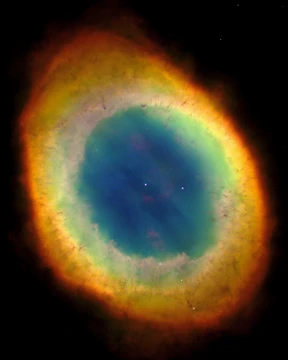
Wolf–Rayet nebula
Nebulae sculpted by the fierce winds of Wolf–Rayet stars.
Last updated
A Wolf–Rayet nebula forms when the intense stellar winds of a Wolf–Rayet star collide with the surrounding interstellar medium. Wolf–Rayet stars are extremely hot, bright, and short-lived massive stars that have moved past hydrogen fusion and are now burning helium or even heavier elements in their cores. The winds from these stars, composed of charged particles moving at thousands of kilometers per second, generate shock waves that heat and ionize nearby gas and dust, making it glow across visible and other wavelengths.
This process creates a surrounding nebula with a characteristic multi-ring structure, featuring shells and cavities carved by the winds, surrounded by dense swept-up material. The structures become visible through fluorescent emission from ionized gas and scattered starlight. Notable examples include NGC 6888 (the Crescent Nebula), NGC 2359 (Thor's Helmet), M1-67, and NGC 3199. These nebulae reveal complex shapes in visible, infrared, and X-ray light, offering insights into the powerful winds and evolution of their parent stars.
Wolf–Rayet stars represent a brief late stage in the life of very massive stars, having shed their outer hydrogen envelopes so that their winds now carry heavier elements like helium, carbon, nitrogen, and oxygen. As the star evolves and loses mass, its winds shape surrounding gas and dust into bubble-like structures: the inner region comes from the current wind, while outer shells are leftovers from earlier mass-loss episodes. Eventually, the star will shed more material and end in a supernova explosion, dramatically altering the nebula's structure and composition.
Lore & Background
Wolf–Rayet stars represent a brief late stage in the evolution of some very massive stars. They have shed their outer hydrogen envelopes and their stellar winds now consist of heavier elements like helium, carbon, nitrogen, and oxygen. The strong, dense stellar winds from these stars consist of streams of charged particles traveling at speeds of thousands of kilometers per second. These winds slam into the surrounding interstellar medium, generating shock waves that heat and ionize the gas and dust, causing it to glow and emit radiation in visible and other wavelengths.
This process creates an enveloping nebula around the Wolf–Rayet star with a distinctive multi-ring structure. The nebula contains shells and cavities carved out by the stellar winds, surrounded by dense swept-up material.
These structures become visible due to fluorescent emission from ionized gas as well as scattered starlight. As a Wolf–Rayet star evolves and loses mass, its winds shape the surrounding gas and dust into bubble-like nebular structures. The inner region forms from the current stellar wind, while outer shells are remnants of previous mass-loss episodes.
Eventually the star will shed more matter, ending its life in a spectacular supernova explosion that will dramatically alter the Wolf–Rayet nebula's structure and composition. Some well-studied Wolf–Rayet nebulae include NGC 6888 (Crescent Nebula), NGC 2359 (Thor's Helmet Nebula), M1-67 (Luminous Blue Variable Nebula), and NGC 3199 (Nebula around WR 18). These nebulae exhibit intricate structures revealed in visible light as well as infrared, X-ray, and other wavelengths.
Reader's Guide
Wolf–Rayet nebulae are significant because they directly trace the final evolutionary stages of the most massive stars. The bubble-like structures and multi-ring shells visible in these nebulae record the history of mass loss from the central star, offering a window into the brief but violent Wolf–Rayet phase. The nebulae around WR 31a and AB7 are notable examples: WR 31a is surrounded by a bubble nebula, while AB7 is one of the highest-excitation nebulae in the Magellanic Clouds, two satellite galaxies of the Milky Way.
By studying these nebulae in visible, infrared, X-ray, and other wavelengths, astronomers gain insight into the powerful stellar winds and the processes that shape the interstellar medium. The eventual supernova explosion of the Wolf–Rayet star will dramatically alter the nebula's structure and composition, linking these objects to the broader cycle of stellar birth and death. The legacy of Wolf–Rayet nebulae lies in their role as laboratories for understanding mass loss, shock physics, and the final fate of massive stars.
More in Emission, Dark and Reflection Nebulae
Sources
Compiled from Wikipedia and the sources listed below. Text from Wikipedia is available under CC BY-SA 4.0; this entry is adapted from it.
- Wikipedia: Wolf–Rayet nebula (CC BY-SA 4.0).
- Word definitions: the Codexery glossary, each quoted from its Wikipedia article.
Spotted an error? Know more?
Reader corrections go straight into our review queue. Suggest an edit · How this site is sourced