DQ Herculis
Prototype intermediate polar and bright nova of 1934.
Last updated
DQ Herculis, also known as Nova Herculis 1934, is a cataclysmic variable star in the constellation Hercules. It is notable as the prototype for a category of cataclysmic variable stars called intermediate polars, and for its bright, slow nova outburst that remained visible to the naked eye for several months.
Quick Facts
- Discovery date
- 13 December 1934
- Discoverer
- J. P. M. Prentice
- Peak magnitude
- 1.5
- Peak date
- 22 December 1934
- Orbital inclination
- 86.5°
- White dwarf mass
- 60% of the Sun's mass
Facts from the source article.
Lore & Background
DQ Herculis was discovered on 13 December 1934 by J. P. M. Prentice from Stowmarket, Suffolk. It reached peak brightness on 22 December 1934 with an apparent magnitude of 1.5, and remained visible to the naked eye for several months. The system is a binary consisting of a white dwarf primary with an estimated 60% of the Sun's mass and a red dwarf secondary with 40% of the Sun's mass. They orbit each other with a period of 0.1936208977 days, and the orbital plane is inclined by 86.5° to the line of sight, causing the white dwarf to undergo a deep eclipse every orbit.
The system shows orbital period variation, possibly due to the presence of a third body. The red dwarf has filled its Roche lobe, and matter is being drawn off at an unspecified rate, forming an accretion disk orbiting the primary. The disk has inferred temperatures ranging from 5,000 to an unspecified upper value.
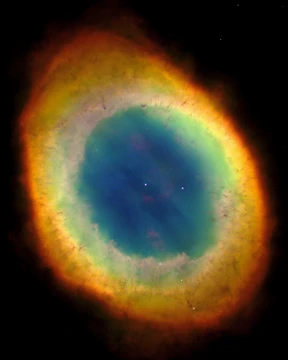
A bright spot in the inner disk appears to pulsate with a 71-second period. In this class of variables, the white dwarf is magnetized, directing infalling matter onto the magnetic poles. The shell of ejected material from the nova outburst is visible as an emission nebula, similar in appearance to a planetary nebula. This roughly elliptical nebula had a size of 32.0 × 24.2 arc seconds as of 2018, and it is expanding at a rate of about 0.16 arc seconds per year.
Reader's Guide
DQ Herculis is significant as the prototype for intermediate polars, a class of cataclysmic variable stars. Its 1934 outburst was one of the brightest objects in the night sky, receiving significant coverage in popular news publications. The system's deep eclipses and 71-second pulsations provide key observational constraints on accretion processes in magnetized white dwarfs.
The expanding emission nebula, imaged 21 years apart, allows direct measurement of the shell's expansion rate. The nova's brightness and timing have also been suggested to have influenced the development of the origin story of the comic book superhero Superman, as proposed by English professor Brad Ricca. The light curve shows a pronounced 'dust dip' roughly four months after peak brightness, caused by dust forming as the ejected shell expanded and cooled.
More in Emission, Dark and Reflection Nebulae
Sources
Compiled from Wikipedia and the sources listed below. Text from Wikipedia is available under CC BY-SA 4.0; this entry is adapted from it.
- Wikipedia: DQ Herculis (CC BY-SA 4.0).
- Word definitions: the Codexery glossary, each quoted from its Wikipedia article.
Spotted an error? Know more?
Reader corrections go straight into our review queue. Suggest an edit · How this site is sourced