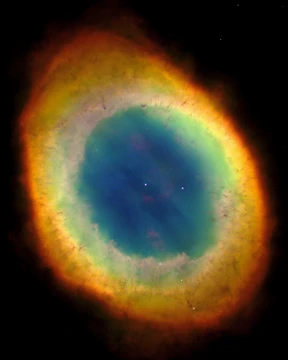
Red Rectangle
A protoplanetary nebula with a rectangular shape and X-shaped spikes.
Last updated
The Red Rectangle is a protoplanetary nebula in the constellation Monoceros, notable for its red color and unique rectangular shape. It is a highly symmetric, compact bipolar nebula with X-shaped spikes, and its central binary star system is completely obscured, providing no direct light.
Lore & Background
The Red Rectangle was discovered in 1973 during a rocket flight associated with the AFCRL Infrared Sky Survey called Hi Star. The binary star at its center, designated HD 44179, was first discovered by Robert Grant Aitken in 1915 and has the variable star designation V777 Monocerotis. The name Red Rectangle was officially added to the IAU Catalog of Star Names on 9 May 2026.
High-resolution images in visible and near infrared light reveal a highly symmetric, compact bipolar nebula with X-shaped spikes, implying anisotropic dispersion of circumstellar material. The central binary system is completely obscured. The nebula is particularly rich in polycyclic aromatic hydrocarbons (PAHs). The presence of such carbon-bearing macromolecules in the X-shaped component, while equatorial regions contain silicate-rich dust and O-bearing molecules, has been interpreted as due to a change in the O/C abundance ratio of the primary star during its late evolution, though PAHs could also form from a central photodissociation region.
The Red Rectangle was the first nebula around an evolved star in which an equatorial disk in rotation was well identified; in most such objects only expansion is observed. The disk absorbs stellar light and is practically not seen in optical images, which mainly represent a diffuse outflow formed of material extracted from the denser disk. Distinct rungs suggest several episodes of increased ejection rate.
Reader's Guide
The Red Rectangle holds significance as a protoplanetary nebula that exhibits a highly symmetric bipolar structure with X-shaped spikes, a morphology that remains partly mysterious. Its equatorial rotating disk was the first such disk identified around an evolved star, a feature rarely observed in similar objects where only expansion is seen. The nebula is particularly rich in polycyclic aromatic hydrocarbons, and the distribution of carbon-bearing and oxygen-bearing molecules has prompted debate about whether the O/C abundance ratio changed during the primary star's late evolution or whether a central photodissociation region drives PAH formation.
The Hubble Space Telescope has revealed features not visible from ground-based telescopes, yet the origins of many features, especially the X-shaped image, remain hidden or mysterious. The bipolar symmetry is common in protoplanetary and planetary nebulae, and theorists have shown it can arise from shocks due to interaction of different phases of stellar winds, but its origin is still debated. The X-like shape and low outflow velocity are peculiar, likely because the nebula's origin is associated with a stable, extended disk, differing from most protoplanetary nebulae.
More in Emission, Dark and Reflection Nebulae
Sources
Compiled from Wikipedia and the sources listed below. Text from Wikipedia is available under CC BY-SA 4.0; this entry is adapted from it.
- Wikipedia: Red Rectangle (CC BY-SA 4.0).
- Word definitions: the Codexery glossary, each quoted from its Wikipedia article.
Spotted an error? Know more?
Reader corrections go straight into our review queue. Suggest an edit · How this site is sourced