HR Delphini
A slow nova with a jittering light curve and a bipolar remnant nebula.
Last updated
HR Delphini, also cataloged as Nova Delphini 1967, is a classical nova located in the constellation Delphinus. It was first spotted by George Alcock at 22:35 UT on 8 July 1967, following over 800 hours of binocular sky searches.
At discovery, its apparent magnitude was 5.0. The nova reached its peak brightness of magnitude 3.5 on 13 December 1967, making it easily visible without a telescope around that time. Pre-outburst images from the Samuel Oschin telescope showed it as a roughly 12th-magnitude star that may have been variable.
HR Delphini was discovered 158 days before reaching peak brightness, and its light curve near the peak was thoroughly documented. Compared to other classical novae, it had an unusually slow rise to maximum. It took 230 days to fade by 3 magnitudes from its peak, classifying it as a "slow" nova. Its decline featured several brief outbursts, earning its light curve the type "J" (for "jitters").
In June 1970, HR Delphini was detected at radio wavelengths of 3.7 cm and 11.1 cm using the Green Bank Interferometer, and at 1.95 cm with the Green Bank 140-foot telescope.
Like all novae, HR Delphini is a binary system: a donor star orbits a white dwarf. The two stars are so close that material transfers from the donor to the white dwarf. The orbital period of this binary pair is 5.14 hours. The white dwarf's mass is estimated between 0.6 and 0.75 solar masses, while the donor is thought to be a main-sequence star with a mass between 0.52 and 0.58 solar masses and a spectral type ranging from K5V to M1V.
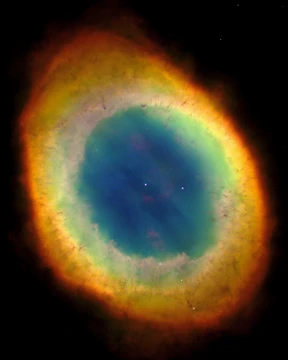
HR Delphini is surrounded by a bipolar nova remnant emission nebula, visible in Hα, Hβ, and forbidden lines of oxygen and nitrogen. The nebula is roughly ellipsoidal, with a central ring around the equatorial region. When discovered in 1981, it measured 3.7 × 2.5 arc seconds; by 1997, when observed with the Hubble Space Telescope, it had expanded to roughly 8.5 × 6.1 arc seconds.
Quick Facts
- Discovery date
- 8 July 1967
- Discoverer
- George Alcock
- Apparent magnitude at discovery
- 5.0
- Peak magnitude
- 3.5
- Peak date
- 13 December 1967
- Orbital period
- 5.14 hours
Facts from the source article.
Lore & Background
HR Delphini was discovered by George Alcock at 22:35 UT on 8 July 1967, after he had searched the sky for over 800 hours with binoculars. At discovery it had an apparent magnitude of 5.0. It reached a peak brightness of magnitude 3.5 on 13 December 1967, making it easily visible to the naked eye. Pre-outburst photographs taken with the Samuel Oschin telescope showed it as a roughly 12th magnitude star that might have been variable.
The nova was discovered 158 days before it reached peak brightness, and its light curve around the peak was very well observed. It had a very slow rise to maximum compared to other classical novae, taking 230 days to fade from its peak by 3 magnitudes, classifying it as a 'slow' nova. Its decline showed several brief outbursts, leading to its light curve being classified as type 'J' (for 'jitters'). In June 1970, it was detected in radio wavelengths at 3.7 cm and 11.1 cm with the Green Bank Interferometer, and at 1.95 cm with the Green Bank 140 foot telescope.
HR Delphini is a binary system with a donor star orbiting a white dwarf. The orbital period is 5.14 hours. The white dwarf mass is estimated between 0.6 and 0.75 solar masses, and the donor star is believed to be a main sequence star with mass between 0.52 and 0.58 solar masses and spectral type in the range K5V to M1V.
The system is surrounded by a bipolar nova remnant emission nebula, visible in Hα, Hβ, and forbidden lines of oxygen and nitrogen. The nebula is roughly ellipsoidal with a central ring around the equatorial region. It measured 3.7 × 2.5 arc seconds when discovered in 1981, and expanded to roughly 8.5 × 6.1 arc seconds when observed with the Hubble Space Telescope in 1997.
Reader's Guide
HR Delphini holds significance as one of the best-observed slow novae, with a light curve that was monitored from 158 days before peak through its extended decline. Its classification as a type 'J' nova—characterized by 'jitters' or brief outbursts during fading—provides a distinctive example of post-eruption variability. The detection of radio emission in 1970 at multiple wavelengths added to the understanding of the nova's ejecta and environment.
The resolved bipolar nebula, first seen in 1981 and later imaged by the Hubble Space Telescope, offers a detailed view of the expanding remnant structure, including a central ring. The binary parameters—orbital period of 5.14 hours, white dwarf mass between 0.6 and 0.75 solar masses, and a K5V to M1V donor star—contribute to models of nova systems and mass transfer. The pre-outburst variability suggested by archival photographs adds a layer of historical context to its eruption.
Frequently Asked Questions
How bright did HR Delphini get at its peak?
The nova climbed to a maximum apparent magnitude of 3.5 on 13 December 1967, about 158 days after Alcock's initial sighting. At that brightness it was plainly visible to the naked eye without any telescope.
What did the progenitor star of HR Delphini look like before the outburst?
Pre-eruption plates taken with the Samuel Oschin telescope showed the system as a faint, roughly 12th-magnitude star that may have displayed some variability. After the nova faded, the ejected material settled into a bipolar nebular remnant rather than a smooth spherical shell.
More in Emission, Dark and Reflection Nebulae
Sources
Compiled from Wikipedia and the sources listed below. Text from Wikipedia is available under CC BY-SA 4.0; this entry is adapted from it.
- Wikipedia: HR Delphini (CC BY-SA 4.0).
- Word definitions: the Codexery glossary, each quoted from its Wikipedia article.
Spotted an error? Know more?
Reader corrections go straight into our review queue. Suggest an edit · How this site is sourced